
Aphidecta obliterata
(Linnaeus, 1758)
larch ladybird, larch ladybug, Larch Lady Beetle
Aphidecta obliterata is a small ladybird beetle (3.5–5 mm) native to Europe, with introduced in North America. It is a specialized of conifer-infesting aphids and adelgids, particularly associated with spruce and larch. The exhibits remarkable color , ranging from tan to brown with pinkish tints to nearly black. Multiple unsuccessful attempts were made to introduce it to eastern Canada as a agent for the balsam woolly aphid (Adelges piceae) beginning in 1941. Females demonstrate sophisticated oviposition , using larval tracks and -surface chemicals to avoid sites with high risk.
Pronunciation
How to pronounce Aphidecta obliterata: //ˌæfɪˈdɛktə ˌɒblɪtəˈreɪtə//
These audio files are automatically generated. While they are not always 100% accurate, they are a good starting point.
Identification
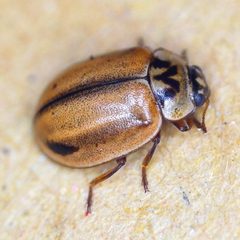
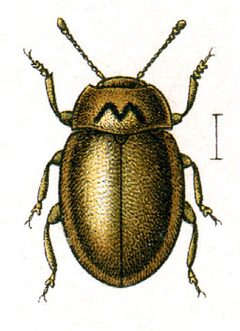
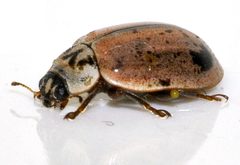
Aphidecta obliterata is distinguished from other ladybirds by its elongate oval body with strongly convex, smooth, shiny that are densely and finely punctured. The bears a distinctive black arch-shaped marking. The pronotum is beige with four dark brown lines forming an M-shaped pattern. Unlike most ladybirds, it lacks prominent spots; instead, markings consist of a dark and usually a dark oblique line posteriorly on the elytra, with small blotches or reduced spots if present. are club-shaped with 9–11 segments. Several color varieties exist, including the entirely black v. fenestrata.
Images
Habitat
Primarily coniferous and mixed forests, especially high bogs, peat areas, and temperate needleleaf forests. Strongly associated with Pinus sylvestris (Scots pine), other Pinus , Picea abies (Norway spruce), and Larix decidua (European larch). Found under bark flakes, beneath bark, and in moss on tree trunks. Occasionally occurs in gardens and parks.
Distribution
Native to Europe, European Russia, the Caucasus, Belarus, Ukraine, Transcaucasia, and Asia Minor. Introduced to North America, with established in Virginia, South Carolina, and Newfoundland.
Seasonality
active in spring and summer. Overwinters in bark crevices and litter.
Diet
Specialized of conifer-infesting aphids and adelgids. Prey includes Adelges piceae (balsam woolly aphid), Elatobium abietinum (green spruce ), Adelges cooleyi (Cooley spruce gall adelgid), and other Lachnidae and Adelgidae on pines.
Life Cycle
Complete with , larval, pupal, and stages. Larvae feed on conifer aphids and adelgids. Adults enter reproductive ; pre-diapausal adults exhibit low respiration rates to conserve energy during summer prey absence. adults show further respiratory depression in autumn for energy conservation.
Behavior
Females exhibit -dependent oviposition deterrence in response to larval tracks, actively avoiding contaminated areas for up to three days. This patch quality assessment promotes even distribution of and reduces risk. Conspecific -surface chemicals also inhibit oviposition. No response to heterospecific tracks from Adalia bipunctata or Chrysoperla carnea. Oviposition rate increases with prey density, mediated by female nutritional status rather than aphid odour cues.
Ecological Role
of conifer aphids and adelgids; contributes to regulation of these herbivore in conifer forest . Evaluated as agent for adelgids. Oviposition-deterring promote spatial distribution of pressure across prey patches.
Human Relevance
Evaluated for of Adelges piceae (balsam woolly aphid) in eastern Canada, though introduction attempts from 1941 onward were unsuccessful due to winter survival limitations. sequenced as part of the Darwin Tree of Life project.
Similar Taxa
- Adalia bipunctataTwo-spotted ladybird with prominent contrasting spots versus A. obliterata's reduced markings; feeder on broadleaf aphids rather than conifer ; lacks oviposition response to A. obliterata tracks.
- Coccinella septempunctataSeven-spotted ladybird with distinctive spot pattern; ; rapidly disperses from conifers when aphid prey absent, unlike A. obliterata which persists as conifer .
Sources and further reading
- BugGuide
- Wikipedia
- GBIF taxonomy match
- iNaturalist taxon
- NCBI Taxonomy
- Mantispidae | Beetles In The Bush
- July | 2024 | Beetles In The Bush
- Laboratory Studies on the Developmental Period and Feeding Behavior of Aphidecta obliterata (L.) (Coleoptera: Coccinellidae), an Introduced Predator of the Balsam Woolly Aphid1
- Oviposition responses to patch quality in the larch ladybird Aphidecta obliterata (Coleoptera: Coccinellidae): effects of aphid density, and con- and heterospecific tracks
- Studies of Predators of the Balsam Woolly Aphid, Adelges piceae (Ratz.) (Homoptera: Adelgidae) VI. Aphidecta obliterata (L.) (Coleoptera: Coccinellidae), an Introduced Predator in Eastern Canada,
- The effects of host plant on the coccinellid functional response: Is the conifer specialist Aphidecta obliterata (L.) (Coleoptera: Coccinellidae) better adapted to spruce than the generalist Adalia bipunctata (L.) (Coleoptera: Coccinellidae)?
- A comparison of Aphidecta obliteratae (L.) (Col., Coccinellidae) populations feeding on Elatobium abietinum (Walker) and on Adelges cooleyi (Gillette)
- The genome sequence of the larch ladybird beetle, Aphidecta obliterata (Linnaeus, 1758) (Coleoptera: Coccinellidae).