
Pineus
Shimer, 1869
Species Guides
3- Pineus pinifoliae(Pine Leaf Adelgid)
- Pineus similis(Ragged Spruce Gall Adelgid)
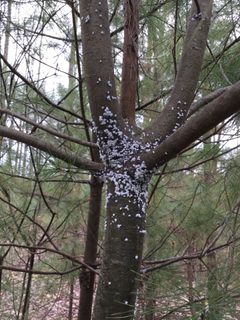
- Pineus strobi(Pine Bark Adelgid)
Pineus is a of adelgids ( Adelgidae) comprising more than 20 described . These insects are small, sap-feeding hemipterans specialized on conifer , primarily Pinus (pines) and Picea (spruces). Species exhibit complex with multiple morphological forms, including winged and wingless , and some alternate between two host species. Several species are economically significant as pests of forestry and ornamental plantings.

Pronunciation
How to pronounce Pineus: /ˈpɪnaɪəs/
These audio files are automatically generated. While they are not always 100% accurate, they are a good starting point.
Identification
Adelgids in the Pineus are distinguished from related adelgids (Adelges) by having four abdominal . They are small, soft-bodied insects with . Winged forms (gallicolae) possess two pairs of wings, while wingless forms (sistentes, neosistentes, fundatrices) are oval to pear-shaped and often covered with woolly wax secretions. First-instar nymphs () are the stage and possess functional legs; subsequent instars of wingless females become .
Images
Habitat
Coniferous forests and ornamental plantings; associated with trees in the Pinus and Picea. Some induce gall formation on spruce shoots, while others feed on bark or needles without gall formation.
Distribution
Widespread in the Northern Hemisphere. Native to North America, Europe, and Asia. Specific distributions vary by : P. similis in Colorado and Maine; P. floccus in eastern North America; P. pineoides in Europe and introduced to eastern Canada; P. orientalis in Ukraine; P. strobi recorded in Fergana Valley, Central Asia.
Diet
Phloem sap of conifer . All feed exclusively on Pinaceae, with most specialized on Pinus (pines) and/or Picea (spruces).
Host Associations
- Pinus strobus - Eastern white pine; primary or alternate for multiple
- Pinus resinosa - Red pine; for P. coloradensis and P. boerneri
- Pinus taeda - Loblolly pine; for P. boerneri
- Pinus elliottii - Slash pine; preferred for P. boerneri
- Picea pungens - Blue spruce; for P. similis
- Picea glauca - White spruce; preferred for P. similis
- Picea rubens - Red spruce; for P. similis and P. pineoides
- Picea mariana - Black spruce; for P. similis
- Picea abies - Norway spruce; for P. similis
Life Cycle
Complex with multiple parthenogenetic and typically one sexual generation. Most have at least five distinct morphological forms: fundatrix (stem mother), gallicola (gall-former on spruce), sistentes and neosistentes (wingless feeding stages on pine), and sexuparae (sexual forms). Some species alternate between spruce (primary , where galls form) and pine (secondary host); others complete their entire cycle on a single host . P. pineoides is exceptional in completing its life cycle on spruce without producing galls or winged forms. Development from to ranges from approximately 65–70 days under laboratory conditions.
Behavior
First-instar nymphs () are the only mobile stage in wingless ; they disperse to new growth or new via wind, birds, mammals, or human activity. Winged gallicolae fly from spruce to pine to initiate new generations. Some are non-migrating. Dense populations produce woolly wax secretions.
Ecological Role
Herbivores that can cause significant damage to trees through direct feeding, gall formation, and associated stress. Heavy cause needle stunting, shoot deformation, reduced growth, and tree decline. Honeydew production can lead to growth, further impairing . Natural enemies include larvae, lady beetles ( on ), the caterpillar Laetilia coccidivora (predator on ), and such as Coccophagus lycimnia.
Human Relevance
Several are economically important forest and ornamental pests. P. pinifoliae, P. boerneri, P. coloradensis, and P. floccus cause damage to pine and spruce in forestry and urban settings. P. orientalis is an pest in Ukraine. reduce aesthetic value of ornamental trees, impair growth, and can kill stressed trees. Management involves monitoring and targeted applications.
Similar Taxa
- AdelgesOther in Adelgidae; distinguished by having six abdominal versus four in Pineus
- Toumeyella of soft scale insects (Coccidae) also found on pines; distinguished by being with hardened coverings rather than mobile adelgid nymphs with woolly wax
Sources and further reading
- BugGuide
- GBIF taxonomy match
- iNaturalist taxon
- NCBI Taxonomy
- Catalogue of Life
- Bug Eric: Striped Pine Scale
- The Biology of Pineus similis (Gill.) (Homoptera: Phylloxeridae) on Spruce.
- PHENOLOGICAL NOTES ON A NON-MIGRATING POPULATION OF PINEUS FLOCCUS (HOMOPTERA: CHERMIDAE)
- The Pine Bark Adelgid, Pineus strobi, Contains Two Novel Bacteriocyte-Associated Gammaproteobacterial Symbionts
- PINEUS STROBI HARTIG, RECORDED FOR THE FIRST TIME IN FERGANA VALLEY, BIOECOLOGY OF THE SPECIES 1839 (HEMIPTERA, ADELGIDAE)
- Biology, Population Trends, and Damage of Pineus boerneri and P. coloradensis (Homoptera: Adelgidae) on Red Pine
- LIFE AND FERTILITY TABLES OF Pineus boerneri ANNAND (HEMIPTERA: ADELGIDAE) ON Pinus spp. (PINACEAE)
- Pineus pineoides (Cholodkovsky) (Homoptera: Adelgidae) on Red Spruce in New Brunswick and Nova Scotia
- Taxonomy and Biology of Pineus strobi (Hartig) and P. coloradensis (Gillette) (Homoptera: Adelgidae)
- Distribution and Damage of Two Pineus Species (Homoptera: Adelgidae) on Red Pine in New England
- SAMPLING POPULATIONS OF PINE LEAF CHERMID PINEUS PINIFOLIAE (HOMOPTERA: CHERMIDAE): III. NEOSISTENTES ON WHITE PINE
- The Life-History of Pineus pinifoliae (Fitch) (Homoptera: Phylloxeridae) and its Effect on White Pine
- Invasive insect pests of introduced plants of the “Оlexandria” Dendrological Park. Report 3: towards a biology of Pineus orientalis (Dreyfus, 1889) (Heteroptera: Adelgidae)
- Influence of Cohabitation and Resinosis on Site Selection and Survival of Pineus boerneri Annand and P. coloradensis (Gillette) (Homoptera: Adelgidae) on Red Pine
- Cohabitation and Host Species Effects on the Population Growth of Matsucoccus resinosae (Homoptera: Margarodidae) and Pineus boerneri (Homoptera: Adelgidae) on Red Pine
- SAMPLING POPULATIONS OF PINE LEAF CHERMID PINEUS PINIFOLIAE (HOMOPTERA: CHERMIDAE): II. ADULT GALLICOLAE ON THE SECONDARY HOST