
Adelgidae
Schouteden, 1909
adelgids, woolly conifer aphids, pine aphids, spruce aphids
Genus Guides
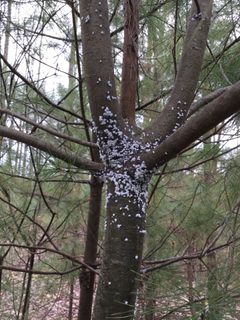
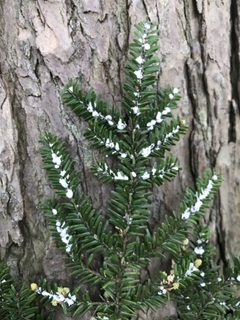
2is a small of sap-sucking insects in the order Hemiptera, closely related to aphids. Members are commonly known as "woolly conifer aphids" due to their waxy secretions and exclusive association with conifer in the family Pinaceae. The family includes some of the most destructive forest pests in North America, notably the hemlock woolly adelgid (*Adelges tsugae*) and balsam woolly adelgid (*A. piceae*), which have caused widespread tree mortality. Adelgids exhibit complex, multigeneration that may include cyclical , host alternation, and .

Pronunciation
How to pronounce Adelgidae: //əˈdɛl.dʒɪˌdiː//
These audio files are automatically generated. While they are not always 100% accurate, they are a good starting point.
Images
Diet
Adelgids feed on phloem sap of conifer trees using . They are exclusively associated with in the Pinaceae.
Host Associations
- Picea (spruce) - primary for holocyclic ; some species complete entire on spruceSexual and fundatrix occur on spruce; some like *Pineus pineoides* complete full on spruce without gall formation
- Pinus (pine) - secondary Hiemosistens feeds on pine needles and shoots
- Abies (fir) - secondary for hiemosistens in some
- Tsuga (hemlock) - secondary Critical for *Adelges tsugae* in eastern North America; eastern and Carolina hemlock lack evolved resistance
- Pseudotsuga (Douglas-fir) - secondary Hiemosistens for some
- Larix (larch) - secondary for *Adelges (Cassiadelges) coccipus* in Bhutan
Life Cycle
Adelgids exhibit complex, multigeneration that are either holocyclic (with and alternation) or anholocyclic (entirely without host alternation). Holocyclic typically have five : sexuales (males and females), fundatrix, alata-migrans, hiemosistens, and alata-remigrans (sexupara). The sexual and fundatrix generations live on the primary host (spruce, *Picea*), while the hiemosistens generation lives on secondary hosts (pine, fir, hemlock, Douglas-fir, or larch). Winged generations (alata-migrans and alata-remigrans) maintain between hosts. Some species exhibit cyclical . In eastern North America, *Adelges tsugae* reproduces asexually through parthenogenesis with two generations per year, producing winged females in spring that cannot reproduce due to absence of suitable spruce hosts.
Ecological Role
Adelgids function as primary consumers in conifer forest . Heavy can cause tree mortality, altering forest composition and structure with cascading effects on wildlife , stream temperature regulation, and erosion control. In their native ranges, adelgids are regulated by co-evolved natural enemies including predatory beetles (Coccinellidae), predatory flies (Chamaemyiidae, Cecidomyiidae, Syrphidae), and . In invaded regions like eastern North America, the absence of effective natural enemies contributes to pest .
Human Relevance
Several adelgid are economically and ecologically significant pests. The hemlock woolly adelgid (*Adelges tsugae*) threatens eastern hemlock forests in North America, with potential consequences for biodiversity, water quality, and recreation. The balsam woolly adelgid (*A. piceae*) has killed millions of Fraser fir and other trees. Management strategies include using imported predatory insects, chemical treatments for high-value trees, and early detection monitoring using specialized funnel traps. Research on adelgid diversity and natural enemies in native ranges (e.g., western North America, Asia, Bhutan) supports preparedness for potential new invasions.
Similar Taxa
- Aphididae (aphids)Both are in the superfamily Aphidoidea, share , produce waxy secretions, and exhibit complex with . Adelgids are distinguished by exclusive association with conifers, more complex alternation patterns, and generally more elaborate gall formation in some .
- PhylloxeridaeTraditionally grouped with in Aphidoidea; both are small, sap-sucking insects with reduced wing venation and complex . Phylloxerids differ in associations (often broadleaf trees, especially oaks and grapes) and typically lack the dense woolly wax secretions characteristic of adelgids.
Sources and further reading
- BugGuide
- GBIF taxonomy match
- iNaturalist taxon
- NCBI Taxonomy
- Catalogue of Life
- Adelgidae | Beetles In The Bush
- Unusual Galls Trigger National Survey of Adelgids and Their Predators in Bhutan Forests
- New Trap Improves Detection of Hemlock Woolly Adelgid
- Tree-killing Hemlock Woolly Adelgids Hitch Rides on Birds
- Little, Fuzzy, But Not So Cute: The Hemlock Woolly Adelgid
- Pests, Predators, and Parasitoids: Wasps Target Flies That Eat Hemlock Woolly Adelgid
- Biology and Evolution of Adelgidae
- Problems of Evolution and Speciation in Adelgidae (Homoptera: Aphidoidea)
- PINEUS STROBI HARTIG, RECORDED FOR THE FIRST TIME IN FERGANA VALLEY, BIOECOLOGY OF THE SPECIES 1839 (HEMIPTERA, ADELGIDAE)
- Spatial and Temporal Distribution of Hemlock Woolly Adelgid (Hemiptera: Adelgidae) Ovisac and Its Associations with the Environment
- Zur Taxonomie, Biologie und Ausbreitung der Tannentrieblaus Dreyfusia nordmannianae (Eckst.) (Hom., Adelgidae) in Tirol Studies on taxonomy, biology and spreading of the silver fir aphid dreyfusia nordmannianae (eckst.) (hom., adelgidae) in tyrol
- Biology, Population Trends, and Damage of Pineus boerneri and P. coloradensis (Homoptera: Adelgidae) on Red Pine
- Deme formation in gall‐making aphids Adelges japonicus (Homoptera: Adelgidae)
- Pineus pineoides (Cholodkovsky) (Homoptera: Adelgidae) on Red Spruce in New Brunswick and Nova Scotia
- Four new adelgid (Hemiptera: Adelgidae) species from Bhutan, including the first legless species of Aphidomorpha
- LIFE AND FERTILITY TABLES OF Pineus boerneri ANNAND (HEMIPTERA: ADELGIDAE) ON Pinus spp. (PINACEAE)
- Phenology and synchrony ofScymnus coniferarum(Coleoptera: Coccinellidae) and its host hemlock woolly adelgid (Hemiptera: Adelgidae) in Tacoma, Washington
- Methods for collecting and rearing three sympatric biocontrol agents of Adelges tsugae (Hemiptera: Adelgidae) in eastern North America.
- Assessing the use of 3D-printed traps to evaluate Hemlock woolly adelgid (Hemiptera: Adelgidae) infestation levels.