
Adelges tsugae
Annand, 1924
Hemlock Woolly Adelgid, HWA
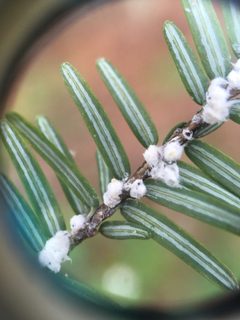
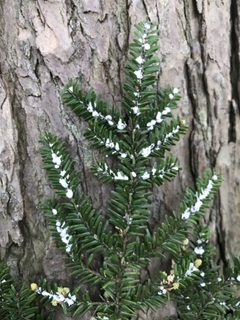
Adelges tsugae, the hemlock woolly adelgid, is a small sap-sucking insect native to East Asia. In eastern North America, it is a destructive pest of eastern hemlock (Tsuga canadensis) and Carolina hemlock (Tsuga caroliniana), causing extensive tree mortality and threatening forest . The insect is named for the white, woolly wax coating that covers its sacs and protects the insects beneath. It reproduces asexually via in North America, producing two per year.
Pronunciation
How to pronounce Adelges tsugae: //əˈdɛl.d͡ʒiz ˈsuː.ɡaɪ//
These audio files are automatically generated. While they are not always 100% accurate, they are a good starting point.
Identification
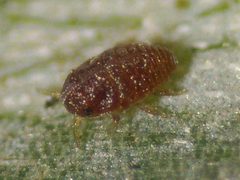
Identification relies on the presence of white, woolly ovisacs on hemlock twigs, particularly on the undersides of branches. The woolly covering distinguishes it from other adelgids. Microscopic examination reveals the insect's reddish-purple body beneath the wax. In eastern North America, no other adelgid produces comparable woolly masses on hemlock. Detection in early may require specialized sampling methods such as Velcro-covered balls or funnel traps.
Images
Appearance
are tiny, approximately 1 mm in length, with . The most visible feature is the white, woolly, waxen ovisac covering masses, which appears as small cottony tufts on hemlock twigs. First instar nymphs, called ',' are minute dark specks resembling pepper flakes. Winged forms occur in the spring but cannot reproduce in North America due to absence of suitable spruce .
Habitat
Eastern hemlock (Tsuga canadensis) and Carolina hemlock (Tsuga caroliniana) forests, from northern Georgia to Maine. Within trees, highest densities occur in the lower crown and on northern exposures. Also found on planted eastern hemlock in urban and park settings. Thrives in cool, moist conditions along streams and in ravines where hemlocks dominate.
Distribution
Native to Japan and East Asia. Introduced to western North America (Pacific Northwest) where it is a minor pest on western hemlock. In eastern North America, first detected in Virginia in 1951; now established in 17 eastern states from northern Georgia to Maine, extending westward to Michigan, Ohio, and Kentucky. Range limited by winter minimum temperatures, with northward expansion facilitated by climate change.
Seasonality
Active primarily in winter, with peak activity from late winter through early spring. Two per year: a winter/spring generation (sistens) and a late spring/early summer generation (progrediens). Aestivates (enters summer dormancy) during warm months, resuming activity in fall. disperse in spring and early summer.
Diet
Phloem sap of hemlock (Tsuga spp.). Specifically feeds on eastern hemlock (Tsuga canadensis), Carolina hemlock (Tsuga caroliniana), and western hemlock (Tsuga heterophylla). Does not feed on spruce (Picea spp.) in North America despite having a winged adapted to spruce in its native Asian range.
Host Associations
- Tsuga canadensis - primary eastern hemlock; highly susceptible, major pest in eastern North America
- Tsuga caroliniana - primary Carolina hemlock; highly susceptible
- Tsuga heterophylla - western hemlock; native co-evolved in Pacific Northwest where HWA is not a major pest
- Tsuga chinensis - Chinese hemlock; demonstrated complete resistance in experimental challenges
Life Cycle
Complex with two per year in eastern North America. Winter/spring generation (sistens): hatch in late winter, settle on twigs, develop through four nymphal stages while covered by woolly ovisac, mature and lay eggs in spring. Late spring/early summer generation (progrediens): eggs hatch, crawlers disperse, some develop into winged females that cannot reproduce (no suitable spruce ), others become wingless egg-laying . is parthenogenetic (asexual) in North America; on spruce occurs only in native Asian range.
Behavior
actively disperse short distances to find feeding sites on hemlock twigs. Passively dispersed longer distances by wind, birds, mammals, and human transport of infested nursery stock. Birds acquire crawlers through both active crawling onto perches and passive contact with branches; peak bird-mediated occurs in May during spring . are once settled, feeding in place beneath protective woolly covering. Aestivates during summer heat to avoid .
Ecological Role
forest pest causing extensive mortality of foundation tree in eastern North America. Eastern hemlock loss threatens services including stream temperature regulation, water flow moderation, and wildlife . In native Pacific Northwest range, regulated by top-down pressure and co-evolved resistance, maintaining stable . Absence of effective natural enemies in eastern North America allows populations.
Human Relevance
Major economic and ecological threat to eastern North American forests. Management includes applications (limited to individual trees in horticultural settings), using predatory beetles (Laricobius nigrinus, L. osakensis) and silver flies (Leucopis spp.), and silvicultural strategies. on hemlock nursery stock implemented to limit spread. Climate change projected to increase winter survival and northward range expansion, intensifying impacts.
Similar Taxa
- Pineus strobiAnother adelgid that produces woolly masses on pine rather than hemlock; association distinguishes them
- Adelges piceaeBalsam woolly adelgid, produces similar woolly masses but on fir (Abies) rather than hemlock
More Details
Biological Control Efforts
Two predatory , Laricobius nigrinus (native to Pacific Northwest, released since 2003) and L. osakensis (native to Japan, released since 2012), and two silver fly species (Leucopis argenticollis, L. piniperda, released since 2015) are being evaluated and deployed as biocontrol agents. Silver flies offer particular promise as they feed on both of HWA, unlike beetles which primarily target the winter generation.
Detection Methods
Specialized sampling techniques include Velcro-covered balls launched into with slingshots, wide funnel traps that can detect 2-3 years before visual appear, and the Lari-Leuco container for simultaneously monitoring both beetles and silver flies.
Climate Change Implications
Winter mortality is a key limiting factor for HWA range expansion. Climate change models predict increased winter survival and growth rates, particularly at the northeastern edge of eastern hemlock distribution, facilitating northward range expansion and intensified impacts throughout current range.
Sources and further reading
- BugGuide
- GBIF taxonomy match
- iNaturalist taxon
- NCBI Taxonomy
- Catalogue of Life
- Biological Control for Hemlock Woolly Adelgid: Where Do We Stand?
- Little, Fuzzy, But Not So Cute: The Hemlock Woolly Adelgid
- New Trap Improves Detection of Hemlock Woolly Adelgid
- New Container Aids in Biocontrol of Hemlock Woolly Adelgid
- Tree-killing Hemlock Woolly Adelgids Hitch Rides on Birds
- Is the Beetle Doing Its Job? How Environmental DNA Can Aid Biological Control Efforts
- Distribution and Abundance of Adelges tsugae (Hemiptera: Adelgidae) Within Hemlock Trees
- Challenging Chinese Hemlock (Tsuga chinensis) with Hemlock Woolly Adelgid ( Adelges tsugae ) Ovisacs
- Detection ofAdelges tsugae(Hemiptera: Adelgidae) wool using Velcro-covered balls
- A Native Lepidopteran is Impacted by Host Defenses Induced by Hemlock Woolly Adelgid (Adelges tsugae)
- Impact of host defenses induced by hemlock woolly adelgid (Adelges tsugae) feeding on a native lepidopteran
- Biology, ecology and efficacy of Lecanicillium muscarium as a potential fungal biocontrol of the invasive hemlock woolly adelgid (Adelges tsugae) on eastern hemlock (Tsuga canadensis)
- Evidence of a Polymorphic Life Cycle in the Hemlock Woolly Adelgid, Adelges tsugae (Homoptera: Adelgidae)
- Top-Down Regulation of Hemlock Woolly Adelgid (Adelges Tsugae) in Its Native Range in the Pacific Northwest of North America
- Seasonal synchrony of life cycles between the exotic predator, Pseudoscymnus tsugae (Coleoptera: Coccinellidae) and its prey, the hemlock woolly adelgid Adelges tsugae (Homoptera:Adelgidae)
- Development and reproductive biology of Laricobius nigrinus, a potential biological control agent of Adelges tsugae
- Field-cage evaluation of the survival, feeding and reproduction of Laricobius osakensis (Coleoptera: Derodontidae), a predator of Adelges tsugae (Hemiptera: Adelgidae)
- Mortality and Recovery of Hemlock Woolly Adelgid (Adelges tsugae) in Response to Winter Temperatures and Predictions for the Future
- Reshaping the Ecology of Invading Populations of Hemlock Woolly Adelgid, Adelges tsugae (Homoptera: Adelgidae), in Eastern North America
- Methods for collecting and rearing three sympatric biocontrol agents of Adelges tsugae (Hemiptera: Adelgidae) in eastern North America.