
Pineus strobi
(Hartig, 1839)
Pine Bark Adelgid, White Pine Bark Aphid
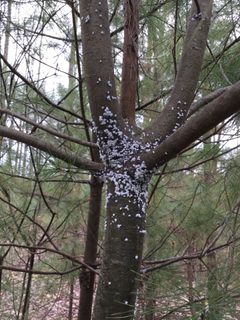
Pineus strobi is a small, sap-sucking insect in the Adelgidae, commonly known as the pine bark adelgid or white pine bark . It is a feeder on white pine (Pinus strobus) and related pine , forming dense colonies on bark and branches. The species has been introduced to regions outside its native range, including central European Russia and the Fergana Valley, where it is considered . Like other adelgids, it possesses complex associations with bacterial endosymbionts that aid in nutritional processing.

Pronunciation
How to pronounce Pineus strobi: //ˈpaɪniəs ˈstroʊbaɪ//
These audio files are automatically generated. While they are not always 100% accurate, they are a good starting point.
Images
Habitat
Bark and branches of white pine and related pine ; colonies form on woody tissues of trees
Distribution
Native to North America; introduced and established in central European Russia (Voronezh, Kursk, Oryol regions), Fergana Valley, and other regions outside native range; recorded in Serbia and Austria
Diet
Phloem sap of pine trees, obtained through
Host Associations
- Pinus strobus - primary white pine, primary for feeding and colony formation
- Pinus resinosa - red/Norway pine, reported as for related Pineus and potentially P. strobi
Life Cycle
Complex typical of adelgids, involving parthenogenetic during growing season; and production occur in autumn to overwinter; specific details of P. strobi life stages not fully documented in available sources
Behavior
Forms dense colonies on bark and branches; produces honeydew as waste product from phloem feeding; sedentary as with limited mobility
Ecological Role
Herbivore that extracts nutrients from pine phloem; honeydew production supports growth of and attracts ants, , and other insects; serves as for specialized bacterial endosymbionts essential for nutritional supplementation
Human Relevance
Considered a pest in forestry and ornamental plantings; in Europe cause concern for white pine ; honeydew deposition creates nuisance conditions on surfaces below infested trees
Similar Taxa
- Pineus coloradensisSimilar , also feeds on pines including Pinus resinosa; distinguished by geographic distribution and preferences
- Cinara strobi 'white pine aphid' creates potential confusion; Cinara strobi is a true (Aphididae) rather than adelgid, with different and
- Adelges tsugaeRelated adelgid in same superfamily; distinguished by specificity on hemlock rather than pine, and different associations
More Details
Endosymbiont associations
Pineus strobi harbors two distinct gammaproteobacterial endosymbionts within specialized bacteriocytes: 'Candidatus Annandia pinicola' and 'Candidatus Hartigia pinicola'. These represent ancient associations that evolved prior to diversification of adelgid , and are essential for nutritional supplementation given the nutrient-poor phloem diet.
Invasive spread dynamics
In central European Russia, spread of P. strobi has been documented from initial introduction points through movement of white pine cuttings from Oryol and Kaliningrad regions, with subsequent establishment in Voronezh, Kursk, and Oryol regions.
Taxonomic note
Some sources list P. strobi as a synonym, though GBIF and other authorities recognize it as accepted. The was originally described as Coccus strobi by Hartig in 1839.
Sources and further reading
- BugGuide
- GBIF taxonomy match
- iNaturalist taxon
- NCBI Taxonomy
- Catalogue of Life
- Got a Question About Butterflies? | Bug Squad
- Aphids serve a tasty autumn treat: White pine aphid, Cinara strobi — Bug of the Week
- Clubmoss along the Ozark Trail | Beetles In The Bush
- Bug Eric: Striped Pine Scale
- I don’t think you’re ready for these Jellies: A brief dive into the world of Jellyfish - Buglife Blog - Buglife
- IMA Fungus publishes its first issue with Pensoft
- The Pine Bark Adelgid, Pineus strobi, Contains Two Novel Bacteriocyte-Associated Gammaproteobacterial Symbionts
- Taxonomy and Biology of Pineus strobi (Hartig) and P. coloradensis (Gillette) (Homoptera: Adelgidae)
- PINEUS STROBI HARTIG, RECORDED FOR THE FIRST TIME IN FERGANA VALLEY, BIOECOLOGY OF THE SPECIES 1839 (HEMIPTERA, ADELGIDAE)
- INVASION SPECIES OF HERMES <i>PINEUS STROBI </i>(HARTIG 1839) (HEMIPTERA: ADELGIDAE)<i/>ON<i> PINUS STROBUS </i>L. IN CENTRAL REGIONS OF EUROPEAN RUSSIA