
Laricobius
Rosenhauer, 1846
Species Guides
3- Laricobius erichsonii
- Laricobius nigrinus(hemlock woolly adelgid predator beetle)
- Laricobius rubidus
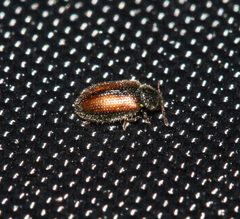
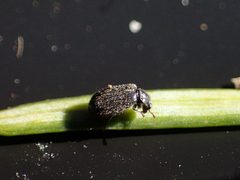
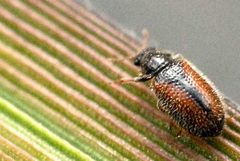
Laricobius is a Holarctic of small predatory beetles in the Derodontidae, comprising approximately 23 described . Unlike other Derodontidae genera that feed on fungi, Laricobius species are specialized of adelgids (Adelgidae), -like insects that infest conifers. Several species, notably L. nigrinus from western North America and L. osakensis from Japan, have been released as agents against the hemlock woolly adelgid (Adelges tsugae) in eastern North America. The genus exhibits two distinct morphological groups: a southeastern Asian/Himalayan group with shortened bodies and narrow pronota lacking explanate margins, and a more widespread Holarctic group with elongate bodies and transverse, fully explanate pronota.
Pronunciation
How to pronounce Laricobius: //læˈrɪkoʊbius//
These audio files are automatically generated. While they are not always 100% accurate, they are a good starting point.
Identification
Identification to requires examination of pronotum shape (explanate vs. non-explanate margins), body proportions (elongate vs. shortened), and presence or absence of ocelli. A key to species is available in the world review by Zilahi-Balogh (2011). Laricobius larvae can be distinguished from other Derodontidae by their association with adelgid colonies and their of dropping from foliage to pupate in soil. are active from fall through early summer and may be found in association with woolly adelgid ovisacs on hemlock twigs.
Images
Habitat
Associated with conifer forests, specifically where adelgids infest Tsuga (hemlock), Picea (spruce), and Abies (fir) . In North America, closely tied to eastern hemlock (Tsuga canadensis), western hemlock (T. heterophylla), and Carolina hemlock (T. caroliniana) forests. Species have been documented establishing in both forest and urban environments where trees occur.
Distribution
Holarctic distribution. Europe: 1 (L. erichsonii). North America: 3 native species (L. nigrinus, L. rubidus, L. laticollis), with L. nigrinus native to the Pacific Northwest (Montana, Idaho, Washington, Oregon, British Columbia) and L. rubidus in eastern North America. Asia: 17 species, with centers of diversity in southeastern Asia and the Himalaya. L. nigrinus and L. osakensis have been introduced to eastern North America for . L. erichsonii was introduced to eastern Canada and the Pacific Northwest for control of balsam woolly adelgid.
Seasonality
active from fall through early summer. Undergo summer (aestival ) coinciding with diapausing first instar adelgid sistens. Oviposition occurs in spring. Larvae present in summer, feeding on adelgid and sistens nymphs. occurs in soil. Adult in fall. Synchrony between and prey is critical for effective .
Diet
Specialized of adelgids (Adelgidae). feed on adelgid . Larvae feed on adelgid eggs and sistens nymphs. Specific prey documented include Adelges tsugae (hemlock woolly adelgid), Adelges piceae (balsam woolly adelgid), and other adelgid .
Host Associations
- Adelges tsugae - preyhemlock woolly adelgid; primary target of releases
- Adelges piceae - preybalsam woolly adelgid; prey of L. erichsonii
- Tsuga canadensis - eastern hemlock; tree of A. tsugae
- Tsuga caroliniana - Carolina hemlock; tree of A. tsugae
- Tsuga heterophylla - western hemlock; native of L. nigrinus and A. tsugae in Pacific Northwest
- Picea spp. - spruce; occasional for adelgid prey
- Abies spp. - fir; occasional for adelgid prey
Life Cycle
(one per year). emerge in fall and are active through early summer. Adults undergo summer during hot months. laid in spring within adelgid woolly ovisacs on twigs. Larvae hatch and feed on adelgid eggs and sistens nymphs. Mature larvae drop from foliage to soil to pupate. New adults emerge in fall. closely synchronized with adelgid prey .
Behavior
and larvae are active . Larvae exhibit negative geotaxis, dropping from foliage to soil for . Adults use visual and olfactory cues to locate adelgid-infested trees and specific prey stages. Adults can disperse between trees. Both life stages feed within woolly adelgid ovisacs. Adults have been observed to undergo summer dormancy () when prey are in .
Ecological Role
of adelgids, serving as a natural agent. In native ranges, contributes to regulation of adelgid on hemlock and other conifers. In introduced ranges (eastern North America), being evaluated and deployed for conservation of eastern hemlock forests threatened by hemlock woolly adelgid. can reduce adelgid densities and improve tree health metrics such as new shoot production.
Human Relevance
Important agents for management of forest pests. L. nigrinus released in eastern North America since 2003; over 400,000 individuals released from Georgia to Maine. L. osakensis released since 2012. L. erichsonii introduced to eastern Canada (1933 onward) and Pacific Northwest (1957-1960) for balsam woolly adelgid control. Monitoring methods include beat sheets, specialized collection containers (Lari-Leuco container), and environmental detection. Establishment success varies geographically, limited by winter minimum temperatures in northern areas. Regulatory concerns arose regarding inadvertent introduction of L. naganoensis with L. osakensis shipments.
Similar Taxa
- Other Derodontidae genera (Derodontus, Peltastica, Nothoderodontus)Other in Derodontidae feed on fungi rather than adelgids; Laricobius distinguished by predatory habit and association with adelgid colonies
- Leucopis (silver flies)Also used as agents for hemlock woolly adelgid; distinguished by being Diptera (flies) rather than Coleoptera, with larvae pupating on twigs rather than dropping to soil
More Details
Phylogenetic Groups
Cladistic analysis recognizes two major groups: (1) southeastern Asian/Himalayan with shortened bodies and narrow pronota lacking explanate margins, and (2) widespread Holarctic species with elongate bodies and transverse, fully explanate pronota. The latter includes four Asian species without ocelli collected from Tsuga infested with Adelges tsugae.
Biocontrol Regulatory Issues
L. naganoensis was inadvertently imported to eastern North America with L. osakensis. USDA subsequently permitted its introduction as a contaminant without standard public review or Environmental Assessment, raising concerns about circumvention of regulatory safeguards for agents.
Detection Challenges
Larval stages of L. nigrinus and L. osakensis are difficult to distinguish morphologically. Environmental methods have been developed to detect and differentiate these in soil, water, and plant matter to improve monitoring .
Sources and further reading
- BugGuide
- Wikipedia
- GBIF taxonomy match
- iNaturalist taxon
- NCBI Taxonomy
- Catalogue of Life
- Laricobius nigrinus beetle - Entomology Today
- Laricobius nigrinus adult - Entomology Today
- Laricobius nigrinus larva - Entomology Today
- Is the Beetle Doing Its Job? How Environmental DNA Can Aid Biological Control Efforts
- New Container Aids in Biocontrol of Hemlock Woolly Adelgid
- Biological Control for Hemlock Woolly Adelgid: Where Do We Stand?
- World review of Laricobius (Coleoptera: Derodontidae)
- Establishment and postrelease recovery of Laricobius nigrinus and Laricobius osakensis (Coleoptera: Derodontidae), released for biological control of Adelges tsugae (Hemiptera: Adelgidae), in the Northeastern United States
- Circumventing regulatory safeguards: Laricobius spp. and biocontrol of the hemlock woolly adelgid
- Morphology ofLaricobius nigrinus(Coleoptera: Derodontidae), a predator of the hemlock woolly adelgid
- Development and reproductive biology of Laricobius nigrinus, a potential biological control agent of Adelges tsugae
- Field-cage evaluation of the survival, feeding and reproduction of Laricobius osakensis (Coleoptera: Derodontidae), a predator of Adelges tsugae (Hemiptera: Adelgidae)
- Visual Ability and Searching Behavior of AdultLaricobius nigrinus, a Hemlock Woolly Adelgid Predator
- Observations on the Effectiveness and Biology of the European Predator Laricobius erichsonii Rosen. (Coleoptera: Derodontidae) in Oregon and Washington
- Host specificity of Laricobius nigrinus Fender (Coleoptera: Derodontidae), a potential biological control agent of the hemlock woolly adelgid, Adelges tsugae Annand (Homoptera: Adelgidae)
- The Impact of Predation of Laricobius nigrinus (Coleoptera: Derodontidae) on Adelges tsugae (Hemiptera: Adelgidae) and Tsuga canadensis (Pinales: Pinaceae) Tree Health
- Orientation Behavior of the PredatorLaricobius nigrinus(Coleoptera: Derodontidae) to Hemlock Woolly Adelgid and Host Tree Odors in a Multi-Chambered Olfactometer
- Biology and development of Laricobius kangdingensis Zilahi-Balogh and Jelínek, a newly discovered predator of Adelges tsugae
- Seasonal abundance and synchrony betweenLaricobius nigrinus(Coleoptera: Derodontidae) and its prey, the hemlock woolly adelgid (Hemiptera: Adelgidae)
- Survival and reproduction of Laricobius nigrinus Fender (Coleoptera: Derodontidae), a predator of hemlock woolly adelgid, Adelges tsugae Annand (Homoptera: Adelgidae) in field cages
- Studies of Predators of the Balsam Woolly Aphid, Adelges piceae (Ratz.) (Homoptera: Adelgidae): V. Laricobius erichsonii Rosen. (Coleoptera: Derodontidae), an Introduced Predator in Eastern Canada,