
Derodontidae
LeConte, 1861
tooth-necked fungus beetles
Genus Guides
3- Derodontus(tooth-necked fungus beetles)
- Laricobius
- Peltastica(tooth-necked fungus beetles)
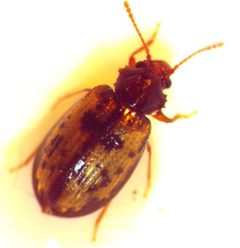
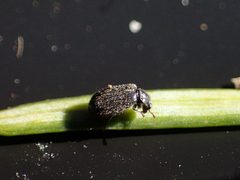
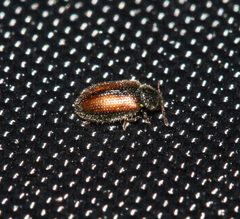
is a small of beetles comprising 42 in 4 and 3 . Members are commonly known as tooth-necked fungus beetles due to the spiny pronotal margins found in most genera, though the genus Laricobius lacks these spines. The family is notable for possessing two ocelli on the , an unusual trait among beetles. The genus Laricobius has gained significant attention as a agent for adelgids threatening hemlock forests in North America.
Pronunciation
How to pronounce Derodontidae: /dɛɹoʊˈdɒntɪdiː/
These audio files are automatically generated. While they are not always 100% accurate, they are a good starting point.
Identification
The combination of small size (2–6 mm), presence of two ocelli on the , and spiny pronotal margins distinguishes most from other . Laricobius lack pronotal spines but retain the diagnostic ocelli. The family can be separated from related Bostrichoidea by these ocelli and pronotal characteristics. Larval stages of Laricobius are difficult to distinguish from each other, requiring molecular methods for accurate identification to species.
Images
Habitat
varies by . Laricobius are associated with coniferous forests, particularly hemlock (Tsuga) stands infested with adelgids. Derodontus species inhabit well-preserved natural forest habitats and are found on fungi. The occupies both native forest and urban environments where trees occur.
Distribution
Holarctic distribution. Europe: 1 (Laricobius erichsonii). North America: 3 species of Laricobius (L. nigrinus, L. rubidus, plus others), plus Derodontus and other . Asia: 17 species, concentrated in south-eastern Asia and the Himalaya. Laricobius nigrinus is native to western North America (Pacific Northwest) and has been introduced to the eastern United States. Laricobius osakensis is native to Japan. Fossil genus Juropeltastica is known from the Middle Jurassic (~163 million years old) Daohugou Beds of China.
Seasonality
Laricobius exhibit seasonal activity synchronized with their adelgid prey. undergo aestival coinciding with diapausing first-instar adelgid sistens. Adult activity, oviposition, and larval development resume in synchrony with prey development stages. Timing varies geographically: adelgid sistens matures 2–3 months earlier in British Columbia than in Virginia and Connecticut.
Diet
Varies by . Laricobius are of adelgids (Adelgidae), including Adelges tsugae (hemlock woolly adelgid), Adelges piceae (balsam woolly aphid), and Pineus strobi. Derodontus species are mycophagous, feeding on fungi including slime molds. Some feed on oyster mushrooms (Pleurotus).
Host Associations
- Adelges tsugae - preyHemlock woolly adelgid; primary target for by Laricobius nigrinus and L. osakensis
- Adelges piceae - preyBalsam woolly aphid; prey of Laricobius erichsonii
- Pineus strobi - preyPine bark adelgid
- Tsuga canadensis - Eastern hemlock; tree of Adelges tsugae
- Tsuga caroliniana - Carolina hemlock; tree of Adelges tsugae
- Pleurotus - foodOyster mushrooms; fungus for mycophagous
Life Cycle
Complete with , larva, pupa, and stages. Laricobius larvae develop through multiple instars, feeding on adelgid eggs and adults. Larval development is synchronized with oviposition by adelgid sistens adults. occurs in soil or litter. Adults emerge and may undergo aestival during summer months when prey are in diapause.
Behavior
Laricobius are active that seek out adelgid colonies on trees. and larvae feed on all life stages of adelgids. Laricobius nigrinus and L. osakensis orient toward host tree odors and adelgid odors in studies, demonstrating chemotactic location of prey. Adults fly and disperse to locate new host trees. Some species exhibit phoretic mite associations, with mites hitchhiking on beetles without causing harm.
Ecological Role
of adelgids in forest . Laricobius serve as natural enemies that help regulate adelgid . In their native ranges, they contribute to natural of adelgid populations on conifers. In eastern North America, introduced Laricobius species are being evaluated and deployed as biological control agents to mitigate hemlock woolly adelgid damage and preserve hemlock ecosystem functions. by L. nigrinus has been shown to significantly impact HWA sistens and promote new shoot production on hemlock trees.
Human Relevance
The Laricobius is significant for of forest pests. Laricobius nigrinus was first released in 2003 and L. osakensis in 2012 for control of hemlock woolly adelgid in eastern North America. Over 400,000 beetles have been released from Georgia to Maine. Establishment has been confirmed in forest and urban environments. These biological control efforts aim to preserve eastern hemlock forests, which provide critical for native bird and maintain functions on steep slopes where chemical control is impractical. Derodontus species are rarely encountered and have no significant economic impact.
Similar Taxa
- Bostrichoidea (superfamily)Related superfamily including death watch beetles, skin beetles, and powder-post beetles; was historically placed here but now placed in separate superfamily Derodontoidea based on morphological differences including the presence of ocelli
- Dermestidae of skin and carpet beetles with similar small size and body form; distinguished by lack of ocelli and different antennal and pronotal structure
- Endomychidae (handsome fungus beetles)Another of fungus-feeding beetles found on mushrooms; distinguished by different body shape, lack of pronotal spines, and absence of ocelli
- Erotylidae (pleasing fungus beetles)Often found in same on fungi; distinguished by typically larger size, more convex body form, and lack of ocelli and pronotal spines
More Details
Taxonomic composition
The comprises 3 : Derodontinae ( Derodontus, 11 ), Laricobiinae (genera Laricobius with 23 species, Nothoderodontus with 6 species), and Peltasticinae (genus Peltastica, 2 species). A fossil genus Juropeltastica is known from the Middle Jurassic of China.
Phylogenetic groups within Laricobius
Two broad clades exist: one confined to south-eastern Asia and the Himalaya with shortened body form and narrow pronotum lacking explanate margins, and a more widespread Holarctic group that is more elongate with transverse, fully explanate pronotum. Four Asian lack ocelli.
Environmental DNA monitoring
Recent research has developed eDNA assays using CO1 gene sequences to detect and differentiate Laricobius in environmental (soil, water, plant matter), aiding monitoring of establishment and spread.
Sources and further reading
- BugGuide
- Wikipedia
- GBIF taxonomy match
- iNaturalist taxon
- NCBI Taxonomy
- Catalogue of Life
- Bug Eric: Fungus Party-y-y!
- Bug Eric: 2022
- Biological Control for Hemlock Woolly Adelgid: Where Do We Stand?
- Is the Beetle Doing Its Job? How Environmental DNA Can Aid Biological Control Efforts
- Bug Eric: Carpet Beetles, Genus Anthrenus
- World review of Laricobius (Coleoptera: Derodontidae)
- Morphology ofLaricobius nigrinus(Coleoptera: Derodontidae), a predator of the hemlock woolly adelgid
- Contribution to distribution of the mycophagous beetle Derodontus macularis (Fuss, 1850) (Coleoptera: Derodontidae) in eastern Moravia
- Observations on the Effectiveness and Biology of the European Predator Laricobius erichsonii Rosen. (Coleoptera: Derodontidae) in Oregon and Washington
- Field-cage evaluation of the survival, feeding and reproduction of Laricobius osakensis (Coleoptera: Derodontidae), a predator of Adelges tsugae (Hemiptera: Adelgidae)
- The Impact of Predation of Laricobius nigrinus (Coleoptera: Derodontidae) on Adelges tsugae (Hemiptera: Adelgidae) and Tsuga canadensis (Pinales: Pinaceae) Tree Health
- Host specificity of Laricobius nigrinus Fender (Coleoptera: Derodontidae), a potential biological control agent of the hemlock woolly adelgid, Adelges tsugae Annand (Homoptera: Adelgidae)
- Orientation Behavior of the PredatorLaricobius nigrinus(Coleoptera: Derodontidae) to Hemlock Woolly Adelgid and Host Tree Odors in a Multi-Chambered Olfactometer
- Studies of Predators of the Balsam Woolly Aphid, Adelges piceae (Ratz.) (Homoptera: Adelgidae): V. Laricobius erichsonii Rosen. (Coleoptera: Derodontidae), an Introduced Predator in Eastern Canada,
- Survival and reproduction of Laricobius nigrinus Fender (Coleoptera: Derodontidae), a predator of hemlock woolly adelgid, Adelges tsugae Annand (Homoptera: Adelgidae) in field cages
- Seasonal abundance and synchrony betweenLaricobius nigrinus(Coleoptera: Derodontidae) and its prey, the hemlock woolly adelgid (Hemiptera: Adelgidae)
- Behavioral Responses ofLaricobiusspp. and Hybrids (Coleoptera: Derodontidae) to Hemlock Woolly Adelgid and Adelgid Host Tree Odors in an Olfactometer
- Comparison between a native and exotic adelgid as hosts forLaricobius rubidus(Coleoptera: Derodontidae)
- Seasonal Abundance and Synchrony between Laricobius osakensis (Coleoptera: Derodontidae) and its Prey, Adelges tsugae (Hemiptera: Adelgidae), in Japan