
Laricobius erichsonii
Rosenhauer, 1846
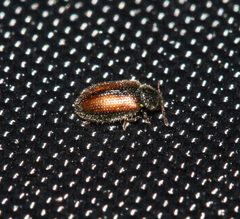
Laricobius erichsonii is a small predatory in the Derodontidae, native to Europe and the sole European representative of the . It has been introduced to North America as a agent for the balsam woolly aphid (Adelges piceae), with releases in eastern Canada since 1933 and in Oregon and Washington from 1957–1960. The is one of the more numerous of A. piceae in its native range. It belongs to the widespread Holarctic group within Laricobius, characterized by an elongate body and transverse, fully explanate pronotum.
Pronunciation
How to pronounce Laricobius erichsonii: //læˈrɪˌkoʊbiəs ˌɛˈrɪkˌsoʊnaɪ//
These audio files are automatically generated. While they are not always 100% accurate, they are a good starting point.
Identification
Distinguished from other Laricobius by its Holarctic : elongate body form with transverse, fully explanate pronotum. Differs from the southeastern Asian group, which has more shortened species with narrower pronota lacking explanate margins. A lectotype was designated by Leschen (2011) to stabilize .
Images
Habitat
Coniferous forests; distribution bound to that of Coniferae supporting its adelgid prey.
Distribution
Native to Europe: from the Italian Alps to near southern Denmark, and from Normandy eastward almost to the Carpathian Mountains. Introduced to the Atlantic Provinces of Canada since 1933, and to Oregon and Washington, USA from 1957–1960, where it survived winters and showed promise of permanent establishment.
Diet
of adelgids, specifically the balsam woolly aphid (Adelges piceae).
Host Associations
- Adelges piceae - preybalsam woolly aphid; primary target of introductions
- Coniferae - plants of prey; distribution bound to these conifers
Ecological Role
agent; of balsam woolly aphid in both native European range and introduced North American .
Human Relevance
Deployed as a agent against the balsam woolly aphid in Canada and the western United States. One of four introduced that survived winters and showed promise of permanent establishment in Oregon and Washington.
Similar Taxa
- Laricobius nigrinusBoth are Derodontid beetles used for adelgid biocontrol, but L. nigrinus is native to western North America and targets hemlock woolly adelgid (Adelges tsugae), while L. erichsonii is European and targets balsam woolly aphid (A. piceae). L. nigrinus has been widely released in eastern North America since 2003.
- Laricobius osakensisBoth are introduced biocontrol agents for adelgids, but L. osakensis is native to Japan and specifically targets hemlock woolly adelgid (A. tsugae), whereas L. erichsonii is European and targets balsam woolly aphid (A. piceae). L. osakensis releases in the U.S. began in 2012.
- Laricobius rubidusNative to eastern North America and a of adelgids; distinguished from the introduced L. erichsonii by native range and association with eastern forest .
Sources and further reading
- BugGuide
- GBIF taxonomy match
- iNaturalist taxon
- NCBI Taxonomy
- Catalogue of Life
- Laricobius nigrinus beetle - Entomology Today
- Laricobius nigrinus adult - Entomology Today
- Laricobius nigrinus larva - Entomology Today
- Is the Beetle Doing Its Job? How Environmental DNA Can Aid Biological Control Efforts
- New Container Aids in Biocontrol of Hemlock Woolly Adelgid
- Biological Control for Hemlock Woolly Adelgid: Where Do We Stand?
- World review of Laricobius (Coleoptera: Derodontidae)
- Observations on the Effectiveness and Biology of the European Predator Laricobius erichsonii Rosen. (Coleoptera: Derodontidae) in Oregon and Washington
- Studies of Predators of the Balsam Woolly Aphid, Adelges piceae (Ratz.) (Homoptera: Adelgidae): V. Laricobius erichsonii Rosen. (Coleoptera: Derodontidae), an Introduced Predator in Eastern Canada,