
Laricobius nigrinus
Fender, 1945
hemlock woolly adelgid predator beetle
Laricobius nigrinus is a small predatory in the Derodontidae, native to western North America. First described by Kenneth Fender in 1945 from Oregon specimens, it is specialized to feed on adelgids, particularly the hemlock woolly adelgid (Adelges tsugae). Since 2003, it has been released as a agent in the eastern United States to combat adelgid threatening eastern and Carolina hemlock trees. The exhibits a with aestival and has established populations across multiple eastern states.
Pronunciation
How to pronounce Laricobius nigrinus: //læˈrɪkoʊbiəs nɪˈɡraɪnəs//
These audio files are automatically generated. While they are not always 100% accurate, they are a good starting point.
Identification
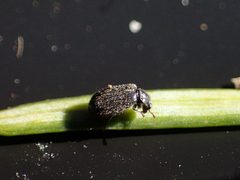
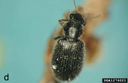
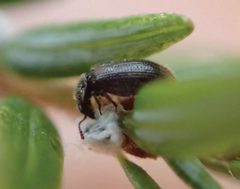
Distinguished from other black Laricobius by the toothed pronotal margin. are small (2.3–2.9 mm), black-bodied with reddish-brown appendages. Larvae are oligopod type with three thoracic leg pairs, no , and twelve stemmata. Molecular identification via CO1 gene sequencing is challenging due to similarity with ; species-specific primers and probes have been developed for qPCR detection in environmental .
Images
Habitat
Native to hemlock forests of the Pacific Northwest. Associated with western hemlock (Tsuga heterophylla) in native range and eastern hemlock (Tsuga canadensis) and Carolina hemlock (T. caroliniana) where introduced. Arboreal, inhabiting tree crowns; fourth instar larvae drop to forest floor to pupate in earthen . Has established in both forest and urban environments in the eastern United States.
Distribution
Native to western North America: western United States and Canada, from Oregon and Washington north to southeastern Yukon. Introduced and established in eastern North America: Pennsylvania, Maryland, New York, New Jersey, Virginia, Georgia, West Virginia, North Carolina, Tennessee, Connecticut, Massachusetts, Maine, and New Hampshire. Establishment in northeastern interior areas appears limited by winter minimum temperatures.
Seasonality
with activity synchronized to over-wintering of Adelges tsugae. active in fall, winter, and early spring; oviposition occurs late winter to early spring. Larvae develop through spring; fourth instars drop to ground in late spring. occurs in soil during summer aestival . Adults eclose in fall and emerge to locate hemlock trees and prey. Temperature-dependent development: cannot complete development above 21°C.
Diet
Specialized of hemlock woolly adelgid (Adelges tsugae). feed on adult adelgids. Larvae feed on within adelgid ovisacs; late instar larvae may also consume nymphs on twigs. Mean larval consumption: 225.9–252.3 adelgid eggs depending on temperature. Unlike most Derodontidae, which are fungal feeders, L. nigrinus exhibits predatory .
Host Associations
- Adelges tsugae - preyhemlock woolly adelgid; sole prey
- Tsuga heterophylla - western hemlock; native tree in Pacific Northwest
- Tsuga canadensis - eastern hemlock; introduced tree in eastern US
- Tsuga caroliniana - Carolina hemlock; introduced tree in eastern US
Life Cycle
: one per year. laid in adelgid ovisacs from late winter to early spring; mean lifetime approximately 100 eggs over 13.2 weeks. Four larval instars; development time egg to temperature-dependent (46.6–88.8 days at 12–18°C). Fourth instar larvae drop to forest floor as , form earthen , and pupate. Aestival during summer months; adults emerge in fall. Post- activity period approximately 31 weeks (females) to 37 weeks (males).
Behavior
activity pattern; significantly more active during day than night. Visual orientation important for locating tree stems at close range—2.2–3.4 times more successful in light than dark. responsive to prey : flies when prey absent, does not fly when prey abundant, resulting in on heavily infested trees. At close range to prey, exhibits slow crawling with frequent turning, antennating, and probing waxy flocculence with palps, suggesting use of olfactory and contact chemoreception. Extensive self- to clean and optimize sensory organ function. Olfactory response to odors of western hemlock, western white pine, and white spruce.
Ecological Role
of hemlock woolly adelgid. Serves as agent for adelgid threatening eastern hemlock forests. can significantly impact adelgid sistens and temporarily improve tree physiology (new shoot production, photosynthetic rate). Positive correlation between adelgid density and density indicates functional predator-prey relationship.
Human Relevance
Approved by USDA-APHIS for release as agent in 2000; field releases began 2003. Over 400,000 beetles released across 18 eastern states from Georgia to Maine. Established provide sustainable, ecologically friendly management option where chemical or silvicultural treatments are infeasible. Monitoring via specialized collection devices (Lari-Leuco container) and environmental assays to track establishment and spread. Hybridization risk with native Laricobius rubidus under study.
Similar Taxa
- Laricobius rubidusNative in eastern US that feeds on pine bark adelgid; black body but lacks toothed pronotal margin of L. nigrinus; potential for hybridization with introduced L. nigrinus
- Laricobius osakensisJapanese also released for HWA biocontrol since 2012; morphologically similar, distinguished by ; CO1 gene sequences nearly identical requiring -specific primers for identification
- Leucopis argenticollis and Leucopis piniperdaSilver flies (Diptera: Chamaemyiidae) also used as HWA biocontrol agents; larvae feed on both adelgid (vs. L. nigrinus restricted to progrediens ), pupate on twigs rather than dropping to ground, and disperse upward rather than downward
More Details
Dispersal characteristics
Post-release studies show slow horizontal : spread rate approximately 39 m/year, with larvae recovered up to 400 m from release sites by fifth . Vertical dispersal is rapid: 86% of F2 generation detected above 15 m in crown, indicating monitoring limited to lower crown underestimates presence.
Temperature limitations
Development ceases above 21°C. Establishment probability declines with decreasing absolute minimum winter temperature, limiting northern range expansion in northeastern United States.
Sources and further reading
- BugGuide
- Wikipedia
- GBIF taxonomy match
- iNaturalist taxon
- NCBI Taxonomy
- Catalogue of Life
- Laricobius nigrinus beetle - Entomology Today
- Laricobius nigrinus adult - Entomology Today
- Laricobius nigrinus larva - Entomology Today
- Is the Beetle Doing Its Job? How Environmental DNA Can Aid Biological Control Efforts
- Biological Control for Hemlock Woolly Adelgid: Where Do We Stand?
- New Container Aids in Biocontrol of Hemlock Woolly Adelgid
- Morphology ofLaricobius nigrinus(Coleoptera: Derodontidae), a predator of the hemlock woolly adelgid
- Development and reproductive biology of Laricobius nigrinus, a potential biological control agent of Adelges tsugae
- Visual Ability and Searching Behavior of AdultLaricobius nigrinus, a Hemlock Woolly Adelgid Predator
- Seasonal abundance and synchrony betweenLaricobius nigrinus(Coleoptera: Derodontidae) and its prey, the hemlock woolly adelgid (Hemiptera: Adelgidae)
- Establishment and postrelease recovery of Laricobius nigrinus and Laricobius osakensis (Coleoptera: Derodontidae), released for biological control of Adelges tsugae (Hemiptera: Adelgidae), in the Northeastern United States
- Host specificity of Laricobius nigrinus Fender (Coleoptera: Derodontidae), a potential biological control agent of the hemlock woolly adelgid, Adelges tsugae Annand (Homoptera: Adelgidae)
- Survival and reproduction of Laricobius nigrinus Fender (Coleoptera: Derodontidae), a predator of hemlock woolly adelgid, Adelges tsugae Annand (Homoptera: Adelgidae) in field cages
- The Impact of Predation of Laricobius nigrinus (Coleoptera: Derodontidae) on Adelges tsugae (Hemiptera: Adelgidae) and Tsuga canadensis (Pinales: Pinaceae) Tree Health
- Orientation Behavior of the PredatorLaricobius nigrinus(Coleoptera: Derodontidae) to Hemlock Woolly Adelgid and Host Tree Odors in a Multi-Chambered Olfactometer
- Seasonal phenology and abundance ofLeucopis argenticollis, Leucopis piniperda(Diptera: Chamaemyiidae),Laricobius nigrinus(Coleoptera: Deridontidae) andAdelges tsugae(Hemiptera: Adelgidae) in the Pacific Northwest USA
- Spatiotemporal distribution of the hemlock woolly adelgid predator Laricobius nigrinus after release in eastern hemlock forests