
Leucopis
Meigen, 1830
silver flies
Species Guides
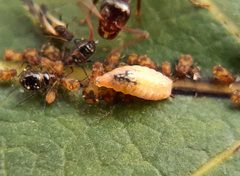
3Leucopis is a of predatory flies in the Chamaemyiidae comprising at least 40 described . Commonly known as silver flies, these insects are specialized of adelgids (woolly aphids), with several species under active investigation and release as agents for forest pests. Species such as Leucopis argenticollis and L. piniperda from the Pacific Northwest are being deployed against the hemlock woolly adelgid (Adelges tsugae) in eastern North America, while L. obscura has been documented as a predator of the balsam woolly aphid (Adelges piceae) in Maine.
Pronunciation
How to pronounce Leucopis: //luˈkɔ.pis//
These audio files are automatically generated. While they are not always 100% accurate, they are a good starting point.
Images
Habitat
Coniferous forests, particularly stands of hemlock (Tsuga spp.) and balsam fir (Abies balsamea) infested with adelgids. studied for biocontrol occur in western hemlock forests of the Pacific Northwest and have been experimentally released in eastern hemlock forests from Tennessee to New York.
Distribution
Widespread across multiple continents; individual vary in range. Leucopis formosana has one of the most extensive distributions in the , ranging from Israel and Western Africa to Australia. L. argenticollis and L. piniperda are native to the Pacific Northwest (Oregon and Washington). L. obscura occurs in Maine, USA. Multiple species have been introduced to eastern North America for .
Seasonality
Larval abundance peaks coincide with adelgid and presence. In the Pacific Northwest, Leucopis spp. larvae remain active for extended periods, spanning both the progrediens (winter/early spring) and sistens (late spring/early summer) of their adelgid , unlike co-occurring that are limited to single generations.
Diet
Specialized of adelgids (Adelgidae). Larvae feed on adelgid and . Documented prey includes Adelges tsugae (hemlock woolly adelgid), Adelges piceae (balsam woolly aphid), and likely other adelgid .
Host Associations
- Adelges tsugae - preyhemlock woolly adelgid
- Adelges piceae - preybalsam woolly aphid
- Tsuga canadensis - eastern hemlock; tree of prey
- Tsuga heterophylla - western hemlock; tree of prey
- Abies balsamea - balsam fir; tree of prey
Life Cycle
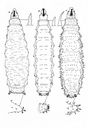
Complete . Larvae pupate on hemlock twigs (not in soil), then emerge as winged that disperse upward through the foliage. This contrasts with co-occurring such as Laricobius beetles, which drop to the soil to pupate. Larval development spans multiple adelgid , providing more continuous pressure than predators.
Behavior
exhibit upward through tree foliage after . Larvae are active on adelgid-infested twigs. The combination of twig- and upward adult has been exploited in the design of specialized collection containers (Lari-Leuco containers) that simultaneously capture descending larvae and ascending Leucopis adults.
Ecological Role
Specialized natural enemies of adelgids; significant mortality agents in native ranges. In the Pacific Northwest, Leucopis spp. occur at 2.3–3.5 times the abundance of co-occurring predatory beetles and provide more temporally extended control due to their multi-generational larval presence. Being evaluated and deployed as agents to mitigate hemlock woolly adelgid damage in eastern North American forests.
Human Relevance
Primary biocontrol agents for management of hemlock woolly adelgid, which threatens eastern hemlock across 17 U.S. states. Experimental releases of L. argenticollis and L. piniperda began in Tennessee and New York in 2015 under USDA permits. The Lari-Leuco container, named in part for this , was developed specifically to monitor Leucopis in biocontrol programs.
Similar Taxa
- LaricobiusCo-occurring adelgid ; beetles (Coleoptera: Derodontidae) that drop to soil to pupate and are active only during the progrediens , whereas Leucopis are flies that pupate on twigs and span both adelgid generations
More Details
Biocontrol releases
Leucopis argenticollis and L. piniperda were released in Tennessee (May 2015) and New York (June 2015) in bag enclosures on infested eastern hemlocks. Early results indicated successful in Tennessee enclosures.
Monitoring technology
The Lari-Leuco container uses an inverted funnel design to capture 94% of Leucopis in the top collection chamber, versus 60% without the funnel, enabling efficient field monitoring of biocontrol .
Sources and further reading
- BugGuide
- Wikipedia
- GBIF taxonomy match
- iNaturalist taxon
- NCBI Taxonomy
- Catalogue of Life
- Leucopis sp. silver fly - Entomology Today
- Leucopis argenticollis Archives - Entomology Today
- Leucopis Archives - Entomology Today
- New Container Aids in Biocontrol of Hemlock Woolly Adelgid
- West Coast Flies to the Rescue of East Coast Hemlock Forests
- Lari-Leuco container - Entomology Today
- Seasonal phenology and abundance ofLeucopis argenticollis, Leucopis piniperda(Diptera: Chamaemyiidae),Laricobius nigrinus(Coleoptera: Deridontidae) andAdelges tsugae(Hemiptera: Adelgidae) in the Pacific Northwest USA
- <i>Leucopis formosana</i> Hennig (Diptera, Chamaemyiidae) - synonymy, distribution, food links
- Distribution of the Balsam Woolly Aphid Predator, Leucopis obscura,1 in Maine