
Adelges abietis
(Linnaeus, 1758)
Pineapple-gall Adelgid, Eastern Spruce Gall Adelgid, Spruce Gall Aphid
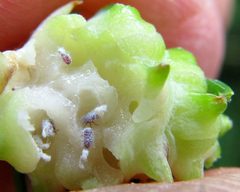
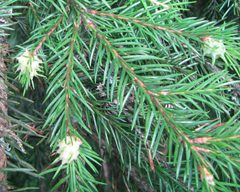
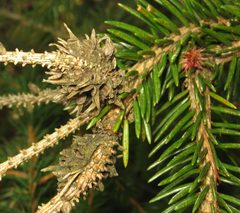
Adelges abietis, commonly known as the pineapple-gall adelgid or eastern spruce gall adelgid, is a conifer-feeding insect that induces distinctive pineapple-shaped pseudocone galls on spruce shoots. The is one of the most common adelgids in its and has been documented across Europe and North America. Unlike the closely related hemlock woolly adelgid (Adelges tsugae), A. abietis is not considered a major destructive pest, though its gall formation causes shoot deformation. The species exhibits strongly aggregated spatial distributions within and among trees.
Pronunciation
How to pronounce Adelges abietis: /əˈdɛlɡiːz ˌæbiˈeɪtɪs/
These audio files are automatically generated. While they are not always 100% accurate, they are a good starting point.
Identification
Adelges abietis is distinguished from other adelgids by the pineapple-shaped (pseudocone) galls it induces on spruce shoots, in contrast to the woolly, waxy coverings produced by A. tsugae on hemlock. The galls are formed on lateral shoots rather than terminal shoots. The adelgids are pear-shaped, soft-bodied green insects with long . Galls in the upper crown tend to be larger than those in the lower crown. The is differentiated from A. laricis and other conifer adelgids by association (Picea spp. vs. Larix or Tsuga) and gall .
Images
Habitat
Coniferous forests and plantations with spruce ; specifically young white spruce (Picea glauca) trees 1–4 m tall in open-grown conditions, or upper crown positions in closed conditions. Gall is highest on mid-crown branches of open-grown trees and shifts to upper crown above branch overlap points after crown closure. Site influences gall expression, with higher associated with greater tree vigor on fertile soils.
Distribution
Native to Europe; introduced to North America. Documented in Belgium (widespread across regions), New Brunswick (Canada), Pennsylvania (USA), and Norway. Intra-crown distribution shows strong spatial : galls cluster on lateral shoots and exhibit contagious distribution patterns following negative binomial rather than Poisson distribution.
Seasonality
Fundatrices (foundresses) initiate gall formation in spring. Second- adelgids emerge from galls in late summer to early fall.
Host Associations
- Picea abies - primary Norway spruce; forms pineapple-shaped galls on shoots
- Picea glauca - primary White spruce; studied in New Brunswick
- Picea sitchensis - primary Sitka spruce; documented per iNaturalist/Wikipedia sources
Life Cycle
The involves fundatrices (foundresses) that initiate gall formation in spring. are laid on needles, with up to approximately one hundred eggs per female. Second- adelgids emerge from galls in late summer to early fall. Gall chambers within the pineapple-shaped structures house developing insects; the number of chambers is closely related to gall size.
Behavior
Exhibits strongly contagious (aggregated) distribution patterns within trees, with galls clustering on lateral shoots rather than terminal shoots. Distribution shifts based on conditions: mid-crown concentration in open-grown trees, upper crown concentration after canopy closure. Inter-tree distribution shows high among trees.
Ecological Role
Induces gall formation on spruce shoots, causing deformation but not typically tree mortality. The fungus Hormonema dematioides occurs in 61% of galls and acts as a significant mortality agent, reducing fundatrix survival from 40% in uninfected galls to 7% in infected galls; this fungus may function as a natural agent limiting adelgid .
Human Relevance
Minor forestry pest; causes shoot deformation on Norway spruce and other spruce in plantations and natural stands. Genetic variation in susceptibility allows for selective breeding and provenance choice to reduce galling. Not considered as destructive as the hemlock woolly adelgid.
Similar Taxa
- Adelges tsugaeBoth are conifer-feeding adelgids in the same , but A. tsugae produces woolly wax coverings on hemlock rather than pineapple-shaped galls on spruce, and is a far more destructive pest in eastern North America
- Adelges laricisRelated conifer adelgid with different preferences (Larix spp.) and gall
Sources and further reading
- BugGuide
- GBIF taxonomy match
- iNaturalist taxon
- NCBI Taxonomy
- Flocked hemlocks - hemlock woolly adelgid, Adelges tsugae — Bug of the Week
- The scourge of the hemlock - hemlock wolly adelgid, Adelges tsugae — Bug of the Week
- Upside and downside of a warming world for the despoiler of hemlocks: Hemlock woolly adelgid, Adelges tsugae — Bug of the Week
- ‘Tis the season to inspect your hemlocks for hemlock wooly adelgid, Adelges tsugae — Bug of the Week
- Biological Control for Hemlock Woolly Adelgid: Where Do We Stand?
- Little, Fuzzy, But Not So Cute: The Hemlock Woolly Adelgid
- INTRA- AND INTER-CROWN DISTRIBUTION OF THE EASTERN SPRUCE GALL ADELGID, ADELGES ABIETIS (L.), ON YOUNG WHITE SPRUCE
- Variation among Norway spruce provenances, families and clones in susceptibility to the spruce gall adelgid ( Adelges abietis )
- Fungus Found in Galls of Adelges abietis (L.) (Homoptera: Adelgidae): Identification, Within-Tree Distribution, and Possible Impact on Insect Survival 1
- Factors associated with the distribution and size of Adelges abietis (Homoptera: Adelgidae) galls on a sev- eral years old spruce (Picea abies) plantation