
Adelges laricis
Vallot, 1836
Larch Woolly Aphid
Adelges laricis is a holocyclic adelgid with a complex involving two : Picea (spruce) as primary host where galls form, and Larix (larch) as secondary host. The exhibits extensive morphological across five (Fundatrix, Migrans alata, Hiemosistens, Sexupara, Sexualis). First-instar nymphs are the only mobile stage; subsequent instars remain with stylets permanently inserted. The species is a significant forest pest causing reduced tree vigor, needle damage, and mortality under chronic .
Pronunciation
How to pronounce Adelges laricis: //əˈdɛldʒiːz ləˈraɪsɪs//
These audio files are automatically generated. While they are not always 100% accurate, they are a good starting point.
Identification
Distinguished from other Adelges by its specific association with Larix decidua as secondary host and Picea spp. as primary host. On larch, colonies appear as woolly masses at needle bases without gall formation. Distinguished from A. tsugae by host preference (larch vs. hemlock) and from A. abietis by secondary host specificity. Winged Migrantes alatae are produced only on spruce; their presence indicates gallicolae . Hiemosistens females on larch produce three offspring types (Sistentes, Progredientes alatae, Progredientes apterae), a pattern unique among adelgids studied.
Images
Habitat
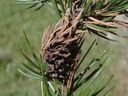
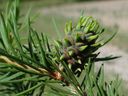
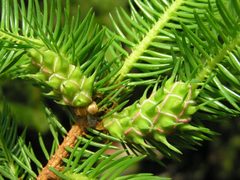
Coniferous forests; specifically associated with European larch (Larix decidua) as secondary and spruce (Picea spp.) as primary host. On larch, occurs on bark near needle bases; on spruce, develops within galls.
Distribution
Northern Hemisphere; recorded from Belgium (Flemish and Walloon regions), Serbia, and Poland. Native range spans Europe where its co-occur.
Seasonality
Active primarily during cooler months; Hiemosistens resumes development in late October to November, matures mid-winter, and lays in late winter. Second generation (Progrediens) hatches March to June. Summer dormancy () occurs as nymphs.
Diet
Phloem sap (passive and active ingestion), xylem sap, and potentially non-vascular tissues. Feeds via on Larix decidua needles and Picea tissues. EPG studies confirm ingestion from phloem, xylem, and non-vascular tissues with distinct waveform patterns for each.
Host Associations
- Larix decidua - secondary European larch; site of non-gall-forming (exules), woolly colonies at needle bases
- Picea spp. - primary Spruce; site of gall formation by Fundatrix , produces Migrantes alatae
Life Cycle
Holocyclic with five in strict sequence: Fundatrix (gallicola on spruce, produces Migrantes alatae exclusively), Migrans alata (migrates to larch, produces Neosistentes and rare Progrediens-type offspring), Hiemosistens ( on larch, produces Sistentes, Progredientes alatae/Sexuparae, and Progredientes apterae), Sexupara (returns to spruce, produces Sexuales), and Sexualis ( produce next Fundatrix). Parthenogenetic on secondary ; occurs only on primary host. Entirely ; eggs laid at feeding site. Only first-instar nymphs () are mobile; subsequent instars remain with stylets permanently inserted.
Behavior
lifestyle after stage with stylets permanently inserted in plant tissue. Secretes protective white woolly wax covering body and . Produces copious honeydew that accumulates as wax-covered spheres on . Probing involves extracellular and intracellular stylet penetration ; gelling saliva forms salivary . Novel AE3 waveform indicates active phloem ingestion mechanism, previously unreported in Hemiptera.
Ecological Role
Serious forest pest causing abnormal wood production, limited branch development, needle and twisting, reduced seed yields, decreased tree vigor, foliage loss, growth reduction, and mortality under severe chronic . influenced by variable offspring type ratios produced by Hiemosistens and Progrediens .
Human Relevance
Significant economic impact on larch and spruce forestry; reduces timber quality and tree health. Management includes maintaining tree vigor through proper planting and irrigation, pruning of infested branches, and application. research ongoing.
Similar Taxa
- Adelges tsugaeHemlock woolly adelgid; distinguished by primary (Tsuga vs. Larix/Picea), two per year in eastern North America, and lack of host alternation in range
- Adelges abietisCooley spruce gall adelgid; distinguished by secondary (Abies vs. Larix) and different gall on spruce
- Pineus spp.Pine woolly aphids; distinguished by preference (Pinus vs. Larix/Picea) and typically smaller size with different wax
More Details
Morph determination variability
Offspring type ratios vary dramatically: single Hiemosistens females may produce predominantly Sistentes or almost exclusively Progredientes; first Progrediens may produce 100% Neosistentes or exclusively Progredientes. Second Progrediens generation produces predominantly Sistentes with variable proportions of Progredientes apterae and Intermediates (up to 84%). Sexuparae rate increases approximately 7-fold in second year after from spruce to larch.
EPG waveform characterization
First detailed electropenetrography study identified seven waveform patterns: AC1-AC3 ( phase), AE1-AE3 (phloem phase), and AG (xylem phase). AE3 waveform represents active phloem ingestion, a novel finding for Hemiptera. Waveforms occur at distinct voltage levels indicating extracellular (positive) and intracellular (negative) penetration.
Sources and further reading
- BugGuide
- GBIF taxonomy match
- iNaturalist taxon
- NCBI Taxonomy
- Catalogue of Life
- Flocked hemlocks - hemlock woolly adelgid, Adelges tsugae — Bug of the Week
- The scourge of the hemlock - hemlock wolly adelgid, Adelges tsugae — Bug of the Week
- Upside and downside of a warming world for the despoiler of hemlocks: Hemlock woolly adelgid, Adelges tsugae — Bug of the Week
- ‘Tis the season to inspect your hemlocks for hemlock wooly adelgid, Adelges tsugae — Bug of the Week
- Biological Control for Hemlock Woolly Adelgid: Where Do We Stand?
- Little, Fuzzy, But Not So Cute: The Hemlock Woolly Adelgid
- Probing behavior of Adelges laricis Vallot (Hemiptera: Adelgidae) on Larix decidua Mill: Description and analysis of EPG waveforms
- Numerical research upon the types and rates of offspring produced by the parthenogenetic generations of Adelges laricis Vall. (Hom., Adelgidae)1