
Hippodamia convergens
Guérin-Méneville, 1842
Convergent Lady Beetle, Convergent Ladybug
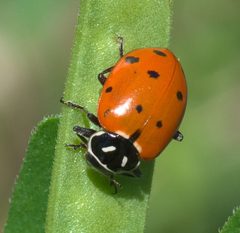
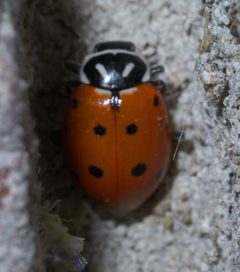
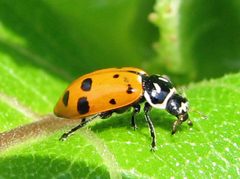
The convergent lady beetle is among the most common lady beetles in North America, recognized by the distinctive white converging lines on its pronotum. It is a voracious of aphids and other soft-bodied insects, with both larvae and actively hunting prey. The exhibits complex traits including facultative reproductive triggered by food scarcity, mass for in western mountain valleys, and long-distance migratory . It is one of the few natural enemies commercially collected from wild aggregations for distribution, though released beetles often disperse rapidly from release sites.
Pronunciation
How to pronounce Hippodamia convergens: /hɪpoʊˈdeɪmiə kənˈvɜrdʒəns/
These audio files are automatically generated. While they are not always 100% accurate, they are a good starting point.
Identification
Distinguished from other lady beetles by the converging white lines on the pronotum that narrow toward the base but do not meet. The 12 black spots on separate it from most other common North American , though spot reduction occurs. Hippodamia parenthesis has parenthesis-shaped rather than converging pronotal markings. Hippodamia tredecimpunctata has 13 spots. The Asian lady beetle (Harmonia axyridis) has a black 'M'-shaped marking on the pronotum. The seven-spotted lady beetle (Coccinella septempunctata) has seven spots and lacks converging pronotal lines.
Images
Habitat
Occupies diverse including grasslands, forests, agricultural fields, gardens, and national parks. In agricultural systems, frequently found in wheat fields and sunflower patches, where use sunflower petioles for hydration during arid summer months. Shows higher survival and reproductive success in warmer temperatures, with optimal conditions around 25°C and 63% relative humidity. Temperature ranges from approximately 6.5°C lower limit to 50°C upper limit.
Distribution
Native to North America with distribution throughout the continent. Introduced to South America (Brazil: Minas Gerais, Mato Grosso, Paraná, São Paulo) from California. Present in Caribbean, Middle America, and Oceania regions. In western North America, forms mass in mountain valleys.
Seasonality
Active primarily spring through fall; peak activity during . Females lay during spring and early summer. In western United States, may enter for up to nine months, forming large in mountain valleys during late summer through winter. from sites typically occurs in early spring, with some variation based on temperature and day length cues.
Diet
Both larvae and are active of soft-bodied insects, with aphids as the primary food resource. Fourth-instar larvae consume approximately 50 aphids daily; adults consume approximately 20 aphids daily. Prey includes aphids (multiple ), , , and other soft-bodied insects. When prey is scarce, adults feed on honeydew, nectar, pollen, and soft plant parts including petals. First-hatched larvae in a clutch may consume unhatched for initial energy. occurs when food is especially scarce.
Host Associations
- Acyrthosiphon pisum - preyPea aphid; major prey ; facultative in this reduce lady beetle survival
- Brevicoryne brassicae - preyCabbage aphid; glucosinolates absorbed by negatively affect lady beetle development and
- Myzus persicae - preyGreen peach aphid; supports faster development than B. brassicae
- Myzaphis rosarum - preyRose aphid; supports faster development than B. brassicae
- Hamiltonella defensa - indirect antagonistFacultative endosymbiont of aphids; reduces lady beetle larval survival 2.6×
- Serratia symbiotica - indirect antagonistFacultative endosymbiont of aphids; reduces lady beetle larval survival 2.56×
- Dinocampus coccinellae - Braconid
- Homalotylus terminalis - Encyrtid
- Tetrapolipus hippodamiae - Mite
- Metarhizium anisopliae - fungus
- Beauveria bassiana - fungus; affects temperature
- Paecilomyces fumosoroseus - fungus
Life Cycle
Complete with four stages: , larva, pupa, . Females lay 200–1000 eggs over several months, in upright spindle-shaped batches of 15–30 eggs near prey. Eggs hatch in approximately 3–5 days. Larvae are dark, somewhat alligator-shaped, and four times over up to one month, growing rapidly. Larvae move between plants by across leaves or through soil when necessary. Pupal stage lasts approximately one week. Adults eclose and mate soon after . If food is abundant, females begin laying within one week; if scarce, may delay up to nine months. Total egg-to-adult development ranges 22–34 days depending on prey and temperature.
Behavior
Active, mobile hunter that travels to locate prey rather than waiting in ambush. Larvae begin searching for prey immediately upon hatching without parental assistance. exhibit pre-reproductive feeding on fats and proteins for approximately one week after , which increases production and promotes ovarian maturation; this also triggers migratory . Forms mass for in western mountain valleys, with adults in diapause known to engage in . Discontinuous food access delays oviposition and reduces ; flight distance and fecundity are negatively correlated, indicating energetic trade-offs. Released beetles in programs show strong tendency even when prey remains available.
Ecological Role
Important natural enemy of pests and other soft-bodied insects in agricultural and natural . Serves as a model organism for studying movement and in fragmented agricultural landscapes. Facultative in aphid prey create indirect defense that reduces predator , potentially lowering pressure on aphid through . Contributes to services though effectiveness varies with landscape context and prey availability patterns.
Human Relevance
Widely used for of aphids in greenhouses and field crops, though effectiveness is limited by rapid of released . One of few natural enemies still wild-collected from mass in western states for commercial distribution. Not included in University of Florida 2021 guidelines for predatory insects in control due to dispersal issues. Occasionally bites humans, apparently to obtain salt rather than defensively. Larvae sometimes mistaken for pests and killed by gardeners. Subject of ecological research on -prey dynamics, tri-trophic interactions involving endosymbionts, and movement in agricultural landscapes.
Similar Taxa
- Hippodamia parenthesisHas parenthesis-shaped white markings on pronotum rather than converging lines
- Hippodamia tredecimpunctataHas 13 elytral spots and different pronotal pattern
- Harmonia axyridisAsian lady beetle has black 'M'-shaped pronotal marking and highly variable spot number including spotless forms
- Coccinella septempunctataSeven-spotted lady beetle has seven elytral spots and lacks converging pronotal lines
- Cycloneda sanguineaSpotless lady beetle lacks elytral spots entirely
Misconceptions
Larvae are frequently mistaken for pests due to their alligator-like appearance and killed by gardeners, though they are ferocious of aphids. The 2019 radar-detected 'bloom' in California attributed to convergent lady beetles was disputed by entomologists due to late season timing and cold air temperatures potentially below muscle function thresholds; positive identification was not confirmed.
More Details
Temperature tolerance
Lower lethal limit approximately 6.5°C; upper limit approximately 50°C; optimal reproductive and survival performance at 25.12°C with 63.78% relative humidity
Commercial collection
Wild collected from mass in mountain valleys of western United States for sale to pest control industry; this practice is rare among natural enemies
Reproductive plasticity
Females adjust size and trajectories based on body size; large females front-load reproductive effort to match , an adaptive strategy constrained by larval food availability
Sources and further reading
- BugGuide
- Wikipedia
- GBIF taxonomy match
- iNaturalist taxon
- NCBI Taxonomy
- Birds, Bats or a Bloom? But No Splat! | Bug Squad
- Looking for Lygus | Bug Squad
- All Hail the Lady Beetles! | Bug Squad
- The Good Guys--and Girls! | Bug Squad
- Bacteria Can Aid Aphids Against Predation and Parasitism
- Researchers Share New Method for Detecting Insect Egg Predators
- Convergent Lady Beetle Hippodamia convergens Guérin-Méneville (Insecta: Coleoptera: Coccinellidae)
- Aphid facultative symbionts reduce survival of the predatory lady beetle Hippodamia convergens
- Searching Behavior ofHippodamia Convergens Larvae(Coccinellidae: Coleoptera)
- Biology and performance of the predator Hippodamia convergens, reared on cabbage aphids Brevicoryne brassicae, Myzaphis rosarum and Myzus persicae
- Reproductive diapause in Hippodamia convergens (Coleoptera: Coccinellidae) and its life history consequences
- Life History Traits in Hippodamia convergens (Coleoptera: Coccinellidae) after Selection for Fast Development
- Resource amount and discontinuity influence flight and reproduction in Hippodamia convergens (Coleoptera: Coccinellidae)
- Larval Food Supply Constrains Female Reproductive Schedules inHippodamia convergens(Coleoptera: Coccinellidae)