
Myzaphis rosarum
(Kaltenbach, 1843)
Lesser Rose Aphid
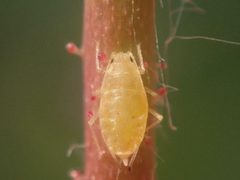
Myzaphis rosarum is a small in the Aphididae, commonly known as the Lesser Rose Aphid. It colonizes Rosa species and various trees, occurring on both wild and cultivated plants. The species serves as prey for aphidophagous including Hippodamia convergens, and has been documented as a suitable supporting predator development in laboratory studies. It is distinguished from by specific morphological characters.

Pronunciation
How to pronounce Myzaphis rosarum: /mɪˈzeɪfɪs ˈroʊzɑːrəm/
These audio files are automatically generated. While they are not always 100% accurate, they are a good starting point.
Identification
Distinguished from the related Myzaphis bucktoni by morphological characters detailed in taxonomic comparisons; specific diagnostic traits require examination of specimens under magnification. Smaller size relative to other rose-feeding aphids may contribute to the 'Lesser Rose '.
Images
Habitat
Rosa (roses) and trees, occurring on both wild and cultivated plants.
Distribution
Documented from the Mantaro Valley, Peru; records from Denmark; Brazil (Ceará, Rio de Janeiro, Rio Grande do Sul, São Paulo); Azores (Flores, São Miguel, Terceira). Widespread in temperate regions.
Diet
Phloem sap of Rosa and trees.
Host Associations
- Rosa spp. - primary Wild and cultivated roses
- trees - Wild and cultivated trees, specific not identified
Ecological Role
Prey for aphidophagous ; serves as suitable food source supporting development of Hippodamia convergens with shorter -to- development time (22.8 days) compared to some alternative prey.
Human Relevance
Pest of cultivated roses and trees; subject to chemical control in agricultural settings, which has prompted interest in alternatives.
Similar Taxa
- Myzaphis bucktoniClosely related also associated with wild roses; distinguished by morphological characters detailed in comparative taxonomic studies.
- Brevicoryne brassicaeUsed as comparative prey in studies; M. rosarum supports faster predator development, indicating different nutritional suitability.
More Details
Predator suitability
In laboratory studies with Hippodamia convergens, M. rosarum supported shorter -to- development (22.8 days) than Brevicoryne brassicae (34.1 days), indicating absence of defensive secondary compounds that negatively affect performance.
Sources and further reading
- BugGuide
- GBIF taxonomy match
- iNaturalist taxon
- NCBI Taxonomy
- Catalogue of Life
- Biology and performance of the predator Hippodamia convergens, reared on cabbage aphids Brevicoryne brassicae, Myzaphis rosarum and Myzus persicae
- A NEW BRITISH SPECIES OF MYZAPHIS VAN DER GOOT ASSOCIATED WITH WILD ROSES, MYZAPHIS BUCKTONI SP. N.; AND A COMPARISON WITH M. ROSARUM (KALTENBACH) (HEMIPTERA, APHIDIDAE)