
Hippodamia tredecimpunctata
(Linnaeus, 1758)
thirteen-spot ladybeetle, thirteen-spotted lady beetle
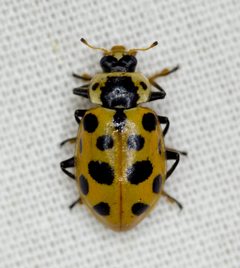
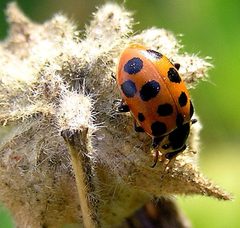
Hippodamia tredecimpunctata is a medium-sized lady beetle distinguished by thirteen dark spots on red to orange . It occupies a narrow in wetland across the northern hemisphere, where it preys on aphids associated with grasses and sedges. The has experienced declines in parts of North America following the introduction of the non-native seven-spot lady beetle.
Pronunciation
How to pronounce Hippodamia tredecimpunctata: //ˌhɪp.oʊˈdeɪ.mi.ə trɪˌdɛ.sɪmˈpʌŋk.teɪ.tə//
These audio files are automatically generated. While they are not always 100% accurate, they are a good starting point.
Identification
Distinguished from other Hippodamia by the combination of thirteen spots and association with wetlands. The convergent lady beetle (H. convergens) has converging white lines on the pronotum rather than thirteen distinct spots. The seven-spot lady beetle (Coccinella septempunctata) has seven spots and broader habitat .
Images
Habitat
Stenotypic restricted to wet meadows, lakesides, flood plains, river deltas, marshes, marshy alder thickets, carr, and bodden. Associated with vegetation including Carex, Sparganium, Phragmites, and Salix.
Distribution
Northern hemisphere: Europe, North Africa, European Russia, Caucasus, Siberia, Russian Far East, Belarus, Ukraine, Moldova, Transcaucasia, Kazakhstan, Middle Asia, Western Asia, Afghanistan, Mongolia, China, Korean Peninsula, Japan, and North America (Canada and northern United States).
Diet
Feeds on Aphis farinosa on grasses and sedges, and on aphids associated with Gramineae and Umbelliferae. Also consumes Sipha glyceriae and Erysiphales on reeds before . Has been observed on cane, rotten hay, detritus, and under peeled-off bark.
Host Associations
- Aphis farinosa - preyon grasses and sedges
- Sipha glyceriae - prey
- Carex - associated vegetation
- Sparganium - associated vegetation
- Phragmites - associated vegetation
- Salix - associated vegetation
Life Cycle
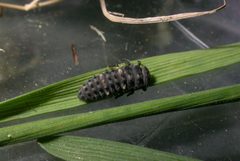
laid in clusters of 10–50 on undersides of leaves. Larvae develop through instars before . Complete .
Ecological Role
of aphids in wetland . declines have been documented in midwestern US, Maine, Quebec, and New Brunswick following establishment of Coccinella septempunctata; however, coexistence with non-native lady beetles occurs in Manitoba and Ontario.
Human Relevance
Used as a agent for management. changes following non-native introduction have implications for biological control programs.
Similar Taxa
- Hippodamia convergensBoth in Hippodamia, but H. convergens has converging white lines on pronotum rather than thirteen spots and occupies broader range.
- Coccinella septempunctataBoth lady beetles with spotted , but C. septempunctata has seven spots, broader , and has displaced H. tredecimpunctata in some regions.
More Details
Population dynamics
Relative abundance has decreased in midwestern US, Maine, Quebec, and New Brunswick following introduction of Coccinella septempunctata. Coexists with non-native lady beetles in Manitoba and Ontario.
Sources and further reading
- BugGuide
- Wikipedia
- GBIF taxonomy match
- iNaturalist taxon
- NCBI Taxonomy
- Birds, Bats or a Bloom? But No Splat! | Bug Squad
- Looking for Lygus | Bug Squad
- All Hail the Lady Beetles! | Bug Squad
- Researchers Share New Method for Detecting Insect Egg Predators
- Bacteria Can Aid Aphids Against Predation and Parasitism
- From Burglars to Bugs: Anti-Theft Dye Useful in Insect-Tracking Studies