
Dinocampus coccinellae
(Schrank, 1802)
Ladybird Parasitoid Wasp
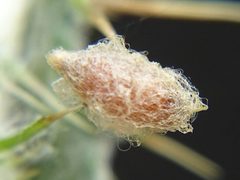
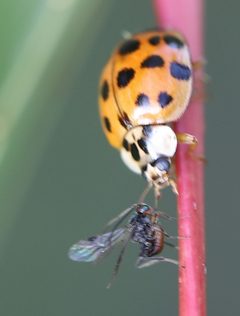
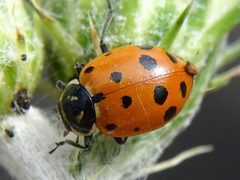
Dinocampus coccinellae is a solitary braconid that parasitizes lady beetles (Coccinellidae). The female wasp deposits a single into the 's , where the larva develops through four instars over 18–27 days before emerging. Upon , the larva paralyzes the host and spins a cocoon attached to the ladybird's legs. The paralyzed host remains alive, twitching occasionally, and serves as a protective bodyguard that deters with its bright coloration and defensive movements. Approximately 25% of hosts recover after the wasp completes development. The wasp is notable for co-injecting Dinocampus coccinellae paralysis virus (DcPV) with its egg, which facilitates host manipulation.
Pronunciation
How to pronounce Dinocampus coccinellae: //ˈdaɪnəˌkæmpəs ˌkɒksɪˈnɛlaɪ//
These audio files are automatically generated. While they are not always 100% accurate, they are a good starting point.
Identification
females are predominantly black with green , and the , front legs, and apex of the are mussel-brown. Males, when present, lack an ovipositor and are slimmer and darker than females. Nearly all individuals are female, produced from unfertilized . The is most readily identified by its distinctive cocoon: a silken structure spun between the legs of a living, paralyzed lady beetle .
Images
Habitat
Occurs in diverse environments where lady beetle are present, including agricultural fields, orchards, gardens, and natural vegetation. Documented from pistachio orchards, meadows, and urban green spaces.
Distribution
distribution. Native range in Asia; established in North America, South America, Europe, and other regions through multiple introductions. Documented in Belgium, Brazil (Distrito Federal, Minas Gerais, Paraná, São Paulo), Algeria, Chile, Italy, Japan, the United Kingdom, the United States, and Ecuador.
Host Associations
- Coleomegilla maculata - primary spotted lady beetle
- Coccinella septempunctata - seven-spot ladybird; native to Europe and Asia, introduced to North America
- Harmonia axyridis - harlequin ladybird; with lower rates in native Asian range compared to invaded areas
- Hippodamia variegata - variegated lady beetle
- Adalia bipunctata - two-spot ladybird
- Hippodamia parenthesis - smallest recorded , producing smallest
- Coccinella septempunctata algerica - first record from Algeria, 2019
- Eriopis chilensis - native Chilean
- Coccinellidae - of over 50 lady beetle
Life Cycle
The develops as a solitary endoparasitoid. The female deposits one into the 's soft underbelly using a spear-like ovipositor. The egg hatches in 5–7 days into a first-instar larva with large , which eliminates competing eggs or larvae before feeding on host and . Four larval instars develop over 18–27 days. The mature larva paralyzes the host, tunnels out, and pupates in a cocoon attached to the host's legs. occurs after 6–9 days. The entire development is completed on a single host individual.
Behavior
Females preferentially target female lady beetles, though males and larvae are occasionally parasitized. acceptance involves assessment of host quality prior to oviposition. The exhibits host discrimination, avoiding previously parasitized hosts. The larva engages in aggressive competition by destroying other or larvae in the host. Host manipulation is mediated by DcPV, which causes partial paralysis and periodic twitching that enhances deterrence. Some hosts recover mobility after wasp .
Ecological Role
Acts as a natural enemy regulating lady beetle . Serves as prey for hyperparasitoids, particularly Gelis agilis, which oviposits into cocoons and consumes the developing wasp. Potential agent for Harmonia axyridis populations, though field rates are typically low (4–7%). Morphological variation in wasp size correlates with size, suggesting phenotypic plasticity or local .
Human Relevance
Represents a potential concern for programs that rely on lady beetles for management, as parasitized may be sterilized even if they recover. A single large aphidophagous ladybird can consume up to 5,500 aphids annually, making -induced reductions economically significant. Research interest in host-parasite interactions and viral-mediated host manipulation. Subject of citizen science monitoring through the U.K. Ladybird Survey.
Similar Taxa
- Gelis agilisHyperparasitoid that attacks D. coccinellae cocoons; distinguished by wingless females, -mimicking appearance, and of ovipositing into existing cocoons rather than lady beetle .
- Meteorus obfuscatusGenetically closely related braconid ( 0.10) based on COI ; distinguished by associations and morphological differences.
- Tachinid fliesOther of lady beetles that typically kill their rather than leaving them alive; distinguished by dipteran and lethal .
Sources and further reading
- BugGuide
- Wikipedia
- GBIF taxonomy match
- iNaturalist taxon
- NCBI Taxonomy
- Catalogue of Life
- Bug Squad
- What's Bugging the Ladybug? | Bug Squad
- Dinocampus coccinellae Archives - Entomology Today
- Dinocampus coccinellae larva emerging from Coccinella septempunctata - Entomology Today
- Bug Eric: "Zombie Ladybugs"
- Tabloid Sensationalism Aside, Lady Bugs Are Still Fascinating
- Host-Acceptance Behavior of Dinocampus coccinellae (Hymenoptera: Braconidae)
- The geographic scope of host use by the ladybeetle parasitoid Dinocampus coccinellae
- Coccinellid host morphology dictates morphological diversity of the parasitoid wasp Dinocampus coccinellae
- Host discrimination in Dinocampus coccinellae (Hymenoptera: Braconidae), a solitary parasitoid of coccinellid beetles.
- Dinocampus coccinellae as a parasitoid of the invasive ladybird Harmonia axyridis in Europe
- Interactions between the Multicolored Asian Lady Beetle Harmonia axyridis and the Parasitoid Dinocampus coccinellae
- Coccinellid host morphology dictates morphological diversity of the parasitoid wasp Dinocampus coccinellae
- Distribution, host range and host preferences of Dinocampus coccinellae (Hymenoptera: Braconidae): A worldwide database
- Primer reporte para el Ecuador de la avispa endoparasitoide Dinocampus coccinellae (Schrank) (Hymenoptera: Braconidae)
- Adaptive preferential selection of female coccinellid hosts by the parasitoid wasp Dinocampus coccinellae (Hymenoptera: Braconidae)
- Identification of the Parasitoid Wasp Dinocampus coccinellae (Schrank) (Hymenoptera: Braconidae) in Pistachio Orchards Using DNA Barcoding
- First record of Coccinella septempunctata algerica (Coleoptera, Coccinellidae) as host of Dinocampus coccinellae (Hymenoptera, Braconidae, Euphorinae) in Algeria
- Interactions between the parasitoid wasp Dinocampus coccinellae and two species of coccinellid from Japan and Britain
- Interactions between the parasitoid wasp Dinocampus coccinellae and two species of coccinellid from Japan and Britain
- Diet of adult ladybird beetle host modifies the postdiapause development of the parasitoid Dinocampus coccinellae (Hymenoptera: Braconidae)
- The genome sequence of a braconid wasp, Dinocampus coccinellae (Schrank, 1802).