
Hippodamia variegata
(Goeze, 1777)
Adonis ladybird, variegated ladybug, spotted amber ladybeetle
Hippodamia variegata is a small predatory ladybeetle native to the Palearctic region that has established across multiple continents through intentional introduction for . measure 3–5.5 mm with highly variable elytral patterning, ranging from unspotted to bearing up to thirteen black spots on a red or orange background. The is a significant in agricultural systems, particularly cotton fields in northwestern China where it dominates natural enemy . Research has documented intraguild on mummies, under prey scarcity, and olfactory-mediated foraging responsive to specific plant volatiles.
Pronunciation
How to pronounce Hippodamia variegata: /ˌhɪpoʊˈdeɪmiə ˌvɛəriˈeɪɡətə/
These audio files are automatically generated. While they are not always 100% accurate, they are a good starting point.
Identification
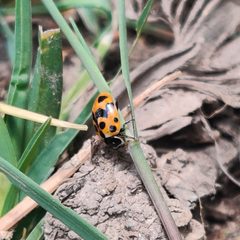
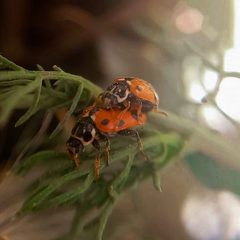
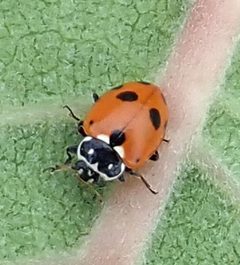
are distinguished from similar Hippodamia by a combination of small size (3–5.5 mm), elongated and slightly convex body form, and highly variable elytral maculation. The pronotum is black with a white-yellowish border and central black mask-shaped marking. A single black spot surrounded by white is present on the scutellum. Males possess a greatly expanded first segment of the legs. The is black with white spots and dark . Legs are blackish-brown with brown ends; underside is black. Elytral spot patterns range from zero to thirteen black spots, creating potential confusion with other spotted ladybeetles; however, the combination of small size, body shape, and pronotal pattern aids identification.
Images
Habitat
Fields, meadows, gardens, and shrubs; prefers dry, rough vegetation over bushes and trees. In agricultural contexts, in cotton fields in northwestern China and established in various agroecosystems globally.
Distribution
Native to the Palearctic region; introduced and established in the Nearctic (Canada, United States), Oriental region (India, China), Australia, South Africa, Kenya, and Chile. Within China, abundant in Xinjiang cotton fields and Hebei Province.
Diet
Aphis gossypii (cotton aphid, primary prey in Chinese cotton systems), Aphis fabae (black bean aphid), Myzus persicae, Acyrthosiphon pisum, Acyrthosiphon gossypii, Aphis craccivora, Poratrioza sinica, and and young larvae of some lepidopteran pests. Consumes mummies (primarily Binodoxys communis, Trioxys asiaticus, Lysiphlebus fabarum, Praon barbatum) and occasionally parasitoids directly.
Life Cycle
Complete with , four larval instars, pupa, and stages. Under laboratory conditions (25°C, 60% RH, 16:8 L:D): mean 3.35 days; total larval period 16.5 days; pre-pupal period 1.40 days; pupal period 3.10 days. Pre-oviposition period averages 6.20 days; oviposition period 43 days. Mean 944 eggs per female with 83% hatching success. Adult longevity: males 50 days, females 55.5 days. Field in Xinjiang cotton fields active June–August, with mummies appearing late June, peaking early July with secondary peak late July.
Behavior
Uses olfaction to locate prey, with demonstrated attraction to plant volatiles including ethyl benzoate, octyl formate, methyl jasmonate, and methyl dihydrojasmonate; electroantennography confirms dose-dependent antennal sensitivity. Exhibits intraguild , consuming mummies and occasionally parasitoids; prey selection depends on relative rather than prey type, with mummy consumption decreasing as density increases. occurs at all life stages: adults consume and younger larvae even when alternative prey is abundant; larval cannibalism increases with instar age, with fourth instars showing maximum cannibalism. Feeding activity increases in presence of attractive plant volatiles.
Ecological Role
in agricultural , particularly in Chinese cotton production systems. Functions as a agent with complex trophic interactions: suppresses pest aphids while simultaneously consuming mummies, potentially interfering with parasitoid-mediated biological control. Part of involving aphids, primary parasitoids, hyperparasitoids, and other . and intraguild influence and structure.
Human Relevance
Intentionally introduced to multiple countries (Australia, South Africa, Kenya, India, China, Canada, United States, Chile) for of crop pests, particularly aphids. Subject of research on behavioral manipulation using plant volatiles for . Potential for negative impact on non-target through intraguild requires consideration in programs.
Similar Taxa
- Hippodamia convergensConvergent lady beetle shares and general body form, but distinguished by consistent pattern of converging white lines on pronotum; H. variegata has mask-shaped pronotal marking and more variable elytral spotting.
- Coccinella septempunctataSevenspotted lady beetle similar in size and spotted , but has fixed pattern of seven spots and rounded body shape; H. variegata has elongated body and highly variable spot number (0–13).
- Harmonia axyridisMulticolored Asian lady beetle overlaps in size and variable spotting, but typically larger (5–8 mm), more domed, and often shows M-shaped pronotal marking; H. variegata is smaller, more elongated, with distinct pronotal mask pattern.
Sources and further reading
- BugGuide
- Wikipedia
- GBIF taxonomy match
- iNaturalist taxon
- NCBI Taxonomy
- Birds, Bats or a Bloom? But No Splat! | Bug Squad
- Limb Regeneration in Lady Beetles: Product of Selection or Developmental Byproduct?
- Researchers Share New Method for Detecting Insect Egg Predators
- Bacteria Can Aid Aphids Against Predation and Parasitism
- From Burglars to Bugs: Anti-Theft Dye Useful in Insect-Tracking Studies
- Hispanic Heritage Month: Publications Showcase
- Behavioral and electrophysiological responses of Hippodamia variegata to plant volatiles
- Cannibalistic behavior of aphidophagous coccinellid, Hippodamia variegata (Goeze, 1777) (Coleoptera: Coccinellidae)
- Intraguild Predation of Hippodamia variegata on Aphid Mummies in Cotton Field
- Odorant-Binding Protein HvarOBP5 in Ladybird Hippodamia variegata Regulates the Perception of Semiochemicals from Preys and Habitat Plants
- Antenna-Biased HvarOBP6 Coordinates Chemical Sense in Ladybug Hippodamia variegata to Aphid Alarm Pheromones and Habitat Plant Volatiles
- Antenna-Biased Odorant Receptor HvarOR25 in Hippodamia variegata Tuned to Allelochemicals from Hosts and Habitat Involved in Perceiving Preys
- Biology of Hippodamia Variegata (Goeze) (Coleoptera: Coccinellidae), on Aphis Fabae Scopoli (Hemiptera: Aphididae)
- Mate choice and polyandry benefit reproduction and progeny fitness in the ladybird Hippodamia variegata (Goeze)