
Trioxys
Haliday, 1833
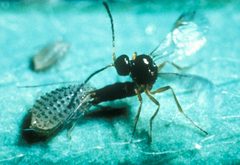
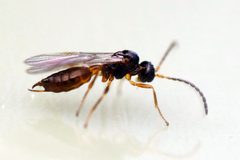
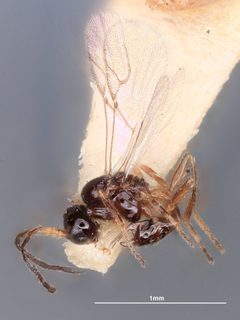
Trioxys is a of in the Aphidiinae (Braconidae). within this genus are internal parasitoids of aphids and have been studied for their potential against agricultural pests. Some species, such as T. indicus, exhibit adaptive learning in discrimination , with experience reducing and improving oviposition . Other species, including T. utilis and T. pallidus, have been deployed or studied for management of specific aphid pests in crops such as alfalfa and hazelnut.
Pronunciation
How to pronounce Trioxys: /ˈtriːɒksɪs/
These audio files are automatically generated. While they are not always 100% accurate, they are a good starting point.
Images
Distribution
Records from Denmark (DK), Norway (NO), and Sweden (SE) documented in GBIF. Individual have more extensive ranges: T. utilis occurs in alfalfa fields in North America; T. pallidus has been introduced to Oregon, USA for hazelnut pest management; T. indicus and related species are recorded from South Asia and the Iberian Peninsula.
Host Associations
- Aphis craccivora - Primary for T. indicus
- Therioaphis maculata - for T. utilis (spotted alfalfa aphid)
- Takecallis species - for T. liui in Iberian Peninsula
- Alloxysta pleuralis - hyperparasitoidCynipoid hyperparasitoid of T. indicus
Life Cycle
Internal development within living . Specific developmental stages and timing vary by and are not well documented in available sources.
Behavior
discrimination ability develops through adaptive learning in at least some (T. indicus). Inexperienced females exhibit longer pre-attack and delayed oviposition decisions compared to experienced individuals. decreases with experience. Learning rate is faster when initial contact is with healthy hosts rather than already parasitized hosts. Age does not influence the development of host discrimination ability. Superparasitism occurs but is not caused by deposition of multiple per oviposition or failure to recognize -parasitized hosts.
Ecological Role
Human Relevance
Used or studied as agents against pests. T. utilis investigated for spotted alfalfa aphid management. T. pallidus introduced and managed in Oregon hazelnut orchards for aphid control.
Similar Taxa
- BinodoxysSome Trioxys , including T. indicus, have been classified under Binodoxys; the two are closely related and may be confused in literature
- AphidiusAnother common aphidiine with similar and ; distinguished by specific wing venation and antennal segment counts
More Details
Taxonomic Note
The Trioxys has undergone taxonomic revision, with some historically placed in subgenera (e.g., Trioxys (Binodoxys) indicus, Trioxys (Trioxys) utilis) or moved to related genera. Current classification places these within Trioxys sensu lato or recognizes Binodoxys as distinct depending on authority.
Invasive Species Record
T. liui, native to Asia, has been recorded as in the Iberian Peninsula where it attacks invasive Takecallis bamboo aphids.
Sources and further reading
- BugGuide
- GBIF taxonomy match
- iNaturalist taxon
- NCBI Taxonomy
- Catalogue of Life
- Factors Responsible for the Superparasitic Ability of the Parasitoid Wasp Trioxys indicus (Hymenoptera: Aphidiidae)
- The Biology, Behavior, and Morphology of Trioxys (Trioxys) utilis, an Internal Parasite of the Spotted Alfalfa Aphid, Therioaphis maculata (Hymenoptera: Braconidae, Aphidiinae)1
- The Development of the Ability of Host Discrimination in the Parasitoid Wasp Trioxys indicus (Hymenoptera: Aphidiidae)
- Figure 3 from: Rakhshani E, Saval JM, Pérez Hidalgo N, Pons X, Kavallieratos NG, Starý P (2020) Trioxys liui Chou & Chou, 1993 (Hymenoptera, Braconidae, Aphidiinae): an invasive aphid parasitoid attacking invasive Takecallis species (Hemiptera, Aphididae) in the Iberian Peninsula. ZooKeys 944: 99-114. https://doi.org/10.3897/zookeys.944.51395
- BIOLOGY, IMPACT, AND MANAGEMENT OF TRIOXYS PALLIDUS IN HAZELNUT ORCHARDS OF OREGON, U.S.A.
- Bionomics of Alloxysta pleuralis, a cynipoid hyperparasitoid of an aphidiid parasitoid Trioxys indicus
- Two new records of the genus Trioxys (Hymenoptera, Braconidae, Aphidiinae) parasitic on bamboo aphids from South Korea.