
Therioaphis trifolii
(Monell, 1882)
yellow clover aphid, spotted alfalfa aphid
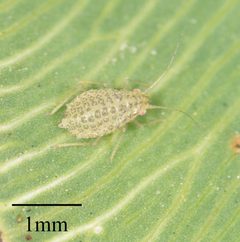
Therioaphis trifolii is a phloem-feeding and major agricultural pest of alfalfa (Medicago sativa) and clover (Trifolium spp.). The species exhibits significant intraspecific variation, with distinct showing -specific adaptations: the spotted alfalfa aphid (SAA) primarily colonizes Medicago species, while the spotted clover aphid (SCA) specializes on Trifolium. Native to the western Palaearctic, it has established globally including Australia, North America, and parts of Asia. The species manipulates host plant defense through salivary secretions, activating salicylic acid signaling while suppressing jasmonic acid responses to improve host suitability.


Pronunciation
How to pronounce Therioaphis trifolii: /ˌθɪəriˈoʊəfɪs ˈtraɪfoʊlaɪ/
These audio files are automatically generated. While they are not always 100% accurate, they are a good starting point.
Identification
Two distinct occur in Australia and elsewhere: the spotted alfalfa (SAA) and spotted clover aphid (SCA). These biotypes are morphologically distinguishable and show strong fidelity—SAA performs optimally on Medicago sativa and related medics, while SCA outperforms SAA on all tested Trifolium . Genetic differentiation between biotypes has been confirmed through and mitochondrial ( oxidase) markers, with diagnostic DNA tests available for identification. Cuticular hydrocarbon profiles and karyology do not distinguish biotypes.
Images
Habitat
Agricultural and pastoral settings, particularly alfalfa/lucerne fields, clover pastures, and improved legume pastures. Found in both cultivated and wild legume stands. Physical characteristics of plants influence suitability: leaf wax content, anatomical structure of vegetative organs, and and length of leaf hairs correlate positively with resistance.
Distribution
Native to western Palaearctic region (Europe, western Asia). Established in Australia (since 1977 for SAA on lucerne; 1989 for SCA on subclover), New Zealand, North America (USA, Canada, Mexico), Central and South America (Chile), Africa (Canary Islands, Egypt, Ethiopia, Libya, Morocco, Sudan), and Asia (China, India, Iran, Iraq, Israel, Japan, Lebanon, Oman, Pakistan, Saudi Arabia, Yemen). In USA: Alabama, Arizona, Arkansas, California, Colorado, Connecticut, Florida, Georgia, Idaho, Illinois, Indiana, Iowa, Kansas, Kentucky, Louisiana, Maine, Maryland, Massachusetts, Minnesota, Mississippi, Missouri, Nebraska, Nevada, New Jersey, New Mexico, New York, North Carolina, Ohio, Oklahoma, Oregon, Pennsylvania, South Carolina, South Dakota, Tennessee, Texas, Utah, Virginia, Washington, West Virginia, Wisconsin, Wyoming.
Seasonality
In central Greece, two peaks observed: first in July, second from mid-September to mid-October, with first peak higher than second. Sharp decline in early August to mid-September attributed to natural enemies rather than climatic factors. Absent December through March; low levels during spring and part of June, and from mid-October through November. Seasonal dynamics influenced by temperature effects on development and .
Diet
Phloem-feeding on Fabaceae legumes. Primary : Medicago sativa (alfalfa/lucerne), Trifolium (clovers, particularly T. subterraneum), and related Medicago and Melilotus species. Host utilization differs between : SAA nearly exclusive on Medicago sativa; SCA on Trifolium subterraneum and other clovers. Barrel medic (Medicago) relatively unsuitable for both biotypes. White clover cultivar 'Irrigation' least suitable host for SCA.
Host Associations
- Medicago sativa - primary alfalfa/lucerne; primary for SAA
- Trifolium subterraneum - primary subterranean clover; primary for SCA
- Trifolium spp. - clover ; SCA performs well on most cultivars, particularly subterranean clover
- Medicago spp. - medics; variable suitability
- Melilotus spp. - sweet clovers
Life Cycle
Complex with multi- documented through life-table studies. Development time varies by cultivar: shortest on 'Defu' alfalfa, longest on 'Hunter River'. Reproductive parameters (reproductive days, longevity, ) vary between host- and susceptible , with transgenerational effects observed. On susceptible cultivar 'Hu', high survival and strong reproductive capacity in early generations (G2-G8); on resistant cultivar 'HA-3', better growth and development in later generations (G9-G10) following . Finite rate of increase and higher on resistant cultivar after G7. Net reproductive rate and mean generation time higher on resistant cultivar after G5. Coevolutionary coupling between and host plant breaks down with gradual adaptation.
Behavior
Salivary-mediated manipulation of plant defense: R-aphids (reared on cultivar) secrete saliva that activates host salicylic acid (SA) signaling while inhibiting jasmonic acid (JA) pathway, reducing plant defense and improving host suitability. S-aphids (reared on susceptible cultivar) show opposite pattern, activating JA and inhibiting SA. Saliva treatment decreases plant repellency and to subsequent feeding. Olfactory reception mediated by antennal primary rhinaria with placoid showing -specific responses to plant volatiles; LP6 respond strongly to methyl salicylate. Phenolic oxidation in saliva hypothesized as mechanism to detoxify host plant phenolics.
Ecological Role
Major agricultural pest causing tremendous global crop yield losses. Acts as for non-persistent plant viruses including alfalfa mosaic virus. Serves as prey for natural enemies including Coccinella septempunctata (seven-spotted lady beetle), Menochilus sexmaculatus, and Coccinella undecimpunctata. Subject to programs using introduced ; eight parasitoid established for long-term suppression in North America.
Human Relevance
Significant economic pest of alfalfa and clover forage crops, reducing yields and quality. Transmits alfalfa mosaic virus, causing major losses in chile peppers and other crops. Subject to extensive programs; successful establishment of has reduced use in alfalfa production. breeding targets physical characteristics (leaf wax, hair , anatomy) and biochemical defenses. Trypsin inhibitors (Msti-94, Msti-16) show potential as , reducing survival to 18-21% and inhibiting digestive . Management complicated by non-persistent virus transmission by transient, non-colonizing aphids.
Similar Taxa
- Therioaphis riehmicongeneric in same , may share associations and
- Acyrthosiphon pisumco-occurring pest of lucerne/alfalfa with similar and range, though in different (Aphidinae vs. Calaphidinae)
- Aphis craccivoraanother pest of legumes, distinguished by and preferences
Sources and further reading
- BugGuide
- Wikipedia
- GBIF taxonomy match
- iNaturalist taxon
- NCBI Taxonomy
- Catalogue of Life
- Publications | Entomology Research Museum
- The Gifts of Ben Puttler: From Aphids to Answers
- Management Prospects for Alfalfa Mosaic Virus in Chile Peppers
- A Case for Preservation: Maintaining Insect Collections in Developing Countries
- Therioaphis trifolii . [Distribution map].
- Therioaphis trifolii saliva: a key factor in aphid survival and plant-defense
- New Insights into the Life History Changes Can Enhance Control Strategies for Therioaphis trifolii
- Studies On Succession, Distribution, and Phenology of Imported Parasites of Therioaphis Trifolii (Monell) In Southern California
- Seasonal abundance of Acyrthosiphon pisum (Harris) (Homoptera: Aphididae) and Therioaphis trifolii (Monell) (Homoptera: Gal1aphididae) on lucerne in Central Greece
- Suitability of clovers (Trifolium species and cultivars) as hosts of spotted clover aphid, a biotype of Therioaphis trifolii (Monell) (Hemiptera : Aphididae)
- Use of Life Tables To Assess Host Plant Resistance in Alfalfa to Therioaphis trifolii f. muculata (Homoptera: Aphididae): Hypothesis for Maintenance of Resistance
- Oxidative interactions between the spotted alfalfa aphid (Therioaphis trifolii maculata) (Homoptera: Aphididae) and the host plant Medicago sativa
- Biology of Menochilus sexmaculatus Fab. and Cocci nel la undecimpunctata L (Coccinellidae: Coleoptera) on Alfalfa Aphid Therioaphis trifolii Monell
- Comparative performance of two biotypes of Therioaphis trifolii (Monell) (Hemiptera: Aphididae) on clovers (Trifolium) and medics (Medicago)
- Comparative morphology and plant volatile responses of antennal sensilla in Cinara cedri (Hemiptera: Lachninae), Eriosoma lanigerum (Hemiptera: Eriosomatinae), and Therioaphis trifolii (Hemiptera: Calaphidinae)
- BIOLOGY AND FEEDING POTENTIAL OF 7-SPOTTED BEETLE, COCCINELLA SEPTEMPUNCTATA (LINNAEUS) ON BERSEEM APHID, THERIOAPHIS TRIFOLII (MONELL) IN LABORATORY
- Inhibitory Effects of Plant Trypsin Inhibitors Msti-94 and Msti-16 on Therioaphis trifolii (Monell) (Homoptera: Aphididae) in Alfalfa
- Biological and genetic characterization of morphologically similar Therioaphis trifolii (Hemiptera: Aphididae) with different host utilization
- Effect of different alfalfa cultivars on growth and development of the spotted alfalfa aphid, Therioaphis trifolii (Monell)