
Coccinella undecimpunctata
Linnaeus, 1758
eleven-spot ladybird, eleven-spotted lady beetle, eleven-spotted ladybird beetle
Coccinella undecimpunctata, commonly known as the eleven-spot ladybird or eleven-spotted lady beetle, is a small predatory in the Coccinellidae. It is to the Palearctic region and has been introduced to Australia and New Zealand as a agent. The is distinguished by eleven black spots on its red or orange , though one central spot creates the appearance of six spots per elytron. It is an effective of aphids and is used in programs.
Pronunciation
How to pronounce Coccinella undecimpunctata: /kɒksɪˈnɛlə ʌnˌdɛkɪmpʌŋkˈtɑːtə/
These audio files are automatically generated. While they are not always 100% accurate, they are a good starting point.
Identification
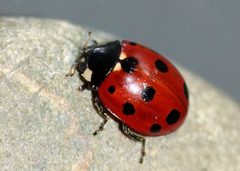
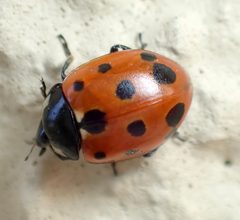
Distinguished from other Coccinella by the specific count and arrangement of eleven black spots on red/orange . The central spot at the elytral base is key—appearing as if there should be twelve spots (six per side), but the medial spot is single. Smaller than C. septempunctata (seven-spotted ladybird, 5.2–8.5 mm). Spot pattern differs from C. quinquepunctata (five spots) and C. novemnotata (nine spots). In North America, distinguished from introduced C. septempunctata and native C. transversoguttata by spot number and arrangement.
Images
Appearance
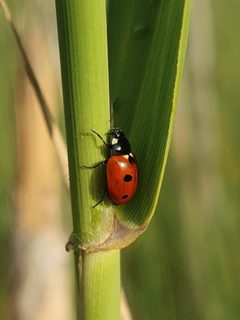
Small lady beetle measuring 4.0–5.0 mm in length. are red to orange with eleven distinct black spots. The spot arrangement appears as six spots per elytron, but the central spot at the base of the elytra (just behind the pronotum) is single and shared, counting as one of the eleven. Pronotum is black with pale margins. and legs are dark.
Habitat
Open grassy including fields, areas, steppe (including Pannonian steppe), stone quarries, wastelands, dry forest edges, meadows, and coastal meadows. Associated with grasses and often found near rivers. Occurs on alluvial soils, detritus, dead grass, and in with Salix purpurea. Frequently associated with Ammophila arenaria. Salt- and found in saline areas with Atriplex tatarica and associated grasses.
Distribution
to the Palearctic: Europe, North Africa, European Russia, the Caucasus, Siberia, the Russian Far East, Ukraine, Moldova, Kazakhstan, Middle Asia, Western Asia, Afghanistan, Mongolia, China, Pakistan, and North India. Introduced to Australia as a agent; introduced also in New Zealand. Formerly present in North America but populations are declining.
Diet
of aphids (Hemiptera: Aphididae). Prey include Aphis fabae, Aphis gossypii, Aphis nerii, Aphis craccivora, Hyalopterus pruni, Macrosiphoniella sanborni, Myzus persicae, and aphids associated with grasses. Fourth instar larvae consume approximately 1.5 times more aphids than . Consumption rates increase with temperature, peaking at 27°C. Shows prey preference hierarchy: Hyalopterus pruni and Macrosiphoniella sanborni most preferred, Aphis fabae least preferred.
Host Associations
- Aphis fabae - preyLeast preferred prey
- Aphis gossypii - preyReared successfully in laboratory studies
- Aphis nerii - preyIntermediate preference
- Aphis craccivora - preyAttracted to volatiles from this prey on Vicia faba
- Hyalopterus pruni - preyMost preferred prey; 57.45%
- Macrosiphoniella sanborni - preyHighly preferred; 53.13%
- Myzus persicae - preyReared successfully in laboratory studies
- Ammophila arenaria - associated plantFrequently found in with this grass
- Salix purpurea - associated plantOccurs in with this willow
- Atriplex tatarica - associated plantSalt-; feeds on aphids inhabiting this saline-tolerant plant
- Vicia faba - associated plantUses plant volatiles induced by to locate prey
Life Cycle
Complete (holometabolous): , larva (four instars), pupa, . Egg stage duration and larval development rates vary with temperature and prey availability. Fourth instar larvae exhibit highest . occurs in soil or protected locations. Adults are sexually reproducing. Egg occurs, with paternal cannibalization increasing and egg viability, maternal cannibalization increasing egg viability only, and biparental cannibalism decreasing pupation and developmental time.
Behavior
Uses olfactory cues to locate prey: attracted to volatiles from -infested plants and directly to aphid volatiles. Mated females show strongest response (47.50%) to combined plant-plus-aphid volatiles; mated males more attracted to aphid volatiles alone (30.0%) than other types. Exhibits with sex-specific benefits. Salt-tolerant, enabling foraging in saline where other predators may be excluded.
Ecological Role
and agent. Reduces aphid in grassy and agricultural , including cereal crops where aphids Barley Yellow Dwarf Virus. Higher aphid consumption rates than Coccinella septempunctata at equivalent temperatures. Part of natural enemy complex regulating aphid populations; fourth instar larvae contribute disproportionately to aphid mortality. Salt allows occupation of saline , expanding predator guild diversity in these environments.
Human Relevance
Used as agent for pests in Australia, New Zealand, and potentially other regions. Effective against cotton mealybug (Phenacoccus solenopsis) and various aphid in agricultural settings. Females consume more prey over lifespan than males. Best released when pest are low. Vulnerable to some : chlorpyrifos and spinosad are highly toxic; deltamethrin less toxic; pirimicarb and pymetrozine recommended as they lack significant impact. Buprofezin sprayed on larvae reduces survival to adulthood by 33%.
Similar Taxa
- Coccinella septempunctataLarger size (5.2–8.5 mm vs. 4.0–5.0 mm), seven spots instead of eleven, different spot arrangement
- Coccinella quinquepunctataFive spots instead of eleven, different geographic distribution
- Coccinella novemnotataNine spots instead of eleven, native to North America, larger size
More Details
Wolbachia infection
Infected by bacteria, which are and kill male offspring in , favoring female offspring. Heat treatment of eggs eliminates the bacteria without molecular trace.
Parasitoids
Subject to by Tetrastichus coccinellae (Hymenoptera: Eulophidae), a . Also potentially parasitized by Dinocampus coccinellae (Braconidae), though this association is better documented for other Coccinella .
Subspecies
Four recognized : C. u. undecimpunctata (nominate), C. u. boreolitoralis Donisthorpe 1918, C. u. menetriesi Mulsant 1850, and C. u. tripunctata Linnaeus 1758.
Sources and further reading
- BugGuide
- Wikipedia
- GBIF taxonomy match
- iNaturalist taxon
- NCBI Taxonomy
- Jasmin Ramirez Bonilla: Targeting Cucumber Beetles on Melons | Bug Squad
- A Mural Like No Other | Bug Squad
- Deep Look's Award-Winning Aphid Video by Josh Cassidy--and a UC Davis Entomologist's Role | Bug Squad
- Spotted Cucumber Beetle: New Guide Profiles Crop Damage, Management for Polyphagous North American Pest
- Bug Eric: "Zombie Ladybugs"
- Tabloid Sensationalism Aside, Lady Bugs Are Still Fascinating
- North American Distribution of Coccinella u. undecimpunctata L. (Coleoptera: Coccinellidae)
- Biological Control of Barley Yellow Dwarf Virus (BYDV) Vector Aphid Using Coccinella septempunctata and Coccinella undecimpunctata in Barley and Wheat
- Rearing of Coccinella undecimpunctata L. (Coleoptera:Coccinellidae)on two Aphid species in relation to the predator's biology
- Searching behavior ofCoccinella undecimpunctata (Coleoptera: Coccinellidae) and its parasitoid,Tetrastichus coccinellae (Hymenoptera:Eulophidae)
- The Adult Tendency of Eleven-Spotted Ladybird, Coccinella undecimpunctata for Preference of Certain Type of Aphid
- Effects of pirimicarb, buprofezin and pymetrozine on survival, development and reproduction ofCoccinella undecimpunctata(Coleoptera: Coccinellidae)
- Responses of the predatory species, Coccinella undecimpunctata L. (Coleoptera: Coccinellidae), to the volatiles from its prey, Aphis craccivora Koch. and Vicia faba plant
- Biology and Predatory Potential of the Eleven Spotted Coccinellid Predator Coccinella undecimpunctata L. (Coleoptera: Coccinellidae) reared on two Aphid Species (Hemiptera: Aphididae) under Laboratory Conditions.
- Searching Behavior of Coccinella undecimpunctata L. (Coleoptera: Coccinellidae) and Its Parasitoid Tetrastichus coccinellae Kurd. (Hymenoptera: Eulophidae)
- TRI-TROPHIC INTERACTION AMONG HOST PLANTS, APHID SPECIES, AND COCCINELLA UNDECIMPUNCTATA L. UNDER LABORATORY CONDITIONS.