
Hyalopterus pruni
(Geoffroy, 1762)
Mealy Plum Aphid
Hyalopterus pruni, the mealy plum , is a sap-feeding aphid in the Aphididae with a distribution. It exhibits a complex involving multiple of wingless followed by the production of winged migrants that disperse to secondary . The is notable for its waxy covering and seasonal host alternation between Prunus species and grasses or reeds.
Pronunciation
How to pronounce Hyalopterus pruni: /haɪəˈlɒptərəs ˈpruːnaɪ/
These audio files are automatically generated. While they are not always 100% accurate, they are a good starting point.
Identification
Distinguished from other Hyalopterus and aphids on Prunus by the combination of mealy white wax covering, short , and conical cauda. The red and pale bluish green coloration help separate it from many other species. The presence of both typical and "red form" individuals within colonies is characteristic. Winged forms, when present, can be distinguished by their timing and secondary preferences.
Images
Appearance
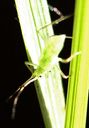
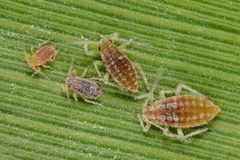
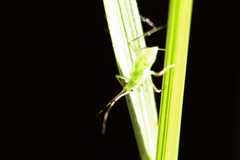
measure 1.5–2.6 mm in body length. Body is narrow and oval-shaped with a conical cauda. are relatively short, reaching approximately half the body length. Coloration is typically pale bluish green, though some individuals in colonies may appear pinkish ("red form"). are red. The entire body is covered with a mealy white wax secretion that can give individuals a gray or light green appearance.
Habitat
Found on plants in orchards, gardens, and natural settings where Prunus occur. Secondary includes reed beds and areas with Phragmites communis, Arundo donax, and other grasses or cattails where winged migrants disperse.
Distribution
distribution, recorded across multiple continents including Europe, North America, and South America (Brazil). Present in Belgium with records from Brussels-Capital Region, Flemish Region, and Walloon Region.
Seasonality
Active from spring through fall. Wingless persist for 3–13 . Winged adults typically appear in June and July, dispersing to secondary . occurs in the stage, with eggs hatching when host plant buds bloom in spring.
Diet
Phloem sap feeder. Primary include Prunus : plum, peach, apricot, and almond. Secondary hosts include Phragmites communis, Arundo donax, reed grasses, and cattails.
Host Associations
- Prunus domestica - primary plum
- Prunus persica - primary peach
- Prunus armeniaca - primary apricot
- Prunus dulcis - primary almond
- Phragmites communis - secondary reed
- Arundo donax - secondary giant reed
Life Cycle
Holocyclic with alternation. overwinter on primary hosts near flower buds. Eggs hatch when buds bloom in spring. Multiple of wingless parthenogenetic females (apterae) occur on primary hosts for 3–13 generations. Winged migrants (alatae) develop in June/July and disperse to secondary hosts (grasses, reeds, cattails). Sexual forms return to primary hosts in fall to produce eggs.
Behavior
Forms colonies on plants. Wingless remain on host plants while winged adults disperse to secondary hosts. Produces copious honeydew during feeding. Colonies may contain mixed color morphs (typical and red forms).
Ecological Role
Herbivore that produces honeydew, which attracts other insects including ants and natural enemies. Has been observed supporting associated insect through honeydew production.
Human Relevance
Agricultural pest of stone fruit orchards. Feeding can cause direct damage to plum, peach, apricot, and almond trees. Honeydew production leads to growth on fruit and foliage, reducing marketability. Management may be required in commercial orchards.
Similar Taxa
- Hyalopterus amygdaliSimilar mealy appearance and range on Prunus; distinguished by morphological details and host preferences
- Brachycaudus helichrysiAlso found on Prunus ; lacks the dense mealy wax covering characteristic of H. pruni
More Details
Wax Production
The mealy white wax covering is a defining feature of this and gives rise to its . This wax may provide protection from desiccation and natural enemies.
Historical Taxonomy
Originally described as Aphis pruni by Geoffroy in 1762, later transferred to Hyalopterus.
Sources and further reading
- BugGuide
- Wikipedia
- GBIF taxonomy match
- iNaturalist taxon
- NCBI Taxonomy
- Catalogue of Life
- Samantha Murray: For the Love of Bees and the Love of Music | Bug Squad
- Crapemyrtle Aphid: A Cosmopolitan Pest of a Popular Ornamental Tree
- Unwanted Webs: Integrated Pest Management for Fall Webworms
- New Trap Improves Detection of Hemlock Woolly Adelgid
- New Guide Highlights IPM for Boxwood Pests
- Don't Bet Your Hedges: IPM Guide Outlines Ficus Whitefly Management