
Hyalopterus
Koch, 1854
Mealy Plum-Reed Aphids
Species Guides
1- Hyalopterus pruni(Mealy Plum Aphid)
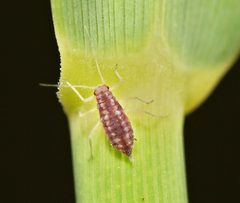
Hyalopterus is a of aphids in the Aphididae, commonly known as mealy plum-reed aphids. in this genus are pests of stone fruit trees in the genus Prunus, causing damage through direct feeding and virus transmission. The genus has undergone recent taxonomic revision, with molecular and morphometric analyses supporting at least three distinct species: H. pruni, H. amygdali, and H. persikonus (the latter described in 2006). Species boundaries are strongly correlated with -plant associations.
Pronunciation
How to pronounce Hyalopterus: /haɪəˈlɒptərəs/
These audio files are automatically generated. While they are not always 100% accurate, they are a good starting point.
Identification
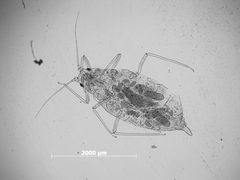
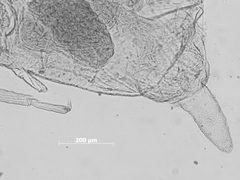
within Hyalopterus are highly similar morphologically and difficult to distinguish by external features alone. Identification relies on -plant association, geographic origin, and molecular analysis (particularly COI gene sequencing). Hyalopterus pruni is associated with Prunus domestica (plum), H. amygdali with Prunus dulcis (almond), and H. persikonus with Prunus persica (peach). Morphometric analysis of 16 characters may reveal subtle differentiation, but definitive identification typically requires phylogenetic analysis.
Images
Habitat
Agricultural and natural containing plants in the Prunus, including orchards of plum, almond, apricot, and peach. Secondary hosts include Phragmites communis (common reed) for some .
Distribution
distribution with Mediterranean origin. Found in Eurasia, Northern America, and introduced regions including California. Turkey serves as an important distribution . Specific records from Denmark, Norway, Sweden, Vermont (USA), and widespread across Europe, North Africa (Tunisia), and western Asia.
Seasonality
In Mediterranean climates, colonies on almond trees begin mid-February, peak early April, and decline by late May. On peach trees, start later (early May) and may persist through summer. Very high summer temperatures (>43°C) cause total mortality.
Diet
Feeds on phloem sap of plants.
Host Associations
- Prunus domestica - primary plum
- Prunus dulcis - primary almond
- Prunus armeniaca - primary apricot
- Prunus persica - primary peach
- Phragmites communis - secondary common reed; used by some
Life Cycle
with alternation between primary Prunus hosts and secondary hosts (including Phragmites). Fundatrix larvae establish colonies in spring. is parthenogenetic during the growing season, with alatae (winged migrants) produced for to secondary hosts or between plants. occurs in autumn, producing .
Behavior
Emigrants (flying alatae) exhibit -specific color attraction, preferentially alighting on unsaturated yellow-green colors matching Phragmites leaves. This color preference is specific to Hyalopterus and differs from related aphids like Aphis fabae, which prefer more saturated colors.
Ecological Role
Significant agricultural pest causing 70-80% crop losses in affected orchards through direct feeding damage (stunted growth, leaf deformation, wilting, premature leaf fall) and as a of plant viruses. Natural enemies including predatory beetles (Adalia fasciatopunctata), (Aphidius transcaspicus), and predatory mite larvae (Allothrombium pulvinum) help regulate .
Human Relevance
Major economic pest of stone fruit orchards worldwide. in California and other regions outside native range. Control relies on including agents, though chemical control is widely applied. Accurate identification is critical for early detection of invasive and targeted management.
Similar Taxa
- Aphis fabaeSimilar and range, but distinguished by color preference —Aphis fabae prefers saturated colors while Hyalopterus prefers unsaturated yellow-green tints.
- Macrosiphum rosaeShares rose and aphidid , but differs in host associations and lacks the specific Prunus-Phragmites host alternation of Hyalopterus.
Sources and further reading
- BugGuide
- Wikipedia
- GBIF taxonomy match
- iNaturalist taxon
- NCBI Taxonomy
- Catalogue of Life
- Research on the morphological and molecular diagnosis of Hyalopterus pruni (Geoffroy) Hyalopterus pruni (Geoffroy)'nin morfolojik ve moleküler teşhisi üzerine araştırma
- HOSTPLANT SPECIFIC COLOUR BEHAVIOUR BY HYALOPTERUS PRUNI (APHIDIDAE)
- Biology of the mealy plum aphid,Hyalopterus pruni(Geoffroy)
- Phylogeny and species reassessment of Hyalopterus (Aphididae, Aphidinae)
- Di‐ and tri‐nucleotide repeat microsatellites for the mealy plum aphid, Hyalopterus pruni
- Figure 2 from: Rakauskas R, Havelka J, Zaremba A (2013) Mitochondrial COI and morphological specificity of the mealy aphids (Hyalopterus ssp.) collected from different hosts in Europe (Hemiptera, Aphididae). ZooKeys 319: 255-267. https://doi.org/10.3897/zookeys.319.4251
- Incorporation of Turkish Hyalopterus spp. into recent species reassessment based on their molecular and morphometric features
- Mitochondrial COI and morphological specificity of the mealy aphids (Hyalopterus ssp.) collected from different hosts in Europe (Hemiptera, Aphididae)
- Life history characteristics of Aphidius transcaspicus, a parasitoid of mealy aphids (Hyalopterus species)
- Host instar preference and functional response of Aphidius transcaspicus, a parasitoid of mealy aphids (Hyalopterus species)
- Host preference by Allothrombium pulvinum (Acari: Trombidiidae) larvae on aphids: Macrosiphum rosae, Aphis gossypii and Hyalopterus amygdali (Homoptera: Aphididae)
- Sur la dynamique des populations de Hyalopterus pruni Geoffroy (Hom., Aphididae) dans la région de Tunis
- Molecular and morphological evaluation of the aphid genus Hyalopterus Koch (Insecta: Hemiptera: Aphididae), with a description of a new species
- Development, feeding and reproduction responses of Adalia fasciatopunctata revelierei(Mulsant) (Coleoptera: Coccinellidae) to Hyalopterus pruni(Geoffroy) (Homoptera: Aphididae)
- Figure 3 from: Rakauskas R, Havelka J, Zaremba A (2013) Mitochondrial COI and morphological specificity of the mealy aphids (Hyalopterus ssp.) collected from different hosts in Europe (Hemiptera, Aphididae). ZooKeys 319: 255-267. https://doi.org/10.3897/zookeys.319.4251