
Allothrombium
Berlese, 1903
Sumo Mites
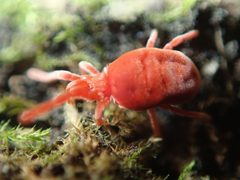
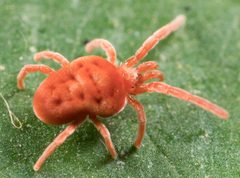
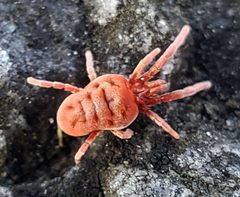
Allothrombium is a of velvet mites ( Trombidiidae) comprising approximately 45 described distributed across the Palaearctic, Ethiopian, Australian, Oriental, and Nearctic realms. Species in this genus exhibit complex involving parasitic larvae and predatory post-larval stages. Larvae are primarily of aphids, while deutonymphs and are free-living of small arthropods and their . Several species have been investigated as potential agents for agricultural pest aphids.
Pronunciation
How to pronounce Allothrombium: //ˌæloʊˈθrɒmbiəm//
These audio files are automatically generated. While they are not always 100% accurate, they are a good starting point.
Identification
Identification to level requires examination of microscopic characters including body setae length and pectination patterns, crista metopica width, and . A. meridionale has been redescribed with detailed morphological data. Larvae can be distinguished from other trombidiid by their ectoparasitic association with aphids and specific attachment site preferences on .
Images
Habitat
Agricultural including apple orchards, peach orchards, pomegranate orchards, cotton fields, wheat fields, and rape fields; also Mediterranean meadows. hibernate in soil and various shelters; overwinter in soil.
Distribution
Palaearctic, Ethiopian, Australian, Oriental, and Nearctic realms. Documented from Iran (Garmsar, Semnan province; West Mazandaran; Shiraz), China (Shanghai), Spain (Navarra-Nafarroa), Serbia, Bulgaria, Macedonia, Romania, Colombia, Panama, United States (Missouri, Illinois), and Denmark, Norway, and Türkiye based on distribution records.
Seasonality
: hatch in spring, larvae emerge in spring (peaking mid-June to third week of July depending on and location), deutonymphs appear in summer, appear in autumn. Adults undergo obligate reproductive during winter.
Diet
Larvae: of aphids including Aphis punicae, Aphis fabae, Aphis gossypii, Macrosiphum rosae, and Hyalopterus amygdali. Deutonymphs and : free-living of small arthropods and their .
Host Associations
- Aphis punicae - larval primary in Iran
- Aphis fabae - larval preferred in Spain; attachment site
- Aphis gossypii - larval preference studied
- Macrosiphum rosae - larval preference studied
- Hyalopterus amygdali - larval preference studied
- Coccinella septempunctata - larval recorded for A. triticium
Life Cycle
Complex with four active stages: larva, (calyptostatic, non-feeding), deutonymph, and . Larvae are ectoparasitic; deutonymphs and adults are free-living predatory. : one per year. laid in soil in spring; hatch in spring. Larvae active spring to early summer. Deutonymphs appear in summer. Adults appear in autumn, overwinter in soil, undergo obligate reproductive , and lay eggs the following spring. Intraspecific variation in deutonymph has been linked to larval .
Behavior
Larval attach preferentially to the of . disperse following negative binomial distribution in orchard environments, with higher abundance on ridges than furrows. Adults hibernate in soil and shelters.
Ecological Role
Natural enemy and agent of pests in agricultural systems. Functions as both (larval stage) and (post-larval stages) of small arthropods. studied in relation to aphid on multiple crop systems.
Human Relevance
Investigated as biocontrol agent for pests in apple orchards, peach orchards, pomegranate orchards, cotton, wheat, and rape. A. ovatum and A. pulvinum studied specifically for controlling effects on Aphis gossypii. Potential for programs.
Similar Taxa
- TrombidiumBoth are large, red velvet mites in Trombidiidae; Allothrombium distinguished by larval on aphids versus Trombidium larvae typically parasitic on arthropods other than aphids or with different ranges
- Other Trombidiidae generaAllothrombium larvae specifically associated with ; identification requires microscopic examination of setal and crista metopica characters
More Details
Taxonomic complexity
The has been described as a 'heterogeneous ' suggesting potential for future taxonomic revision. Allothrombium monosolenidion was recently synonymized with A. incarnatum based on rearing experiments linking larval and stages.
Developmental plasticity
of larvae contribute to intraspecific morphological variation in subsequent deutonymph stage, as demonstrated in A. fuliginosum.
Species diversity
Approximately 45 described globally; 13 from Palaearctic and Ethiopian realms, 9 from Australian, 3 from Oriental, 5 Neotropical, and 2 Nearctic species historically, though additional Nearctic species have since been described.
Sources and further reading
- BugGuide
- Wikipedia
- GBIF taxonomy match
- iNaturalist taxon
- NCBI Taxonomy
- Description of Allothrombium shirazicum adult (Acari: Trombidiidae) from Iran
- Seasonal abundance of Allothrombium monochaetum and Allothrombium pulvinum in Navarra-Nafarroa (northern Spain), with notes on larval host preference and rate of parasitism
- Biology of Allothrombium shirazicum Zhang (Acari: Trombidiidae) in Garmsar, Semnan province, Iran
- Attachment sites of Allothrombium pulvinum larvae (Acari: Trombidiidae) ectoparasitic on aphid hosts)
- Studies on aphid host selection by parasitic larvae of Allothrombium ovatum (Acari: Trombidiidae)
- New record of Allothrombium incarnatum Oudemans (Prostigmata: Trombidiidae) from Türkiye, with the report of a new synonym
- Biology of Allothrombium ovatum (Acari: Trombidiidae) and its controlling effect on Aphis gossypii (Homoptera: Aphididae)
- Biology of Allothrombium pulvinum Ewing (Acari: Trombidiidae) in West Mazandran, Iran
- A new host record of Allothrombium triticium larvae (Acari: Trombidildae) ectoparasitic on Coccinella septempunctata (Coleoptera: Coccinellidae)
- Host selection by parasitic Allothrombium ovatum larvae (Acari: Trombidiidae) and mite-aphid population dynamics on cotton, wheat and rape
- Host preference by Allothrombium pulvinum (Acari: Trombidiidae) larvae on aphids: Macrosiphum rosae, Aphis gossypii and Hyalopterus amygdali (Homoptera: Aphididae)
- A Redescription ofAllothrombium meridionaleBerlese, 1910 (Acari: Trombidiformes: Trombidioidea) with Notes on Biology and Developmental Malformations
- NEW HOST DATA FOR TERRESTRIAL PARASITENGONA OF SERBIA WITH NOTE ON Allothrombium clavatum Saboori, Pesic and Hakimitabar, 2010
- Description and Mating Behaviour of Allothrombium lerouxi, new species, (Acarina: Trombidiidae), a Predator of Small Arthropods in Quebec Apple Orchards
- Notes on the occurrence and distribution of the biocontrol agent, Allothrombium pulvinum Ewing (Acari, Trombidiidae), in a peach orchard in China
- Host species of larvae contribute to intraspecific variation of deutonymphs - a case study of Allothrombium fuliginosum (Trombidiformes: Trombidiidae) parasitizing aphids.