
Trombidiidae
True Velvet Mites, Red Velvet Mites, Sumo Mites, Rain Bugs
Genus Guides
3- Allothrombium(Sumo Mites)
- Dinothrombium(Giant Velvet Mites)
- Trombidium(velvet mites)
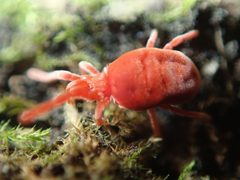
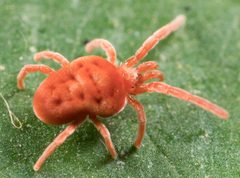
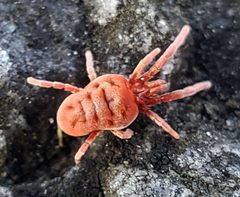
Trombidiidae are among the largest mites, with typically 4 mm or less but some exceeding 12 mm. They display bright red coloration and a soft, velvety appearance due to dense setae. The exhibits complex with alternating active and inactive stages, and a dramatic shift from parasitic larvae to predatory postlarval forms. They inhabit plant litter and soil surfaces across diverse geographic regions.
Pronunciation
How to pronounce Trombidiidae: //trɒmˈbɪdi.aɪdiː//
These audio files are automatically generated. While they are not always 100% accurate, they are a good starting point.
Identification
Distinguished from other Trombidioidea by palp structure visible in lateral view. Macroscopic color differences allow preliminary field separation among syntopic : Trombidium brevimanum appears crimson red versus bright red in other species. Definitive identification requires examination of palp and often COI sequencing. Larvae are parasitic and morphologically distinct from postlarval forms, requiring rearing for species-level identification.
Images
Appearance
are conspicuously bright red to crimson, with a soft, velvety texture created by dense covering of setae. Most adults measure under 4 mm, but some reach 12 mm or more, making them the largest mites outside of engorged ticks. The body is rounded and somewhat flattened dorsoventrally. Palps are prominent and visible in lateral view, important for -level identification.
Habitat
Plant litter, upper soil layers, and soil surfaces in forests, meadows, fields, and allotment gardens. Found in mesic upland forests, uncultivated grassy areas, and lower parts of tree trunks. Activity concentrated on soil surface during early spring through late summer.
Distribution
Widespread across Europe, Asia, North Africa, and North America. Well-documented in western Palearctic including Poland, with records from Wrocław, Bieszczady Mountains, Bystrzyckie Mountains, Stołowe Mountains, Białowieża, Notecka Forest, and Vistula Spit. Distribution records from Denmark, Norway, and Sweden in GBIF.
Seasonality
Active on soil surface from early spring through late summer. One breeding cycle per year. often overwinter, becoming plump in autumn and potentially shriveling through winter energy use. laid in spring.
Diet
Larvae are of insects and other arachnids, creating stylostomes (feeding canals) to access liquified tissues; parasitic phase lasts 5-8 days at 22°C day/15°C night. Deutonymphs and are active of small arthropods including economically significant pests.
Host Associations
- Acyrthosiphon pisum - LARVAL_HOSTPea aphid; confirmed experimental for Allothrombium fuliginosum
- Aphis sambuci - LARVAL_HOSTElder aphid; confirmed experimental for Allothrombium fuliginosum
- Macrosiphum rosae - LARVAL_HOSTRose aphid; confirmed experimental for Allothrombium fuliginosum; larvae on this host produce smaller deutonymphs despite larger host size
- Hyadaphis sp. - LARVAL_HOSTHoneysuckle aphid; confirmed experimental for Allothrombium fuliginosum
- Tetragnatha sp. - LARVAL_HOSTSpider ; for Trombidium brevimanum larvae
- Enoplognatha ovata - LARVAL_HOSTCandystripe spider; for Trombidium brevimanum larvae
- Xysticus ulmi - LARVAL_HOSTCrab spider; for Trombidium brevimanum larvae
- Palomena prasina - LARVAL_HOSTGreen shield bug; for Trombidium holosericeum larvae
- Panorpa communis - LARVAL_HOST; for Trombidium holosericeum larvae
- Rhagonycha fulva - LARVAL_HOSTSoldier beetle; for Trombidium holosericeum larvae
- Javesella sp. - LARVAL_HOSTPlanthopper ; for Trombidium heterotrichum larvae
Life Cycle
Complex with seven stages typical of Parasitengona: , prelarva (inactive), larva (active, parasitic, 5-8 days duration), (inactive, quiescent, calyptostatic), deutonymph (active, predatory), tritonymph (inactive, quiescent, calyptostatic), and (active, predatory). Success of from protonymph to deutonymph was 49-57.5% depending on . Marked heteromorphism between larval and postlarval forms.
Behavior
Larvae actively seek and attach to dorso-lateral or , or thorax- border; 1-3 larvae per host observed. are active that refuse to stop moving, making them difficult photographic subjects. No microhabitat segregation observed among syntopic .
Ecological Role
Larvae function as of insects and arachnids, potentially contributing to segregation among syntopic congeneric through differential exploitation. Deutonymphs and serve as of small arthropods. Some species have potential as agents for pests.
Human Relevance
Oil made from Trombidium grandissimum is used in traditional Indian medicine. Harmless to humans despite large size of some . May be encountered by gardeners and naturalists in soil and litter . Spiderlings of some spider species subject to by trombidiid larvae in natural settings.
Similar Taxa
- ErythraeidaeAlso parasitic larvae on spiders; distinguished by different palp structure and typically less dense setation
- Other Trombidioidea familiesRequire examination of palp in lateral view for definitive separation; many former trombidiid now elevated to rank
More Details
Systematics
The of Trombidiidae has been in flux; many former have been elevated to rank within Trombidioidea. identity often requires COI sequencing and species delimitation tools (ABGD, ASAP) combined with phylogenetic inference.
Intraspecific Variation
identity significantly affects deutonymph in Allothrombium fuliginosum. Larvae parasitizing Macrosiphum rosae produced smaller deutonymphs despite this host having larger body size, indicating factors other than host size influence mite development.
Laboratory Rearing
Successful laboratory rearing uses plaster/charcoal substrate at 22°C (day), 15°C (night), 80% humidity with 12:12 hour .
Sources and further reading
- BugGuide
- Wikipedia
- GBIF taxonomy match
- iNaturalist taxon
- NCBI Taxonomy
- Catalogue of Life
- Mite on White | Beetles In The Bush
- Bug Eric: Candystripe Spider
- Host species of larvae contribute to intraspecific variation of deutonymphs - a case study of Allothrombium fuliginosum (Trombidiformes: Trombidiidae) parasitizing aphids.
- Author Correction: The syntopic occurrence of velvet mites Trombidium spp. (Acariformes: Trombidiidae) with the first characteristics of the larva of Trombidium heterotrichum.
- The syntopic occurrence of velvet mites Trombidium spp. (Acariformes: Trombidiidae) with the first characteristics of the larva of Trombidium heterotrichum.