
Hyadaphis
Kirkaldy, 1904
Honeysuckle-Umbellifer Aphids
Species Guides
3- Hyadaphis coriandri(coriander aphid)
- Hyadaphis foeniculi(Fennel Aphid)
- Hyadaphis tataricae(Honeysuckle aphid)
Hyadaphis is a of aphids in the Aphididae containing approximately 19 described . Species in this genus are primarily associated with plants in the families Caprifoliaceae (honeysuckles) and Apiaceae (umbellifers). Several species are economically significant agricultural pests, particularly on coriander, fennel, and other spice crops. The genus exhibits heteroecious with alternation between primary hosts (typically Lonicera spp.) and secondary hosts (various Apiaceae).
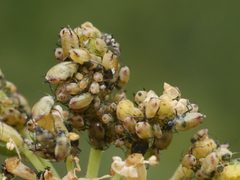
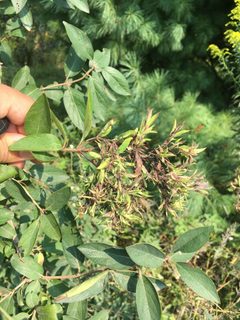
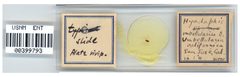
Pronunciation
How to pronounce Hyadaphis: /haɪəˈdeɪfɪs/
These audio files are automatically generated. While they are not always 100% accurate, they are a good starting point.
Identification
Hyadaphis can be distinguished from the related Semiaphis by differences in antennal and siphuncular . Within the genus, species are grouped by siphunculus size and shape, with some species having short siphunculi and others longer tapering forms. females show diagnostic differences in body shape and setation patterns that allow species-level identification.
Images
Habitat
occur on plants in both natural and cultivated settings. Primary hosts include honeysuckle species (Lonicera spp.) in woodland edges, hedgerows, and ornamental plantings. Secondary hosts encompass agricultural fields and gardens growing Apiaceae crops including coriander (Coriandrum sativum), fennel (Foeniculum vulgare), dill (Anethum), and related umbelliferous plants.
Distribution
The has a wide distribution including Europe, Asia (Lebanon, Israel, Pakistan, India), and North America. Hyadaphis tataricae, native to Europe, has been introduced to North America where it is established throughout Quebec, Canada. Records from GBIF indicate presence in Scandinavia (Denmark, Norway, Sweden), the United States (Vermont), and other regions.
Diet
Phloem sap feeder on plants. Documented hosts include Lonicera spp. (honeysuckle), Coriandrum sativum (coriander), Foeniculum vulgare (fennel), Anethum sp. (dill), and Andrachne cordifolia. Feeding causes direct damage through sap removal and may facilitate secondary .
Host Associations
- Lonicera nummulariifolia - primary of H. levantina
- Lonicera spp. - primary general primary for multiple Hyadaphis
- Coriandrum sativum - secondary major agricultural of H. coriandri
- Foeniculum vulgare - secondary of H. foeniculi and H. coriandari
- Anethum sp. - secondary of H. anethi
- Andrachne cordifolia - secondary of H. parva
Life Cycle
Heteroecious with alternation between primary woody hosts (Lonicera) and secondary herbaceous hosts (Apiaceae). includes females, viviparae (winged morphs), and sexual morphs including males and females. occurs as on primary hosts. The presence of males has been confirmed for H. anethi; sexual morphs are inferred for other based on -level patterns.
Behavior
Significant variation in rates between different plant and cultivars has been documented. viviparae mediate between primary and secondary hosts. Colony formation occurs on young growth and developing inflorescences of host plants.
Ecological Role
Herbivorous pest on cultivated and wild plants. Serves as prey for natural enemies including ladybird beetles (Coccinellidae) such as Menochilus sexmaculatus. are influenced by host plant chemistry, with biochemical factors including free , total soluble sugars, and phenolic compounds affecting resistance levels.
Human Relevance
Several are significant agricultural pests causing yield losses in spice and herb crops. Hyadaphis coriandri is a major constraint to coriander production in arid regions. H. foeniculi affects fennel crops. Control measures include synthetic and bio- such as (neem-based products) and fungi ( bassiana). breeding targets biochemical traits including phenol content, which shows significant negative correlation with levels.
Similar Taxa
- SemiaphisRelated in tribe Macrosiphini; distinguished by antennal development and siphuncular structure. Semiaphis nolitangere has been confused with Hyadaphis historically.
Sources and further reading
- BugGuide
- Wikipedia
- GBIF taxonomy match
- iNaturalist taxon
- NCBI Taxonomy
- Catalogue of Life
- Three new Asiatic species of Hyadaphis (Hemiptera, Aphididae)
- Evaluation of Bio-pesticides against Aphid, Hyadaphis coriandri(Das) on Coriander
- HYADAPHIS TATARICAE (HOMOPTERA: APHIDIDAE), A PEST OF HONEYSUCKLE NEW TO NORTH AMERICA
- Control Of Hyadaphis Tataricae (Homoptera: Aphididae) On Honeysuckle Including Observations On Host Plant Resistance
- Bio-Chemical Factors Associated with Resistance to Aphid, Hyadaphis coriandari (Das) in Fennel at Bikaner, Rajasthan, India
- The Biology and Thermal Requirements of the Fennel Aphid Hyadaphis foeniculi (Passerini) (Hemiptera: Aphididae)
- <i>Semiaphis nolitangere</i> Aizenberg, 1954 and differences between the genera <i>Semiaphis</i> van der Goot, 1913 and <i>Hyadaphis</i> Kirkaldy, 1904
- Biometrics of the lady bird beetle, Menochilus sexmaculatus (Fabr.) (Coleoptera: Coccinellidae) fed on three different aphid hosts: Aphis craccivora, Lipaphis erysimi, and Hyadaphis coriandri under laboratory conditions from Rajnandgaon, Chhattisgarh
- Within Plant Distribution and Dynamics ofHyadaphis foeniculi(Hemiptera: Aphididae) in Field Fennel Intercropped with Naturally Colored Cotton