
Hyadaphis tataricae
(Aizenberg, 1935)
Honeysuckle aphid
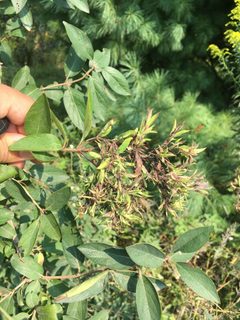
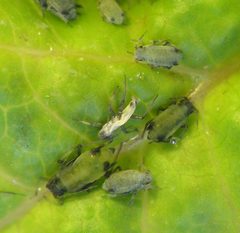
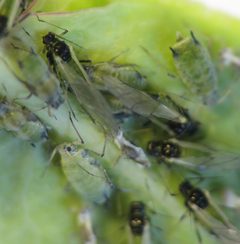
Hyadaphis tataricae is a European introduced to North America, first recorded in Quebec, Canada, and subsequently found in the north-central United States. It is a significant pest of ornamental honeysuckle (Lonicera spp.), causing distinctive witches'-brooming deformation of growing tips. The species exhibits marked variation in susceptibility, with some cultivars showing strong resistance.
Pronunciation
How to pronounce Hyadaphis tataricae: //haɪəˈdeɪfɪs ˌtætəˈraɪsiː//
These audio files are automatically generated. While they are not always 100% accurate, they are a good starting point.
Identification
Identification relies on association with symptomatic honeysuckle plants showing witches'-brooming of growing tips. Distinguished from other aphids on Lonicera by the specific deformation pattern it produces. Confirmation requires examination.
Images
Habitat
Ornamental plantings of large bush-type honeysuckles in gardens and horticultural settings.
Distribution
Native to Europe (Czech Republic, Norway, Sweden). Introduced to North America: widespread in Quebec, Canada; north-central United States including Vermont.
Seasonality
Peak activity in June and July, based on timing of applications.
Diet
Phloem-feeding on honeysuckle (Lonicera spp.).
Host Associations
- Lonicera x zabelii - susceptible; witches'-brooming damage
- Lonicera x notha -
- Lonicera x muendeniensis -
- Lonicera x amoena 'Alba' -
- Lonicera x xylosteoides -
- Lonicera tatarica 'Arnold Red' -
Behavior
Causes witches'-brooming deformation of growing tips on susceptible honeysuckle cultivars. Exhibits differential rates across honeysuckle and cultivars.
Ecological Role
Pest of cultivated ornamental honeysuckles; no known native ecological role in North America.
Human Relevance
Economic pest of ornamental honeysuckle in horticulture. Susceptible to control by acephate, dimethoate, and oxydemeton-methyl; not controlled by malathion. offers promising management strategy.
Similar Taxa
- Other Hyadaphis speciesCongeneric aphids may occur on related plants; requires morphological examination to distinguish.
- Aphis spp. on LoniceraOther feed on honeysuckle but do not produce the distinctive witches'-brooming characteristic of H. tataricae.
More Details
Host Resistance
Significant variation in susceptibility exists among honeysuckle cultivars. Lonicera x zabelii and similar large bush-type honeysuckles are highly susceptible, while L. x notha, L. x muendeniensis, L. x amoena 'Alba', L. x xylosteoides, and L. tatarica 'Arnold Red' show resistance.
Invasion History
First North American record from Quebec, Canada. Subsequent detection in north-central United States indicates ongoing range expansion.