
Rhagonycha fulva
(Scopoli, 1763)
Common Red Soldier Beetle, Bloodsucker Beetle, Hogweed Bonking Beetle
Rhagonycha fulva, commonly known as the common red soldier beetle or hogweed bonking , is a soft-bodied beetle in the Cantharidae. It was first described by Scopoli in 1763 as Cantharis fulva. The is widespread across Europe and Anatolia, and has been introduced to North America where it is established in British Columbia, Quebec, and Ontario. are active from June to August and are frequently observed mating on flowers.


Pronunciation
How to pronounce Rhagonycha fulva: /ræˈɡoʊ.nɪ.kə ˈfʊl.və/
These audio files are automatically generated. While they are not always 100% accurate, they are a good starting point.
Identification
The black patch on the distinguishes Rhagonycha fulva from similar soldier beetles. The simple (non-bilobed) third tarsal segment and black separate it from related . The combination of orange pronotum, red elytra with black tip, and soft body form is distinctive. are entirely black or with only the first segment orange.
Images
Appearance
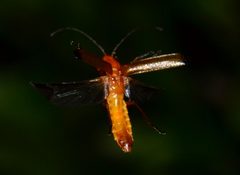
measure 8–10 mm in length with a soft, flexible body. The and pronotum are orange and shiny with fine on the head. The pronotum narrows toward the head, though its shape is variable. The are dark shiny red and cover the wings and most of the , terminating in a distinct black patch at the end—a key identifying feature. are black, though the first segment is occasionally orange. Legs have orange and tibiae with black ; the third tarsal segment is simple (not bilobed).
Habitat
Found in grassland, woodland, hedgerows, parks, and gardens. frequent open-structured flowers, particularly umbellifers such as cow parsley (Anthriscus sylvestris) and hogweeds (Heracleum spp.), as well as Asteraceae. Larvae inhabit the base of long grasses.
Distribution
Native to Europe and Anatolia. Introduced to North America with established in British Columbia, Quebec, and Ontario.
Seasonality
active June through August. Peak activity coincides with flowering of umbelliferous plants.
Diet
feed on aphids, pollen, and nectar. Larvae are predatory on ground-dwelling including slugs and snails.
Host Associations
- Heracleum sphondylium - Significant
- Heracleum mantegazzianum - Significant
- Anthriscus sylvestris - foraging site frequently found on flowers
Life Cycle
Larvae develop at the base of long grasses, preying on ground-dwelling . emerge in summer, living short lives focused heavily on mating. Specific details of and stage are not documented in available sources.
Behavior
spend much of their short adult lives mating and are frequently observed in pairs on flowers, giving rise to the colloquial name 'hogweed bonking .' They are significant of hogweed . The soft body allows flexibility but provides limited protection.
Ecological Role
of aphids and other small in both and larval stages. Significant of Heracleum sphondylium and H. mantegazzianum. Contributes to pollination services in grassland and woodland edge .
Human Relevance
Beneficial insect in gardens and agricultural settings due to . The misleading 'bloodsucker ' has no basis in fact—the does not bite humans. Popular cultural recognition in England under the humorous name 'hogweed bonking beetle.'
Similar Taxa
- Other Cantharidae speciesRhagonycha fulva distinguished by black elytral patch, simple third tarsal segment, and specific color pattern of orange pronotum with red
- Cantharis speciesFormerly classified in Cantharis; R. fulva moved to Rhagonycha based on morphological differences including tarsal structure
Misconceptions
The 'bloodsucker ' is entirely misleading—this does not feed on blood or bite humans. The name likely arose from superficial resemblance to other insects or the red coloration.
More Details
Etymology
The German name 'Roter Weichkäfer' (red soft ) refers to the soft, flexible body characteristic of all soldier beetles. The English colloquial name 'hogweed bonking beetle' reflects the ' conspicuous mating on hogweed flowers.
Taxonomic History
Originally described as Cantharis fulva by Giovanni Antonio Scopoli in 1763 in Entomologia Carniolica, later transferred to Rhagonycha.
Sources and further reading
- BugGuide
- Wikipedia
- GBIF taxonomy match
- iNaturalist taxon
- NCBI Taxonomy
- How Ants Do Battle: Toxic Sprays, Thick Armor, Overwhelming Numbers, and More
- Bug Eric: Two-spotted Cobweb Weaver and kin
- Seeding for Success - Buglife Blog - Buglife
- Gardening for Solitary Bees - Buglife Blog - Buglife
- How One Entomologist Followed a Passion to Understand Insect Interactions
- Coffee Berry Borers Use Gut Bacteria to Detoxify Caffeine