
Cantharis
Linnaeus, 1758
soldier beetle, leatherwing
Species Guides
10- Cantharis alticola(Mountaineer Cantharid Beetle)
- Cantharis aneba(soldier beetle)
- Cantharis fidelis(soldier beetle)
- Cantharis grandicollis(soldier beetle)
- Cantharis lecontei(soldier beetle)
- Cantharis livida(pale soldier beetle)
- Cantharis oregona
- Cantharis rufa(soldier beetle)
- Cantharis transmarina
Cantharis is a large of soldier beetles in the Cantharidae. Members possess soft, flexible that give rise to the 'leatherwings.' Both and larvae are partially , preying on soft-bodied , though adults may feed primarily on nectar, pollen, and honeydew. The genus is frequently encountered in meadows and agricultural settings where it contributes to natural pest control.
Pronunciation
How to pronounce Cantharis: //ˈkænθərɪs//
These audio files are automatically generated. While they are not always 100% accurate, they are a good starting point.
Identification
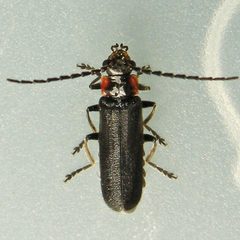
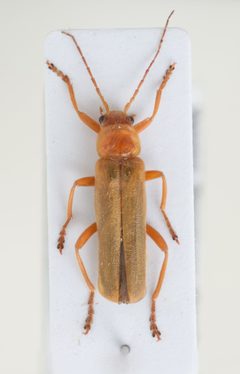
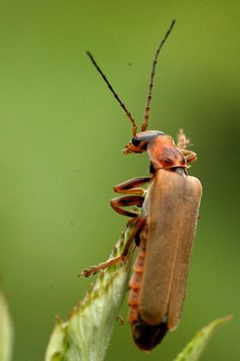
Distinguished from other by soft, flexible rather than hardened shell-like wing covers. Separated from similar soldier beetle (Chauliognathus, Podabrus) by specific antennal and pronotal proportions, though -level identification requires detailed examination. The combination of elongate body, soft elytra, and black-and-red/orange coloration distinguishes Cantharis from most other beetle families. Not to be confused with Lytta vesicatoria (Spanish fly), which belongs to family Meloidae and was historically misclassified under Cantharis.
Images
Habitat
Meadows and arable land, where microclimatic conditions provide high relative humidity favorable for larval development. Frequently found on flowers and vegetation infested with aphids or other honeydew-producing insects.
Distribution
Widespread across the Holarctic region; numerous documented across Europe, Asia, and North America. In California alone, the is one of three common soldier beetle genera present.
Seasonality
active during daylight hours; specific seasonal activity patterns vary by and region. Larval stages occur in humid soil or litter layers.
Diet
and larvae partially , preying on soft-bodied including earthworms, dipteran larvae, and lepidopteran larvae. Adults have been observed feeding on nectar, pollen, and honeydew, and may rely primarily on these food sources under natural conditions.
Behavior
are and commonly observed on flowers or foliage. When disturbed, adults may withdraw their legs and drop to the ground in a death-feigning response. Adults, larvae, and pupae can excrete noxious defensive chemicals from specialized abdominal glands. The aposematic coloration advertises this chemical defense to vertebrate .
Ecological Role
of soft-bodied arthropods contributing to natural regulation of . Their high abundance and general carnivory enable them to serve as natural pest control agents in agricultural systems.
Human Relevance
Beneficial insects in gardens and agricultural settings due to on aphids and other pest . Frequently observed and photographed by naturalists. Subject of occasional confusion with the unrelated Spanish fly (Lytta vesicatoria), a toxic blister beetle historically misclassified in this .
Similar Taxa
- Lytta vesicatoriaHistorically misclassified as Cantharis vesicatoria; actually belongs to Meloidae. Superficially similar appearance but unrelated; Spanish fly is toxic to humans while Cantharis are not.
- ChauliognathusAnother common soldier beetle in the same ; distinguished by specific antennal and body proportions.
- PodabrusCommon soldier beetle sharing Cantharidae; separation requires examination of pronotal and antennal characteristics.
Misconceptions
The name 'cantharis' has been erroneously applied to the Spanish fly (Lytta vesicatoria), a toxic blister beetle in Meloidae. This misclassification persisted until Johan Christian Fabricius corrected it in 1775, establishing the Lytta. Cantharis are not toxic to humans and are beneficial , unlike the medically significant Spanish fly.
More Details
Historical Taxonomy
The was established by Linnaeus in 1758. A major taxonomic correction occurred in 1775 when Fabricius removed the Spanish fly from Cantharis and placed it in the new genus Lytta within Meloidae.
Common Names
Called 'soldier beetles' due to coloration reminiscent of British military uniforms; 'leatherwings' refers to the soft, flexible .
Subgeneric Classification
Includes subgenera Cantharis and Cyrtomoptila, with the latter containing such as C. carsteni, C. gemina, C. lateralis, and C. pagana.