
Erythraeidae
Robineau-Desvoidy, 1828
Subfamily Guides
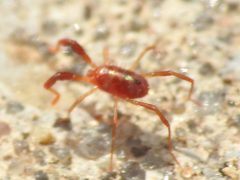
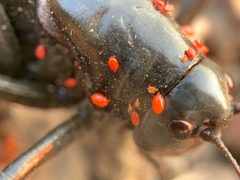
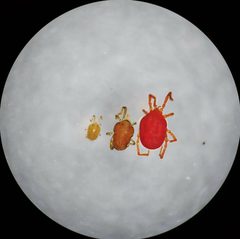
5Erythraeidae is a of predatory mites in the order Trombidiformes. are free-living, fast-running with long legs adapted for pursuit. Larvae are of various arthropods, including harvestmen, spiders, bees, and grasshoppers, using a stylostome to feed on body fluids. These mites are typically oval, relatively large for mites, reddish in color, and densely hairy. The family belongs to the superfamily Erythraeoidea within the diverse group Parasitengona, which includes velvet mites, chiggers, and water mites.
Pronunciation
How to pronounce Erythraeidae: /ˌɛɹɪˈθɹeɪɪˌdiː/
These audio files are automatically generated. While they are not always 100% accurate, they are a good starting point.
Identification
Distinguished from related microscopically by the presence of a single claw on the tibia of the palp. The combination of oval body, dense hairiness, reddish coloration, and exceptionally long first and fourth legs separates from most other mite families. Larvae can be identified by their parasitic association with and the presence of a stylostome for feeding.
Images
Appearance
Oval, relatively large mites, usually reddish-colored and densely hairy. Legs are long, especially the first and fourth pairs, adapted for running. Possess either one or two pairs of . Microscopic examination reveals a single claw on the tibia of the palp, distinguishing them from related .
Habitat
occupy diverse terrestrial . Some , such as Abrolophus, deposit on sun-exposed rocks. The Balaustium has been observed cruising pavement for windblown pollen in spring. Larval habitats are determined by distribution.
Distribution
Worldwide distribution with records from Europe, Asia, Africa, Australasia, North America, and South America. Documented from Iran, Colombia, Spain, France, Italy, Serbia, Sicily, Ukraine, Montenegro, China, and Guatemala. In North America, molecular evidence suggests well over 100 in the U.S. and Canada alone, many undescribed.
Seasonality
active in spring in temperate regions. Spiderlings parasitized by erythraeid larvae emerge in autumn and overwinter, suggesting larval activity in late summer to autumn.
Diet
are free-living . Larvae are that feed on body fluids and dissolved tissues of using a stylostome.
Host Associations
- Harvestmen (Opiliones) - larval Explicitly mentioned as for larval erythraeids
- Spiders (Araneae) - larval Specifically documented for Enoplognatha ovata spiderlings by Trombidiidae and Erythraeidae
- European honey bee (Apis mellifera) - larval Leptus ariel in Guatemala; Leptus alberti in Colombia
- Stingless bees (Partamona peckolti, Paratrigona eutaeniata, Tetragonisca angustula) - larval Leptus alberti in Colombia
- Leioproctus species (Colletidae) - larval Leptus monteithi in Tasmania
- Grasshoppers (Orthoptera: Acrididae, Eumastacidae, Pyrgomorphidae) - larval Charletonia parasitize up to 107 species across all four Australian of Acrididae
- Leafhoppers (Hemiptera) - larval Documented from Southwestern China
Life Cycle
Complex typical of Parasitengona with parasitic larvae and predatory . Larvae bite a hole into the and use a stylostome to feed. After engorgement, larvae detach and develop through inactive stages (calyptostatic) to become free-living predatory adults.
Behavior
are fast runners using long legs for pursuit of prey. Males perform a circular dance before depositing , even without females present. During this dance, males deposit a secretion trail containing a that facilitates rediscovery by the male and likely by females. Multiple spermatophores are deposited at single locations; older spermatophores are pushed to the substrate when new ones are added. Up to 24 spermatophores may be deposited within 2 hours in culture conditions.
Ecological Role
function as in terrestrial . Larvae act as that may influence . Some have been investigated for potential as agents.
Human Relevance
Generally not medically important to humans directly. Some parasitize bees, including honey bees, which may have implications for apiculture. Bright red species in the Balaustium are regularly noticed by the public in spring. Serve as bioindicators due to their specific requirements and sensitivity to environmental conditions.
Similar Taxa
- TrombidiidaeAlso in Erythraeoidea; larvae are of arthropods. Distinguished by microscopic characters of the palp tibia claw structure.
- Trombiculidae (chiggers)Also in Parasitengona with parasitic larvae, but larvae feed on vertebrates rather than arthropods, and are morphologically distinct.
- Hydrachnidae (water mites)Also in Parasitengona but adapted to freshwater; are aquatic with morphological adaptations for swimming rather than running.
More Details
Taxonomic diversity
The contains 62 , including Abrolophus, Balaustium, Charletonia, Erythraeus, and Leptus. Many remain undescribed, particularly in North America where molecular evidence suggests over 100 species in the U.S. and Canada alone.
Reproductive biology
structure includes three protein secretions: Secretion I envelops sperm, Secretion II forms the stalk, and Secretion III forms the crown. Secretions harden through oxidative conversion of sulfhydryl groups to disulfide bonds, prevented from premature hardening by an oily secretion from the accessory gland.
Research significance
Erythraeidae, along with other Parasitengona, are important for understanding the evolutionary transition from terrestrial to aquatic in mites. They serve as models for studying complex evolution and indirect sperm transfer mechanisms.
Sources and further reading
- BugGuide
- Wikipedia
- GBIF taxonomy match
- iNaturalist taxon
- NCBI Taxonomy
- Catalogue of Life
- Bug Eric: Candystripe Spider
- "Go Pick Up a Mite!" Two Cents From an Acarologist and His Love for Mites
- Revision of the genus Charletonia Oudemans (Acrina : Erythraeidae)
- Charletonia stekolnikovi sp. n. (Acari, Erythraeidae) from Iran
- Funktionsanatomie der genitalorgane und fortpflanzungsverhalten bei den männchen der Erythraeidae (Acari, trombidiformes) Functional anatomy of the genital tract and reproductive behavior of the males in the mite family erythraeidae (Acari, trombidiformes)
- Host Relations and Distribution of Australian Species of Charletonia (Acarina, Erythraeidae) Parasitizing Grasshoppers
- New records of mites from some European countries (Trombidiformes: Erythraeidae, Trombidiidae) with new data for some species
- Two new species of Abrolophus (Acari: Erythraeidae) from Montenegro
- A new species of Balaustium von Heyden, 1826 (Acari: Actinotrichida, Erythraeidae) from Spain
- Correction: Xu et al. Four New Species of Larval Charletonia and Leptus (Acari: Trombidiformes: Erythraeidae), with a Checklist of the Two Genera and Their Hosts from China. Insects 2022, 13, 1154.
- Two new species of larval Erythraeidae (Parasitengona) ectoparasites of leafhoppers from Southwestern China.
- Leptus alberti n. sp. (Trombidiformes: Erythraeidae) parasitizing free-living colonies of Apis mellifera, Partamona peckolti, Paratrigona eutaeniata and Tetragonisca angustula in Totoró and Valle del Cauca, Colombia.