
Phalangiidae
Latreille, 1802
Phalangiid Harvestmen, Harvestmen
Genus Guides
9- Leptobunus
- Liopilio
- Mitopus
- Odiellus(harvestmen)
- Oligolophus
- Opilio
- Paroligolophus
- Phalangium(harvestmen)
- Rilaena
A of harvestmen (Opiliones: Eupnoi) containing approximately 380 described . The family includes the widespread and well-studied Phalangium opilio, one of the most recognizable harvestmen in temperate regions. Members are characterized by long, slender legs and a body lacking the narrow waist seen in spiders. The family has a primarily Holarctic distribution with some representation in Africa and other regions.
Pronunciation
How to pronounce Phalangiidae: /fəˈlænjiiːdiː/
These audio files are automatically generated. While they are not always 100% accurate, they are a good starting point.
Identification
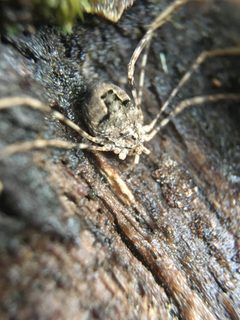
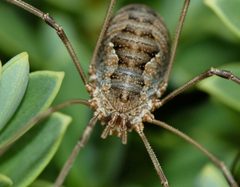
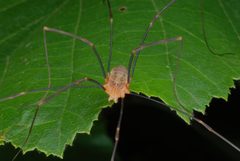
Phalangiidae can be distinguished from the superficially similar Phalangodidae (suborder Laniatores) by their placement in suborder Eupnoi. Within Eupnoi, phalangiids typically exhibit extremely long, thread-like legs relative to body size, a small rounded or oval body with a distinctive pattern often described as a 'diamond-shaped saddle' marking, and positioned on a small ocular . The body is not divided into separate and as in spiders. are relatively small and pincer-like. Many show pronounced in body size and leg proportions.
Images
Habitat
Found across diverse terrestrial including forests (coniferous, deciduous, and mixed woodlands), grasslands, agricultural landscapes, and human-altered environments. Some show specific preferences; for example, Megabunus diadema prefers mixed wood habitats in Western Norway. Phalangium opilio is notably ubiquitous in agroecosystems and remnant natural landscapes.
Distribution
Primarily Holarctic with extensions into other regions. Documented from Europe (including Britain, France, Scandinavia), Asia (Central Asia, Siberia, China, Japan), and North America. Some have been introduced beyond native ranges; Phalangium opilio is established in the United States, and Dicranopalpus ramosus is an introduced species in Europe. African representation includes such as Cristina, Dacnopilio, and Guruia.
Seasonality
Activity patterns vary by and latitude. Megabunus diadema shows maxima in late June in Western Norway. Phalangium opilio is active across extended periods in temperate regions, with observations spanning multiple months in suitable conditions.
Diet
Predatory on small . Phalangium opilio has been documented feeding on nonbiting midges (Chironomidae) and various insects, arachnids, and other invertebrates. Prey detection occurs primarily through physical contact with leg tips rather than visual or olfactory cues.
Behavior
Prey detection relies on tactile sensing via leg tips, with legs I and II held forward and upward to serve sensory functions. Members can autotomize multiple legs with minimal impact on locomotion. Phalangium opilio exhibits a type II when foraging, with handling time estimated at approximately 2.41 minutes per prey item.
Ecological Role
in terrestrial . May contribute to of insect pests including . Phalangium opilio facilitates nutrient and energy transfer between aquatic and terrestrial systems through on emergent midges.
Human Relevance
Phalangium opilio is among the most frequently encountered harvestmen in human-modified landscapes and is commonly observed in gardens, agricultural fields, and urban areas. Often mistaken for spiders due to superficial resemblance. No documented medical or economic significance; harvestmen lack venom and do not bite humans.
Similar Taxa
- PhalangodidaeBoth are of harvestmen, but Phalangodidae belongs to suborder Laniatores rather than Eupnoi, and typically exhibits shorter legs relative to body size and different .
- SclerosomatidaeAnother in Eupnoi with long-legged harvestmen; separation requires examination of male genitalia and detailed leg segment proportions.
More Details
Parthenogenesis
At least one , Megabunus diadema, is primarily parthenogenetic with rare males documented. This represents an unusual reproductive mode within the .
Taxonomic complexity
The contains multiple (Dicranopalpinae, Oligolophinae, Opilioninae, Phalangiinae, Platybuninae) with complex generic-level ; many remain poorly defined and require revision.
Morphological variation
Body size and leg proportions show significant intraspecific variation across and geographic regions, complicating identification based solely on measurements.
Sources and further reading
- BugGuide
- Wikipedia
- GBIF taxonomy match
- iNaturalist taxon
- NCBI Taxonomy
- Catalogue of Life
- Bug Eric: My Personal National Moth Week, 2017
- Further studies on harvestman genus Homolophus (Opiliones: Phalangiidae), with descriptions of two new species
- Ecology and body size of the parthenogenetic Megabunus diadema (Fabricius, 1779) (Opiliones: Phalangiidae) at Karmøy, Western Norway
- Influence of light levels and predator characteristics on the functional response of the European harvestman (Opiliones: Phalangiidae).