
Sclerosomatidae
Simon, 1879
Sclerosomatid Harvestmen
Genus Guides
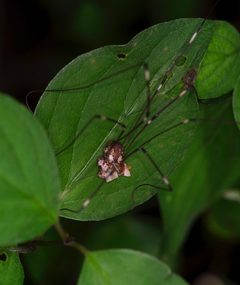
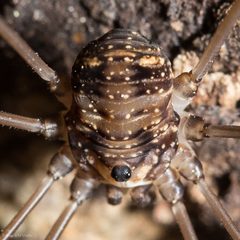
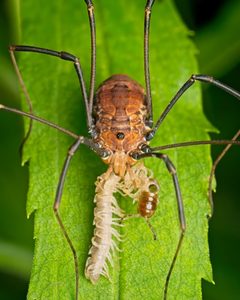
7Sclerosomatidae is a large of harvestmen (Opiliones) comprising approximately 1,300 described . The family is characterized by a hardened body structure, reflected in its name derived from Greek skleros ('hard') and soma ('body'). Members exhibit the classic 'daddy long legs' with small, rounded bodies and long, slender legs. The family includes several —Gagrellinae, Gyantinae, Leiobuninae, and Sclerosomatinae—distributed across diverse worldwide. Some species display iridescent metallic coloration, particularly in tropical lineages. A former subfamily has been removed to form the separate family Globipedidae.
Pronunciation
How to pronounce Sclerosomatidae: //ˌsklɛɹoʊsoʊˈmætəˌdiː//
These audio files are automatically generated. While they are not always 100% accurate, they are a good starting point.
Identification
Distinguished from other harvestman by the combination of opisthosomal tergites forming a parvum and pectinate claw. Differs from Phalangiidae in body patterns. The Gagrellinae and Leiobuninae can be recognized by iridescent metallic coloration in many tropical . Trachyrhinus species are identifiable by relatively short legs and distinctive color patterns including orange intersegmental articular . Gyantinae (single Gyas) is restricted to the Alps.
Images
Habitat
Diverse including shortgrass prairie, coastal dunes, mountainous forests, and tropical environments. Specific microhabitats include dense Ammophila arenaria vegetation in dunes, Japanese beech forest zones above 700m elevation, and undisturbed sand-shifting areas. Some show strong habitat specificity with patchy local distribution.
Distribution
Worldwide distribution with major centers of diversity in Asia (especially Southeast Asia, India, Nepal, Japan), Latin America, and North America. European fauna includes alpine (Gyas) and widespread Leiobuninae. Fossil evidence from Eocene Messel deposits (ca. 47 Ma, Germany) indicates historical presence in Europe with warmer climate associations. Some are geographically restricted: Gyas to the Alps, Trachyrhinus to North America (North Dakota to north-central Texas).
Seasonality
Activity patterns vary by and latitude. Trachyrhinus favosus is active only during fall. Nelima gothica follows typical North European phalangiid : juveniles develop in late spring and summer, with autumn and -stage hibernation. Tropical species likely show extended or year-round activity.
Life Cycle
life-cycle documented in some temperate : development through late spring and summer, autumn , and hibernation in the stage. Specific details vary among and geographic regions.
Behavior
Defensive include vigorous bouncing that blurs body form while (observed in Trachyrhinus favosus), and chemical defense through repugnatorial glands producing phenols, quinones, ketones, and/or alcohols. Some exhibit aposematic coloration warning of distastefulness. with synchronized swaying movements have been observed in Neotropical species.
Human Relevance
Subject of taxonomic and phylogenetic research due to high diversity and complex classification history. Some serve as indicators of quality and climate conditions. Fossil specimens from Messel provide rare insights into Cenozoic arachnid evolution and ancient coloration mechanisms. Epizoic cyanobacteria associations suggest potential microhabitat indicators.
Similar Taxa
- PhalangiidaeSimilar 'daddy long legs' but differs in structure and claw morphology; Sclerosomatidae has more extensively tergites
- GlobipedidaeRecently separated from Sclerosomatidae as a distinct ; previously treated as a within Sclerosomatidae
- NemastomatidaeBoth in Eupnoi but Nemastomatidae typically has more complex male genitalia and different body proportions
More Details
Subfamily classification
The comprises four recognized : Gagrellinae (tropical, often iridescent), Gyantinae (alpine, Gyas), Leiobuninae (widespread, includes Leiobunum with 126 ), and Sclerosomatinae (European, Mediterranean). The former 'Globipedinae' has been elevated to family rank as Globipedidae.
Fossil record
Eocene fossils from Messel, Germany (ca. 47 Ma) represent the first formal description of fossil harvestmen from this locality and among the few non-amber Cenozoic records. These specimens preserve iridescent metallic coloration previously unknown in arachnid fossils, supporting placement in Gagrellinae or Leiobuninae.
Chemical ecology
Gagrellinae possess specialized repugnatorial glands; Prionostemma have been documented to sequester myrmicacin, an -derived compound, suggesting chemical from prey or associations.
Epizoic associations
At least one Neotropical harbors epizoic cyanobacteria (Scytonema coactile and S. guyanense) on the , forming visible greenish patches—representing a novel record of cyanobacterial epibiosis on harvestmen.
Sources and further reading
- BugGuide
- Wikipedia
- GBIF taxonomy match
- iNaturalist taxon
- NCBI Taxonomy
- Catalogue of Life
- Phreaky Phalangid | Beetles In The Bush
- Epizoic cyanobacteria associated with a Neotropical harvestman (Opiliones: Sclerosomatidae) from Costa Rica
- Iridescent harvestmen (Arachnida: Opiliones: Sclerosomatidae) from the Eocene of Messel, Germany
- Distribution and life-cycle ofNelima gothica(Opiliones, Sclerosomatidae) in Danish dunes
- Geographic variation of chromosomes and somatic morphology in the Japanese polymorphic species Leiobunum hiraiwai (Arachnida: Opiliones: Sclerosomatidae)
- Sexual Differences in the Behavior of the Harvestman Leiobunum vittatum (Opiliones, Sclerosomatidae) Towards Conspecific Cues
- Taxonomic notes on Holcobunus Roewer, 1910, with descriptions of three new species, and new records for Holcobunus nigripalpis Roewer, 1910<br />(Opiliones: Eupnoi: Sclerosomatidae)
- The scent gland chemistry of Gagrellinae (Opiliones, Sclerosomatidae): evidence for sequestration of myrmicacin in a species of Prionostemma.