
Eupnoi
Hansen & Sørensen, 1904
Eupnoan Harvestmen
Suborder Guides
2- Caddoidea
- Phalangioidea(harvestmen)
Eupnoi is a suborder of harvestmen (order Opiliones) comprising approximately 1,700 described across more than 200 . The group is divided into two superfamilies: Phalangioidea, which includes the familiar long-legged "daddy long-legs" common in northern temperate regions, and the smaller Caddoidea, characterized by prominent and spiny . Eupnoi harvestmen possess a unique secretory gland opening via an ozopore on the dorsum, which produces defensive and communicative chemicals. They exhibit complex social including multi-specific roosting and chemical-based alarm signaling.
Pronunciation
How to pronounce Eupnoi: /juːpˈnɔɪ.aɪ/
These audio files are automatically generated. While they are not always 100% accurate, they are a good starting point.
Identification
Eupnoi can be distinguished from other harvestman suborders by the combination of long legs (particularly in Phalangioidea), the presence of a ozopore associated with a unique secretory gland, and the absence of the heavily armored, short-legged characteristic of Laniatores. From Dyspnoi, they differ in leg proportions and genetic relationships. Caddoidea are distinguished from Phalangioidea by their prominent and spiny . -level identification relies on characters including ocularium structure, morphology, pedipalp armature, and cuticular microanatomy; traditional characters such as body length and leg segment ratios are often unreliable.
Images
Appearance
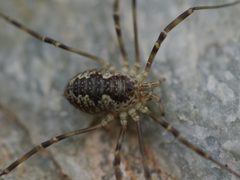
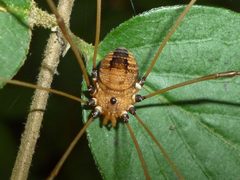
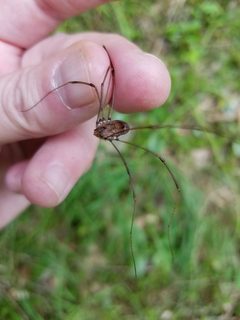
Eupnoi harvestmen display the classic harvestman body plan with a prosoma and opisthosoma forming an oval to elongated body, and characteristically long, slender legs. Phalangioidea typically have extremely elongated legs, particularly the second pair, which are often waved in the air as sensory appendages. Caddoidea species possess prominent and conspicuously spiny . All Eupnoi have an ocularium (eye ) bearing the eyes, and a ozopore opening from a unique secretory gland. Cuticular surface texture and setal distribution vary considerably among species and may include tubercles, spines, or smooth areas.
Habitat
Eupnoi occupy diverse across their broad distribution. Phalangioidea are common in wooded habitats, forest edges, and grasslands, with many species favoring moist microhabitats under logs, stones, and leaf litter. Caddoidea are found in temperate zones of both hemispheres, including forests in Japan, southern South America, Venezuela, New Zealand, and Australia. Sclerosomatidae show distinct habitat preferences: Leiobuninae range across the Holarctic into montane regions; Gagrellinae inhabit Indo-Malayan and neotropical forests; Gyinae occur at high elevations in the Caucasus, Alps, and Nepal. Many species form traditional roosting in sheltered locations.
Distribution
Eupnoi have a global distribution spanning all continents except Antarctica. Phalangioidea are particularly diverse and abundant in northern temperate regions. Caddoidea occur in temperate zones of both hemispheres, with records from Japan, North America, southern South America, Venezuela, New Zealand, and Australia; Baltic amber contains 40-million-year-old Caddoidea fossils. Neopilionidae exhibit a Gondwanan distribution (South America, South Africa, Australia). Sclerosomatidae display complex biogeographic patterns: Leiobuninae across the Holarctic to Rica; Gagrellinae in Indo-Malayan and neotropical regions; Sclerosomatinae restricted to the Palearctic. Phalangiidae show Mediterranean-centered diversity with some introduced Nearctic .
Seasonality
Activity patterns vary by and climate. Temperate species are typically active during warmer months, with some species forming during cooler periods. Specific seasonality data not documented at suborder level.
Host Associations
- Leptus (Erythraeidae) - Larval mites parasitize harvestmen, attaching primarily to leg ; and intensity vary with and quality
Behavior
Eupnoi harvestmen exhibit sophisticated chemical communication mediated by their unique secretory gland. They rely on short-range olfaction and contact chemoreception using specialized setae. Documented include: defensive secretion release; alarm signaling potentially involving ; spatial marking of traditional roosting sites; recruitment to ; and chemical communication during courtship. The second pair of legs is frequently waved in the air as pseudo- to detect stimuli. When disturbed, individuals may exhibit (playing dead) or voluntarily autotomize legs as additional defense mechanisms.
Ecological Role
Eupnoi serve as prey for various and as for ectoparasitic mites. Their may influence local structure. As predators and scavengers, they contribute to nutrient cycling and prey on small , though specific functions are poorly documented. Mite intensity on Eupnoi has been proposed as an indicator of quality in forest ecosystems.
Human Relevance
Eupnoi harvestmen are familiar to the public as "daddy long-legs" and are generally considered harmless. They are common subjects in macrophotography due to their accessibility and distinctive appearance. Some introduced (e.g., certain Phalangiinae in the Nearctic) have expanded their ranges with human activity. The group has received significant research attention for their unique chemical communication systems and as models for studying social and .
Similar Taxa
- DyspnoiTraditionally grouped with Eupnoi as Palpatores; differs in leg proportions and recently proposed as sister to Laniatores rather than to Eupnoi; includes with enlarged for crushing snail shells (e.g., Ischyropsalis, Nipponopsalis) not found in Eupnoi
- LaniatoresShort-legged, heavily armored harvestmen with enlarged for ; lacks the long-legged, ozopore-bearing of Eupnoi; generally more robust and less
- CyphophthalmiMite-like, eyeless harvestmen lacking ocularium; extremely small and cryptic; no chemical defense glands comparable to Eupnoi ozopore system
More Details
Systematic Uncertainty
and limits within Eupnoi remain uncertain and require revision. The monophyly of Caddoidea and Phalangioidea is supported, but relationships among constituent families are poorly resolved. The supposed family 'Stygophalangiidae' is not a harvestman but likely a mite.
Research Opportunities
Chemical communication in Eupnoi presents significant research gaps, including: confirmation of function in ; identification of roost-marking chemicals; mechanisms of female-male chemical communication; and trade-offs between chemical defense and /.
Sources and further reading
- BugGuide
- Wikipedia
- iNaturalist taxon
- Catalogue of Life
- Answer to Super Crop Challenge #1 | Beetles In The Bush
- Chemical communication and ecology in Eupnoi harvestmen
- Comparative Study of the Microanatomy of Four Species of Harvestmen (Opiliones, Eupnoi)
- Distribution of 18S rDNA clusters in Central European harvestmen of the suborder Eupnoi (Arachnida: Opiliones)
- Contrasting patterns of divergence and gene flow in subspecies of a forest-dwelling harvestman Leiobunum japanense (Eupnoi: Opiliones: Arachnida)
- Host–parasite interactions between mites (Acari: Erythraeidae) and harvestmen (Opiliones, Eupnoi) as indicators of habitat quality in the Atlantic Forest
- Taxonomic notes on Holcobunus Roewer, 1910, with descriptions of three new species, and new records for Holcobunus nigripalpis Roewer, 1910<br />(Opiliones: Eupnoi: Sclerosomatidae)