
Dyspnoi
Hansen & Sørensen, 1904
Dyspnoan Harvestmen
Suborder Guides
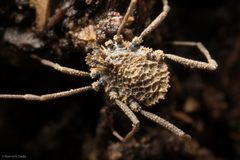
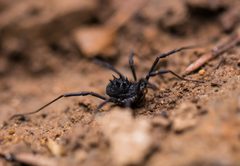
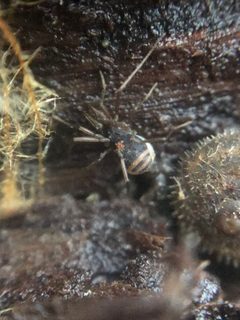
3Dyspnoi is a suborder of harvestmen (Opiliones) comprising approximately 43 extant and 356 described across eight . The group is organized into three superfamilies: Acropsopilionoidea, Ischyropsalidioidea, and Troguloidea. Dyspnoi represents one of the most biogeographically conserved higher groups of harvestmen, with distribution patterns suggesting relictual status as paleo-European mainland fauna. Members possess distinctive defensive with complex functional anatomy involving hidden ozopores and specialized secretion discharge mechanisms.
Pronunciation
How to pronounce Dyspnoi: //ˈdɪspnɔɪ//
These audio files are automatically generated. While they are not always 100% accurate, they are a good starting point.
Identification
Dyspnoi can be distinguished from other Opiliones suborders by the presence of prosomal defensive with ozopores hidden in a depression (atrium) formed by a integumental fold of the and dorsal parts of I, rather than exposed ozopores as seen in Laniatores, Cyphophthalmi, and some Eupnoi. The scent gland ducts possess a specific closing mechanism with a pad-like tissue valve and associated musculature for secretion discharge. Some , such as Nipponopsalis and Ischyropsalis, exhibit notably enlarged in both sexes used for crushing snail shells. Members of the Nemastomatidae within this suborder often show reduced body size and regression in cave-dwelling (troglobitic) .
Images
Habitat
Predominantly temperate forest and woodland , with many associated with moist microhabitats including leaf litter, soil crevices, and decaying wood. Several lineages have independently adapted to cave environments (troglobitic), showing troglomorphic features such as reduction and elongation of appendages. Some Ortholasmatinae (Nemastomatidae) occur in tropical high-elevation habitats, including cloud forests in Mexico and montane regions in northern Thailand.
Distribution
Primarily distributed in the Northern Hemisphere temperate regions, with exceptional biogeographic conservation among harvestmen groups. The suborder does not occur in the Southern Hemisphere except for Acropsopilioidea. Major centers of diversity include Europe, North America, and temperate Asia. The Hadzinia-Nemaspela complex in the Balkans and Caucasus represents relictual paleo-European mainland fauna that survived Pleistocene climatic changes in southern . The Nemaspela is primarily Caucasian with disjunct occurrence in the Dinaric region.
Diet
Specialized feeding habits documented in some lineages: Nipponopsalis and Ischyropsalis possess enlarged adapted for crushing and consuming snails. General feeding for most Dyspnoi remains poorly documented, though likely includes small and detritus based on related harvestmen groups.
Behavior
Defensive involves chemical defense via prosomal . The secretion discharge mechanism is complex and unusual: fluid is directed toward ozopores via cuticular grooves on coxapophyses of legs I, then sucked into scent gland by dilator muscles creating negative pressure. After dilution of naphthoquinone-rich gland contents, secretion-loaded fluid is discharged via transversal compressor muscles. This represents a derived mechanism distinct from other Opiliones suborders.
Ecological Role
Predatory and scavenging roles in soil and leaf litter ; specialized snail in certain lineages. Troglobitic contribute to nutrient cycling in cave .
Similar Taxa
- EupnoiBoth are suborders of long-legged harvestmen (Palpatores), but Eupnoi lack the hidden ozopore structure and complex closing mechanism characteristic of Dyspnoi; Eupnoi typically have exposed ozopores.
- LaniatoresShort-legged harvestmen with exposed ozopores and different ; Laniatores often possess enlarged for defense rather than the enlarged seen in some Dyspnoi.
- CyphophthalmiMite-like harvestmen with exposed ozopores and generally reduced body size; lack the distinctive atrium-enclosed ozopores and associated gland musculature of Dyspnoi.
More Details
Scent gland evolution
The functional anatomy of Dyspnoi represents a derived condition within Opiliones, with the hidden ozopore in an atrium and specialized valve-like closing mechanism representing evolutionary innovations for controlled chemical defense.
Cheliceral enlargement
Enlarged have evolved independently in Dyspnoi (Nipponopsalis, Ischyropsalis) and Eupnoi (Megalopsalis, Pantopsalis), but differ in function: Dyspnoi use them for feeding (snail crushing) in both sexes, while Eupnoi use them primarily for male-male combat.
Conservation status
Many Dyspnoi have restricted distributions and specialized requirements (caves, relict forests), making them potentially vulnerable to habitat destruction and climate change, though formal assessments are limited.
Sources and further reading
- BugGuide
- Wikipedia
- iNaturalist taxon
- Catalogue of Life
- Answer to Super Crop Challenge #1 | Beetles In The Bush
- Functional anatomy of scent glands in Paranemastoma quadripunctatum (Opiliones, Dyspnoi, Nemastomatidae)
- Nemaspela ladae sp. n., a new troglobitic nemastomatid (Opiliones, Dyspnoi, Nemastomatidae) from a Dinaric cave