
Brachycaudus helichrysi
(Kaltenbach, 1843)
leaf curl plum aphid, leaf-curling plum aphid, peach leaf curl aphid
Brachycaudus helichrysi is a small first described by Kaltenbach in 1843. Molecular studies have revealed it comprises two cryptic sibling lineages, B. helichrysi H1 and H2, which are morphologically indistinguishable but genetically divergent and differ in strategies. H1 follows a typical heteroecious cycle with on plum trees, while H2 consists largely of obligate superclones with some sexual on peach trees in India.

Pronunciation
How to pronounce Brachycaudus helichrysi: /brəˈkɪkɔːdəs ˌhɛlɪˈkraɪsi/
These audio files are automatically generated. While they are not always 100% accurate, they are a good starting point.
Identification
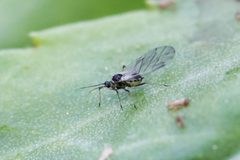
Distinguished from the thistle aphid (Brachycaudus cardui) by the lack of a dark, shining abdominal patch. The short, pale, flanged cornicles and bluntly rounded cauda are additional diagnostic features. Seasonal color change from brownish to yellowish-green in wingless forms, and the specific pattern of dark spots on the of winged females, aid field identification. Molecular methods () are required to distinguish the cryptic sibling lineages H1 and H2.
Images
Appearance
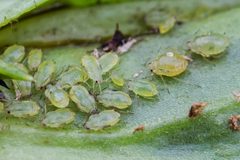
Wingless females have an oval to pear-shaped body reaching up to 2 mm in length. Early-season individuals are brownish, becoming yellowish-green later. are pale green and short, approximately half the body length. The lacks a dark shining patch—a key distinction from the similar Brachycaudus cardui. The cauda is bluntly rounded. Legs are pale except at the extremities. Cornicles are pale, short, and flanged. Winged females measure 1.3–1.8 mm with a blackish , longer antennae, blackish , and green abdomen bearing dark spots on segments three through six. are black.
Habitat
Associated with cultivated and wild Prunus as primary , particularly plum (Prunus domestica), damson, and peach (Prunus persica). Secondary hosts include herbaceous plants in Asteraceae (e.g., Chrysanthemum), Fabaceae (e.g., Trifolium pratense), and sunflower. H2 lineage shows broader polyphagy on herbaceous hosts. Found in orchards, agricultural settings, and areas with host plant availability.
Distribution
distribution with worldwide occurrence. H1 lineage shows geographic structure with differentiated Central Asian versus American–European . H2 lineage comprises globally distributed superclones. Sexual H2 populations documented only from peach trees in Northern India. Present in Belgium with records from multiple regions; additional records from Brazil (Rio Grande do Sul).
Seasonality
as fertilized on primary twigs and spurs. Egg hatch occurs during winter or early spring, before host trees leaf out. Colony development on primary hosts proceeds through spring, with winged forms appearing by May and migrating to secondary hosts. Autumn sees return to primary hosts, , and egg-laying. Timing varies geographically; Northern Irish showed delayed egg hatch compared to other regions.
Diet
Phloem-feeding on plant sap. Fundatrices initially feed at bud bases, moving to softer tissues, new shoots, and leaf undersides as foliage develops.
Host Associations
- Prunus domestica - primary plum; site of and deposition
- Prunus spinosa - primary documented in Northern Ireland studies
- Prunus persica - primary peach; particularly associated with H2 lineage sexual in India
- Prunus persica var. nucipersica - primary nectarine
- Chrysanthemum - secondary Asteraceae; summer colony site
- Helianthus annuus - secondary sunflower; significant agricultural
- Trifolium pratense - secondary red clover; documented in studies
- Asteraceae - secondary -level association for summer colonies
Life Cycle
Heteroecious in H1 lineage: as on primary , fundatrix hatching before bud-break, multiple parthenogenetic generations on primary host through spring, to secondary hosts in May, several generations on herbaceous hosts through summer, autumn return migration to primary hosts, and egg-laying. H2 lineage primarily anholocyclic with obligate via persistent superclones; limited sexual reproduction on peach documented only in Northern India.
Behavior
Forms dense colonies on leaf undersides, causing characteristic curling, twisting, and distortion of foliage. Fundatrices exhibit progressive movement from bud bases to softer expanding tissues and new shoots. forms disperse to found new colonies on secondary . Stylet penetration involves puncture, facilitating virus acquisition.
Ecological Role
Serious pest of stone fruit causing direct damage through feeding and indirect damage as a virus . Documented vector of potato virus Y with 34% transmission in Northern Irish , higher than previously estimated. Also vectors plum pox virus. Serves as prey for natural enemies including ladybirds (Coccinellidae: Oenopia sauzeti, Cheilomenes sexmaculata), lacewings, soldier beetles, and hoverflies.
Human Relevance
Major agricultural pest of plum, damson, peach, and nectarine orchards. Damage includes leaf curling and distortion, flower shedding, and fruit drop. Virus status enhances economic significance, particularly for potato crops early in the growing season. Subject of research using predatory ladybirds. Control methods have been studied since at least 1955.
Similar Taxa
- Brachycaudus carduithistle aphid; distinguished by presence of dark shining patch on , which B. helichrysi lacks
Misconceptions
Historically treated as a single , but molecular evidence demonstrates B. helichrysi comprises two cryptic (H1 and H2) with contrasting and associations. Morphological similarity led to previous conflation of these distinct evolutionary lineages.
More Details
Cryptic Species Complex
Molecular using mitochondrial (COI), nuclear (EF-1α), and Buchnera aphidicola markers revealed two -level lineages with genetic divergence comparable to other Brachycaudus pairs. H1 and H2 overlap geographically and share herbaceous preferences but differ in reproductive mode and primary host association.
Superclone Distribution
H2 lineage contains at least eight highly successful global superclones that persist via obligate , representing one of the most widespread clonal complexes documented.
Sources and further reading
- BugGuide
- Wikipedia
- GBIF taxonomy match
- iNaturalist taxon
- NCBI Taxonomy
- Catalogue of Life
- Biology and functional response of Oenopia sauzeti (Mulsant) on peach leaf curl aphid, Brachycaudus helichrysi (Kaltenbach)
- The Biology, Life History and Methods of Control of the Leaf Curling Plum AphidBrachycaudus Helichrysi(KLTB.)
- Molecular phylogeny reveals the existence of two sibling species in the aphid pestBrachycaudus helichrysi(Hemiptera: Aphididae)
- Différenciation génétique et écologique au sein des populations du puceron Brachycaudus helichrysi (Hemiptera Aphididae) : mise en évidence de deux espèces soeurs au cycles de vie contrastés
- Stylet activities and potato virus Y vector efficiencies by the aphids Brachycaudus helichrysi and Drepanosiphum platanoidis
- Biology, demographic traits and predation rate of Cheilomenes sexmaculata (Fabricius) (Coleoptera: Coccinellidae) on peach leaf curl aphid, Brachycaudus helichrysi (Kaltenbach) (Hemiptera: Aphididae)
- The life‐history of the leaf‐curling plum aphid Brachycaudus helichrysi in Northern Ireland and its ability to transmit potato virus YC(AB)
- Regular or covert sex defines two lineages and worldwide superclones within the leaf‐curl plum aphid (Brachycaudus helichrysi, Kaltenbach)
- Large-scale phylogeographic study of the cosmopolitan aphid pestBrachycaudus helichrysireveals host plant associated lineages that evolved in allopatry