
Brachycaudus cardui
Linnaeus, 1758
thistle aphid, plum-thistle aphid
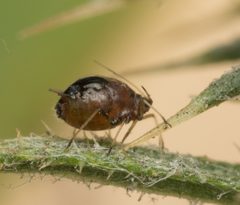
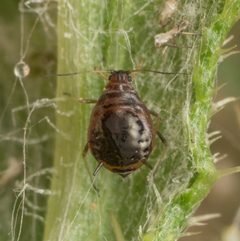
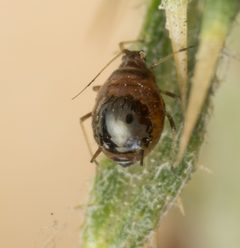
Brachycaudus cardui is a heteroecious with a complex alternating between primary woody (Prunus spp.) and secondary herbaceous hosts, primarily thistles and other Asteraceae. Wingless females are small (1.8–2.5 mm), oval to pear-shaped, and variable in color. The species is notable for causing leaf roll on Prunus and for transmitting plum pox virus, a serious agricultural . Colony establishment depends heavily on attendance.
Pronunciation
How to pronounce Brachycaudus cardui: //ˌbræ.kɪˈkaʊ.dəs ˈkɑːr.dju.aɪ//
These audio files are automatically generated. While they are not always 100% accurate, they are a good starting point.
Identification
The dark, shining patch on the distinguishes B. cardui from the similar plum leaf curl (Brachycaudus helichrysi). The combination of heteroecious (Prunus to Asteraceae alternation), small size, and color variability further supports identification. Microscopic examination may be required for definitive separation from .
Images
Habitat
Found in diverse environments including orchards, meadows, roadsides, and damp areas. Primary are cultivated and wild Prunus trees. Secondary hosts include thistles (Carduus, Cirsium), other Asteraceae, and occasionally Boraginaceae. Colonies require attendance for successful establishment; ant exclusion causes colony failure even on suitable host plants.
Distribution
Widely distributed across Europe, Asia, North Africa, and North America. Documented in Hungary on Senecio jacobaea in northwestern regions, and present on the Azores (Faial, Flores, São Miguel, Terceira) and in Belgium.
Seasonality
Active on primary Prunus in spring and autumn. Migrates to secondary herbaceous hosts (Asteraceae, Boraginaceae) during summer months. Winged individuals return to primary hosts in autumn to complete the seasonal cycle.
Diet
Phloem-feeding with -alternating strategy: primary hosts are Prunus (plum, cherry, apricot, peach, damson); secondary hosts include thistles (Carduus, Cirsium), other Asteraceae such as ragwort (Jacobaea vulgaris), and occasionally Boraginaceae such as Symphytum.
Host Associations
- Prunus domestica - primary plum
- Prunus avium - primary cherry
- Prunus armeniaca - primary apricot
- Prunus persica - primary peach
- Prunus insititia - primary damson
- Carduus - secondary thistle
- Cirsium - secondary thistle
- Jacobaea vulgaris - secondary ragwort; colonies fail without attendance
- Senecio jacobaea - secondary documented in Hungary
- Symphytum - secondary Boraginaceae; occasionally used
Life Cycle
Heteroecious with obligatory alternation. Overwinters as on primary Prunus hosts. Spring reproduce viviparously on Prunus, producing winged migrants that disperse to secondary herbaceous hosts in early summer. Multiple parthenogenetic generations occur on secondary hosts. Winged individuals return to Prunus in autumn to produce sexual morphs and eggs. Colony persistence on secondary hosts depends on attendance.
Behavior
Forms colonies attended by ants that feed on honeydew and defend against . Experimental exclusion of ants causes colony failure even when plants are abundant. Winged migrants exhibit directed between primary and secondary hosts. On secondary hosts, colonies are typically found on stems and flowerheads.
Ecological Role
Herbivore that induces leaf rolling on primary . Serves as honeydew producer supporting mutualists. Acts as of plum pox virus (Sharka ), transmitting this serious among Prunus with significant agricultural consequences.
Human Relevance
Agricultural pest of stone fruit orchards. Direct damage includes leaf rolling on Prunus spp. Indirect damage through transmission of plum pox virus, which causes significant economic losses in plum, peach, apricot, and cherry production. attendance complicates efforts.
Similar Taxa
- Brachycaudus helichrysiSimilar and also infests Prunus; distinguished by absence of dark shining patch on
More Details
Ant mutualism dependency
Research has demonstrated that B. cardui colonies fail to establish on secondary in the absence of ants, even when suitable host plants are abundant. This obligate or near-obligate mutualism involves ants feeding on honeydew and providing protection from and .
Sources and further reading
- BugGuide
- Wikipedia
- GBIF taxonomy match
- iNaturalist taxon
- NCBI Taxonomy
- Catalogue of Life
- The Bee and the Butterfly | Bug Squad
- The Migratory Painted Lady and a UC Davis Chancellor's Postdoctoral Fellow | Bug Squad
- Of Butterfly Patterns and Genetic Codes | Bug Squad
- Painted Ladies on the Move | Bug Squad
- A Flash of Orange: Welcome, California Tortoiseshell! | Bug Squad
- Two Insect Contests: One Winner, One to Go | Bug Squad
- Brachycaudus species on herbaceous plants along highways in Hungary