
Brachycaudus
Van der Goot, 1913
Short-tailed Aphids
Species Guides
3- Brachycaudus cardui(thistle aphid)
- Brachycaudus helichrysi(leaf curl plum aphid)
- Brachycaudus tragopogonis(Goatsbeard Aphid)
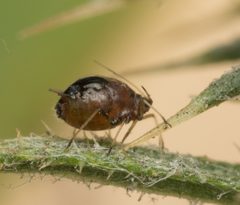
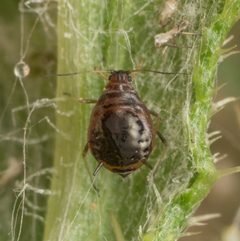
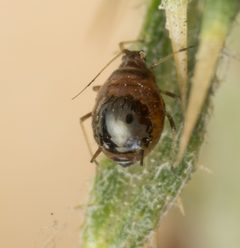
Brachycaudus is a of aphids in the Aphididae, commonly known as short-tailed aphids. The genus contains approximately 43 distributed worldwide, including significant agricultural pests such as B. helichrysi (peach leaf curl ) and B. rumexicolens. Species in this genus exhibit remarkable evolutionary lability in strategies, with transitions occurring between monoecy on woody , heteroecy (host alternation), and monoecy on herbaceous plants. This flexibility contradicts the traditional assumption that aphids cannot regain primary woody hosts once lost.
Pronunciation
How to pronounce Brachycaudus: /ˌbræ.kɪˈkaʊ.dəs/
These audio files are automatically generated. While they are not always 100% accurate, they are a good starting point.
Identification
-level identification of Brachycaudus requires examination of morphological features including: the number of (larval sensory organs) between the two hairs on the first tarsal joint of the three legs in first instar larvae, which are replaced by sensory setae in later instars; the length of the hardened part of the second rostral segment; and the distribution of hairs on first instar larvae. The number of marginal setae per abdominal segment on both sides of the body varies between morphs and can be used for -level distinction. These features distinguish Brachycaudus from the related genus Appelia. Winged and wingless morphs occur; winged forms have with ocular and ocelli.
Images
Habitat
occupy diverse depending on type. species on woody occur on Prunus species (Rosales) and Spiraea species. Heteroecious species alternate between primary woody hosts (primarily Prunus) and secondary herbaceous hosts in including Asteraceae, Boraginaceae, Caryophyllaceae, Lamiaceae, Polygonaceae, and Scrophulariaceae. Monoecious herbaceous species colonize dicotyledonous herbaceous plants in open and disturbed habitats including roadsides and agricultural areas. Specific habitat associations vary by species: B. lychnidis occurs on Silene alba along highways; B. rumexicolens inhabits areas with Polygonaceae weeds.
Distribution
Worldwide distribution with records from Europe, Asia, Africa, Australia, and the Americas. GBIF records indicate presence in Norway and Sweden. B. helichrysi occurs globally with differentiated lineages (H1 and H2) showing distinct geographic patterns—H1 exhibits geographically structured genetic clusters while H2 superclones are widely distributed. B. divaricatae, originally described from the Middle East, has established in Central Europe including Poland and Hungary. B. schwartzi has been reported from Tunisia since 2010. B. rumexicolens, native to North America, has been introduced to Australia.
Seasonality
Activity patterns vary by and climate. B. rumexicolens has theoretical development limits of 6.4°C (lower) and 32°C (upper), with maximum at 19°C and peak growth rate at approximately 28°C. In south-western Australia, B. rumexicolens shows suitable population growth periods in autumn and spring, with unlikely summer survival. B. divaricatae in Poland shows early seasonal with sexuales emerging in mid-May and first laid in June, completing 6-8 per season. B. spiraeae completes its entire on Spiraea species with late summer generations and sexual forms developing on the same .
Diet
Phloem-feeding on plant vascular tissues. Primary hosts for heteroecious are Prunus species (plum, peach, cherry). Secondary hosts include cultivated herbaceous plants: sunflowers (Helianthus), chrysanthemums, and various Asteraceae; also Boraginaceae (Symphytum), Caryophyllaceae (Melandrium, Silene), Lamiaceae, Polygonaceae (Rumex, Emex, Atraphaxis, Rheum), and Scrophulariaceae. herbaceous species feed on single host : B. lychnidis on Silene, B. setosus on Tragopogon, B. mordvilkoi on Symphytum, B. cardui on Senecio, B. rumexicolens on Rumex and Emex.
Host Associations
- Prunus spp. - primary Woody for heteroecious ; includes plum, peach, cherry, apricot
- Spiraea spp. - Complete of B. spiraeae on S. salicifolia, S. vanhouttei, S. arguta
- Helianthus annuus - secondary Sunflower, cultivated for B. helichrysi
- Chrysanthemum spp. - secondary Cultivated for B. helichrysi
- Silene alba - for B. lychnidis
- Senecio jacobaea - secondary for heteroecious B. cardui
- Symphytum officinale - for B. mordvilkoi
- Tragopogon orientalis - for B. setosus
- Rumex spp. - Target for by B. rumexicolens in Australia
- Emex spp. - Weed target for by B. rumexicolens
Life Cycle
Three distinct types occur: (1) Monoecy on woody —complete development on Rosales, primarily Prunus; (2) Heteroecy—host alternation between primary woody hosts (Prunus) for and -laying, and secondary herbaceous hosts for parthenogenetic ; (3) Monoecy on herbaceous hosts—complete development on herbaceous plants without host alternation. Life cycle is evolutionarily labile with documented transitions in multiple directions. Heteroecious typically overwinter as eggs on primary hosts. Some species exhibit facultative heteroecy or anholocyclic (parthenogenetic year-round) . B. divaricatae in Poland exhibits a shortened cycle with summer-winter , completing 6-8 on Prunus cerasifera with early sexual reproduction (mid-May of sexuales). B. helichrysi H2 consists primarily of persistent clonal lineages (superclones) reproducing parthenogenetically worldwide.
Behavior
alternation involves seasonal between primary and secondary hosts in heteroecious . Winged morphs (alatae) disperse between host plants. B. helichrysi H1 and H2 frequently co-occur on the same herbaceous plant, forming mixed colonies despite being reproductively isolated cryptic species. B. spiraeae induces strong plant growth deformities including leaf and shoot curling through salivary secretions; on Spiraea vanhouttei, saliva can cause complete withering of young shoot tips. No significant correlation exists between changes and changes in host range breadth.
Ecological Role
Herbivore and phloem-feeder on diverse plants. Some act as crop pests causing direct damage through feeding and indirect damage through virus transmission (implied by pest status but not explicitly documented in sources). B. rumexicolens has been evaluated as a potential agent against Polygonaceae weeds in Australia. Prey for predatory insects including coccinellid beetles (Cheilomenes sexmaculata, Oenopia sauzeti).
Human Relevance
Agricultural pests: B. helichrysi causes serious damage to stone fruit trees (Prunus spp.) and cultivated herbaceous plants including sunflowers and chrysanthemums, inducing leaf curl deformities. B. schwartzi is an emerging pest on peach and plum in Tunisia. B. divaricatae poses a threat to plum farming in Europe. B. rumexicolens is under evaluation for of Rumex and Emex weeds in Australia, with proposed to increase effectiveness. Management strategies include monitoring temperature-dependent development for predictive modeling and conservation of natural enemies.
Similar Taxa
- AppeliaRelated within subtribe Brachycaudina; distinguished by number of on first tarsal joint of first instar larvae and number of sensory setae on females—features that are fixed and diagnostic between the two genera
- AphisDifferent of Aphididae; Brachycaudus distinguished by short cauda (tail-like structure) giving the 'short-tailed aphids', and specific larval patterns not present in Aphis
More Details
Evolutionary lability of life cycles
The Brachycaudus provides a critical test case for hypotheses about evolution in aphids. Contrary to the widely accepted scenario that heteroecy evolved from monoecy on woody and that primary hosts cannot be regained once lost, phylogenetic analyses demonstrate repeated transitions from monoecy on herbs toward heteroecy. This suggests that the determinants of host alternation are less constrained than previously thought and that life cycle lability may drive speciation by shifting reproductive phases to different plants.
Cryptic species in B. helichrysi
Molecular studies using mitochondrial, nuclear, and Buchnera aphidicola markers revealed that B. helichrysi comprises two (H1 and H2) with genetic divergence comparable to interspecific levels in the . These are morphologically indistinguishable but differ in : H1 exhibits cyclic with geographic structure using plum trees as primary , while H2 consists mainly of persistent, globally distributed superclones plus a sexual heteroecious lineage found on peach in India.
Taxonomic methods
Examination of cleared specimens in distilled water is recommended for accurate morphological study, as this preserves natural body form and reveals systematic details often obscured by traditional slide-mounting methods. This technique was instrumental in revising characters used to separate Brachycaudus from related , demonstrating that Börner's (1930) characters (marginal distribution, pronotal hair number, secondary rhinaria on antennal segment III) are unreliable, while larval hair distribution and tarsal are diagnostic.
Sources and further reading
- BugGuide
- Wikipedia
- GBIF taxonomy match
- iNaturalist taxon
- NCBI Taxonomy
- Catalogue of Life
- Brachycaudus species on herbaceous plants along highways in Hungary
- Différenciation génétique et écologique au sein des populations du puceron Brachycaudus helichrysi (Hemiptera Aphididae) : mise en évidence de deux espèces soeurs au cycles de vie contrastés
- Evolutionary lability of a complex life cycle in the aphid genus Brachycaudus
- Exotic aphid species Brachycaudus divaricatae in Central Europe: Distribution, host specificity and molecular diversity
- The Biology And Ecology Of Brachycaudus Divaricatae Shaposhnikov (Hemiptera, Aphidoidea) On Prunus Cerasifera Ehrhart In Western Poland
- Brachycaudus schwartzi Börner, un nouveau ravageur sur pêcher et prunier en Tunisie
- The Biology, Life History and Methods of Control of the Leaf Curling Plum AphidBrachycaudus Helichrysi(KLTB.)
- Bionomics and the predicted distribution of the aphid Brachycaudus rumexicolens (Hemiptera: Aphididae)
- Effect of Temperature and Host on Development of <I>Brachycaudus schwartzi</I> (Homoptera: Aphididae)
- Brachycaudus Divaricatae Shaposhnikov (Hemiptera: Aphididae): Changes in Host Specificity Pose a New Threat to Plum Farming
- Brachycaudus divaricatae Shaposhnikov, 1956 in Europe: biology, morphology and distribution, with comments on its taxonomic position (Hemiptera, Sternorrhyncha: Aphididae)
- Biology and functional response of Oenopia sauzeti (Mulsant) on peach leaf curl aphid, Brachycaudus helichrysi (Kaltenbach)
- Molecular phylogeny reveals the existence of two sibling species in the aphid pestBrachycaudus helichrysi(Hemiptera: Aphididae)
- Biology, demographic traits and predation rate of Cheilomenes sexmaculata (Fabricius) (Coleoptera: Coccinellidae) on peach leaf curl aphid, Brachycaudus helichrysi (Kaltenbach) (Hemiptera: Aphididae)
- Biologische und morphologische Untersuchungen über Brachycaudus spiraeae (Oestl.) C. B., einer an Spiräen schädlichen Blattlaus (Homoptera: Aphididae)