
Dinocampus
Förster, 1862
Species Guides
1- Dinocampus coccinellae(Ladybird Parasitoid Wasp)
Dinocampus is a of braconid wasps in the Euphorinae. The genus contains at least 25 described , with Dinocampus coccinellae being the most extensively studied. Members of this genus are endoparasitoids of lady beetles (Coccinellidae), exhibiting complex manipulation including the induction of partial paralysis that causes hosts to guard developing cocoons. The genus has a distribution and has been recorded from multiple continents.
Pronunciation
How to pronounce Dinocampus: //ˌdaɪnoʊˈkæmpəs//
These audio files are automatically generated. While they are not always 100% accurate, they are a good starting point.
Identification
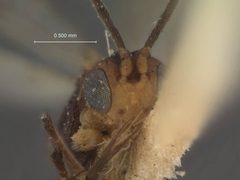
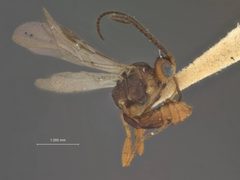
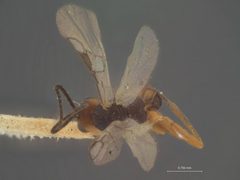
Dinocampus are small braconid wasps, typically under 5 mm in body length. Females possess a well-developed, spear-like ovipositor used to insert into beetles. Males are generally slimmer and darker than females, and lack an ovipositor. In Dinocampus coccinellae, females are deep black with green ; the , front legs, and apex of the are mussel-brown. The petiolate abdomen (with a long, slender basal segment) is a distinctive morphological feature. Species-level identification requires examination of wing venation, segment count, and genitalia structure.
Images
Habitat
are defined by lady beetle distribution. Dinocampus occur in agricultural fields, orchards, gardens, meadows, and urban green spaces where coccinellid beetles are present. Specific microhabitat associations include pistachio orchards, lavender plantings, and various crop systems supporting aphidophagous lady beetles.
Distribution
. Records exist from North America (United States, Canada), South America (Chile, Ecuador), Europe (United Kingdom, Italy, France, Scandinavia, Germany), Asia (native range of some ; inferred European origin for D. coccinellae with multiple introductions to the Americas), and Africa (Algeria, South Africa). GBIF distribution records include Denmark, Norway, and Sweden.
Seasonality
Activity coincides with lady beetle presence and temperature conditions suitable for development. Field studies indicate activity from spring through autumn, with peak rates varying by region. In temperate zones, wasps likely overwinter as larvae within host beetles or as pupae in cocoons.
Host Associations
- Coccinellidae (lady beetles/ladybirds) - endoparasitoidPrimary ; over 50 documented as hosts for D. coccinellae alone
- Coleomegilla maculata (spotted lady beetle) - Preferred in North America; ~25% recovery rate after
- Coccinella septempunctata (seven-spotted lady beetle) - Native in Europe; produces largest female due to host body size
- Harmonia axyridis (harlequin/multicolored Asian lady beetle) - ; rates 4–7% in invaded areas, much lower in native Asian range
- Hippodamia variegata (variegated lady beetle) - Documented in Algeria and Turkey
- Hippodamia parenthesis (parenthesis lady beetle) - Smallest recorded; produces smallest
- Adalia bipunctata (two-spotted lady beetle) - Native European ; less impact from compared to H. axyridis
- Eriopis chilensis - Native in Chile
- Coccinella septempunctata algerica - First record from Algeria; preferred over H. variegata (16.7% vs. 2.2% )
Life Cycle
Females deposit a single into the 's soft underbelly using their ovipositor. The egg hatches in 5–7 days into a first-instar larva with large , which eliminates competing eggs or larvae before feeding on host and . The larva passes through four instars over 18–27 days while the host continues foraging. When ready to pupate, the larva paralyzes the host, emerges, and spins a silken cocoon attached to the host's legs. The completes pupal development in 6–9 days before emerging as an . Some host beetles recover mobility after wasp .
Behavior
Females use antennal contact to assess suitability and discriminate between suitable and unsuitable host before oviposition. The deposits Dinocampus coccinellae Paralysis Virus (DcPV) along with the ; this virus replicates in the wasp larva and migrates to the host , inducing partial paralysis and periodic twitching that deters from the cocoon. The paralyzed host effectively guards the cocoon, reducing risk. Wasps developing with living protectors produce fewer eggs due to energetic costs of maintaining host paralysis.
Ecological Role
of aphidophagous lady beetles, with potential to influence services provided by these . Field rates typically range 4–7%. May serve as biological control agent for lady beetle , particularly Harmonia axyridis, though effectiveness is limited by low parasitism rates. Subject to hyperparasitism by Gelis agilis, an -mimicking ichneumonid that oviposits into cocoons.
Human Relevance
Of concern in agricultural systems relying on lady beetles for , as can reduce . A single large aphidophagous lady beetle may consume up to 5,500 aphids annually; -induced sterilization further impacts . Has been incorrectly sensationalized as creating "zombie" ladybugs in popular media. Subject of extensive scientific research due to complex host manipulation mechanisms involving viral .
Similar Taxa
- MeteorusRelated braconid in Euphorinae; also of beetles. Distinguished by wing venation and cocoon placement (Meteorus cocoons typically hang suspended by a thread rather than attached directly to legs).
- Gelis agilisHyperparasitoid that attacks Dinocampus cocoons, not a . Wingless females mimic ants and oviposit into cocoons; easily distinguished by and .
Misconceptions
Popular media have described parasitized lady beetles as "zombies," which overstates the biological phenomenon. The is partially paralyzed and exhibits defensive twitching, but retains some physiological functions and may recover fully. The term "STD" has been incorrectly applied to unrelated fungal of lady beetles in sensationalized reporting. The does not kill its host outright, unlike many .
More Details
Host size effects
size is positively correlated with body size; larger hosts like Coccinella septempunctata produce larger female wasps, while smaller hosts like Hippodamia parenthesis produce smaller wasps. This relationship suggests phenotypic plasticity or local to host .
Reproductive biology
Nearly all D. coccinellae are female offspring of unfertilized (). Males are occasionally found and are produced from fertilized eggs; they lack ovipositors and are slimmer and darker than females.
Viral symbiosis
D. coccinellae is associated with Dinocampus coccinellae Paralysis Virus (DcPV), an virus that facilitates manipulation. This represents an independent evolution of viral weaponry in , distinct from the better-known of other braconid lineages.
Sources and further reading
- BugGuide
- Wikipedia
- GBIF taxonomy match
- iNaturalist taxon
- NCBI Taxonomy
- Catalogue of Life
- Bug Squad
- What's Bugging the Ladybug? | Bug Squad
- Dinocampus coccinellae Archives - Entomology Today
- Dinocampus coccinellae larva emerging from Coccinella septempunctata - Entomology Today
- Bug Eric: "Zombie Ladybugs"
- Tabloid Sensationalism Aside, Lady Bugs Are Still Fascinating
- Host-Acceptance Behavior of Dinocampus coccinellae (Hymenoptera: Braconidae)
- The geographic scope of host use by the ladybeetle parasitoid Dinocampus coccinellae
- Coccinellid host morphology dictates morphological diversity of the parasitoid wasp Dinocampus coccinellae
- Interactions between the Multicolored Asian Lady Beetle Harmonia axyridis and the Parasitoid Dinocampus coccinellae
- Host discrimination in Dinocampus coccinellae (Hymenoptera: Braconidae), a solitary parasitoid of coccinellid beetles.
- Dinocampus coccinellae as a parasitoid of the invasive ladybird Harmonia axyridis in Europe
- Identification of the Parasitoid Wasp Dinocampus coccinellae (Schrank) (Hymenoptera: Braconidae) in Pistachio Orchards Using DNA Barcoding
- Coccinellid host morphology dictates morphological diversity of the parasitoid wasp Dinocampus coccinellae
- Distribution, host range and host preferences of Dinocampus coccinellae (Hymenoptera: Braconidae): A worldwide database
- Primer reporte para el Ecuador de la avispa endoparasitoide Dinocampus coccinellae (Schrank) (Hymenoptera: Braconidae)
- First record of Coccinella septempunctata algerica (Coleoptera, Coccinellidae) as host of Dinocampus coccinellae (Hymenoptera, Braconidae, Euphorinae) in Algeria
- Interactions between the parasitoid wasp Dinocampus coccinellae and two species of coccinellid from Japan and Britain
- Interactions between the parasitoid wasp Dinocampus coccinellae and two species of coccinellid from Japan and Britain
- Diet of adult ladybird beetle host modifies the postdiapause development of the parasitoid Dinocampus coccinellae (Hymenoptera: Braconidae)
- New Records of the Parasitic waspDinocampus coccinellae(Hymenoptera: Braconidae) and its Hosts in South Africa
- The genome sequence of a braconid wasp, Dinocampus coccinellae (Schrank, 1802).