
Aphidius ervi
Haliday, 1834
Aphidius ervi is a in the Aphidiinae, widely distributed globally and extensively used in programs against pests. It parasitizes larger aphid , particularly Macrosiphum euphorbiae (potato aphid) and Aulacorthum solani (foxglove aphid), and to a lesser extent Acyrthosiphon pisum (pea aphid). The wasp induces castration and immunosuppression through venom proteins, allowing its larva to develop within the living aphid until emerging from a characteristic 'aphid mummy' by chewing a round exit hole.
Pronunciation
How to pronounce Aphidius ervi: //əˈfɪdiəs ˈɛr.vi//
These audio files are automatically generated. While they are not always 100% accurate, they are a good starting point.
Identification
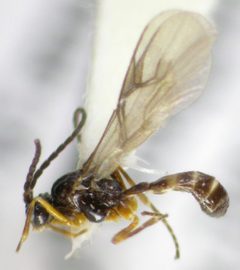
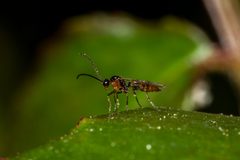
mummies containing A. ervi appear as papery brown, desiccated aphid , distinguished from living aphids by their rigid, empty appearance. Emerging leave a near-perfectly round exit hole in the of the mummy. Adults are tiny braconid wasps with a highly mobile, jointed capable of curling beneath the body to direct the ovipositor forward for stinging. Specific morphological distinction from such as Aphidius rhopalosiphi requires expert examination.
Images
Habitat
Agricultural , particularly fields and greenhouses containing Fabaceae crops and other plants supporting large . Documented plants include alfalfa, red clover, pea, potato, corn, winter wheat, oat, onion, and winter barley. Also found in gardens and landscape plantings with aphid .
Distribution
Global distribution including Europe (native range), North America (introduced 1950s), South America (Brazil: Minas Gerais, Paraná, Rio de Janeiro, Rio Grande do Sul, São Paulo), Africa, Australia, and the Azores (Pico, Terceira). First recorded in Slovenia in 2008.
Seasonality
Active during spring and summer when are abundant; time varies with temperature and availability.
Diet
feed on floral nectar and other sources. Larvae are obligate endoparasitoids, feeding exclusively on tissues within living .
Host Associations
- Macrosiphum euphorbiae - preferred potato aphid
- Aulacorthum solani - preferred foxglove aphid
- Acyrthosiphon pisum - pea aphid; success reduced by bacterial defenses
- Buchnera aphidicola - indirect interactionA. ervi venom regulates this endosymbiont's contribution to nutritional suitability
Life Cycle
Female locate colonies using plant volatile cues and honeydew attractants. Upon encountering a , the female curls her forward beneath her body and stings the aphid with her ovipositor, depositing a single and venom. The egg hatches into a larva that feeds selectively on host tissues while the aphid continues to live and feed (koinobiont ). The larva induces host castration through venom proteins and suppresses host immune responses via a serine homolog (AeSPH) that inhibits melanization. Late in development, the larva consumes vital organs, killing the host and forming a papery mummy. occurs within the mummy; the emerges by chewing a round exit hole. Multiple occur annually.
Behavior
Females exhibit a distinctive attack posture with the curled beneath the body to direct the ovipositor forward. Patch experience modifies subsequent acceptance decisions. require floral resources for energy; presence of diverse flowering plants enhances survival and activity. Some Aphidius induce parasitized aphids to wander away from colonies, reducing hyperparasitism risk; this has been observed in and may occur in A. ervi.
Ecological Role
Primary regulating in agricultural and natural . Serves as a key agent reducing aphid damage to crops. Competes with native parasitoid , including Praon pequodorum in North America; competitive outcomes depend on defensive status. Hyperparasitoids attack A. ervi within aphid mummies, creating multitrophic interactions.
Human Relevance
Widely used in commercial programs and sold for release in greenhouses, conservatories, and field crops. Introduced to North America in the 1950s specifically to control the pea aphid. Effectiveness varies with due to bacterially mediated host defenses. Serves as a model organism for studying host- interactions, venom biochemistry, and immunosuppression mechanisms.
Similar Taxa
- Aphidius rhopalosiphiCongeneric with overlapping range; larval competition between influences and patch use
- Praon pequodorumNative North American competing with introduced A. ervi; outcompetes A. ervi on pea aphids with bacterial defenses due to to defensive
- Aphelinus abdominalisAnother used in ; differs in suitability and instar preference patterns
More Details
Venom biochemistry
A. ervi venom contains a serine homolog (AeSPH) that inhibits phenoloxidase cascade activation, suppressing melanization immune responses. Separate venom components induce host castration by disrupting reproductive physiology.
Host manipulation
The regulates the endosymbiont Buchnera through venom action, altering nutritional suitability for the developing .
Competitive dynamics
In North America, A. ervi outcompetes most native on undefended pea aphids but loses to Praon pequodorum on aphids with Hamiltonella defensa bacterial defenses. Even 10% defended aphids in a can allow P. pequodorum to outcompete A. ervi.
Sources and further reading
- BugGuide
- Wikipedia
- GBIF taxonomy match
- iNaturalist taxon
- NCBI Taxonomy
- Catalogue of Life
- What’s up when aphids have a hole in their rear end: Tiny parasitic wasps, Aphidius spp. — Bug of the Week
- American Underdog Wasp Fights for Foothold on Exotic Hosts
- Host castration by Aphidius ervi venom proteins
- first record of Aphidius ervi Haliday in Slovenia
- Aphidius ervi venom regulates Buchnera contribution to host nutritional suitability
- An ‘artificial aphid’ for Aphidius ervi (Hym., Braconidae)
- Host aphid immunosuppression by Aphidius ervi venom
- Patch Experience Changes Host Acceptance of the Aphid Parasitoid Aphidius ervi
- Mating behaviour of Aphidius ervi (Hymenoptera: Braconidae): The role of antennae
- Bottom-up effect of water stress on the aphid parasitoid Aphidius ervi
- Figure 6: GO term distribution—Molecular function for genes with different expression patterns between Aphidius ervi libraries.
- Larval interspecific competition influences adult behaviour of two aphid parasitoids:Aphidius rhopalosiphiandAphidius ervi(Hymenoptera: Aphidiinae)
- Figure 1: Sampling design for RNA sequencing and differential expression analysis in the aphid parasitoid wasp Aphidius ervi .
- Host species suitability and instar preference of Aphidius ervi and Aphelinus abdominalis
- Peer Review #2 of "Morphological variation of Aphidius ervi Haliday (Hymenoptera: Braconidae) associated with different aphid hosts (v0.2)"
- Peer Review #2 of "Morphological variation of Aphidius ervi Haliday (Hymenoptera: Braconidae) associated with different aphid hosts (v0.1)"
- Figure 5: GO term distribution—biological process for genes with different expression patterns between Aphidius ervi libraries.