
Ephedrus
Haliday, 1833
Ephedrus is a of small braconid wasps in the Aphidiinae, all of which are obligate of aphids. The genus includes both extant and fossil species, with records from the Eocene Baltic amber indicating an ancient evolutionary history. Multiple species have been evaluated or employed as agents against agricultural pest aphids, particularly in greenhouse systems. Species-level studies reveal complex discrimination involving external and internal host quality assessment.
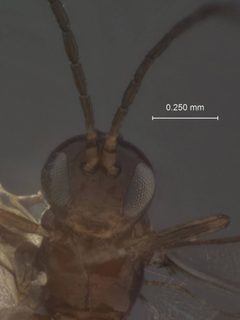
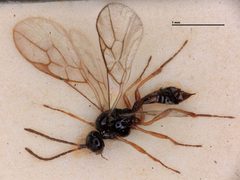
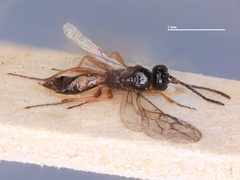
Pronunciation
How to pronounce Ephedrus: //ɛˈfɛdrəs//
These audio files are automatically generated. While they are not always 100% accurate, they are a good starting point.
Identification
Ephedrus are distinguished from other aphidiine by a combination of morphological characters including wing venation and antennal segmentation; E. antennalis possesses 12-segmented , a unique character within the genus. The subgenus Fovephedrus and species groups such as the root (including E. carinatus) have distinct morphological features. Species identification typically requires examination of microscopic characters and reference to specialized taxonomic keys.
Images
Distribution
Records indicate presence in Denmark (DK), Norway (NO), and Sweden (SE). Additional confirmed occurrences include Finland and Japan. Fossil are known from Late Eocene Baltic amber and Eocene Sakhalinian amber.
Host Associations
- Aphididae - All Ephedrus are obligate of aphids
- Acyrthosiphon pisum - Documented for E. californicus; parasitization observed on nymphal instars 1-4
- Macrosiphum creelii - Documented for E. californicus; developed faster and gained more mass than on same-sized A. pisum
- Myzus persicae - Documented for E. cerasicola and E. nacheri
- Aphis gossypii - Documented for E. nacheri in greenhouse studies
- Elatobium abietinum - Documented for E. koponeni on Picea abies in Finland
Life Cycle
Development is solitary; a single completes development per . Development time from oviposition to varies with host , host instar at parasitization, and host quality. In E. californicus, development time varied non-linearly with host instar, being shortest on first and fourth instar hosts. On lower quality hosts, parasitoids may trade longer development time for increased adult mass. Sexual size dimorphism occurs, with females typically larger than males; the degree of dimorphism decreases with increasing host size in E. californicus.
Behavior
Females exhibit sophisticated discrimination abilities. In E. californicus and E. cerasicola, females can detect parasitized hosts through an external effective for several hours (0-9 hours in E. californicus; a few hours in E. cerasicola), perceived by antennal contact, and through internal markers detected via ovipitor . Experienced females respond to external markers while naive females do not. Host discrimination is time-dependent and influenced by host quality changes associated with development. When occurs, the older larva typically eliminates younger competitors through physical combat, physiological suppression, or chemical means depending on relative developmental stages. E. cerasicola females aggregate on heavily -infested plants (500-1000 aphids per plant) and avoid plants with low or no aphid .
Ecological Role
through . such as E. cerasicola and E. californicus function as agents in agricultural and greenhouse systems. E. nacheri has been evaluated as an alternative to Aphidius species for greenhouse aphid control, though its intrinsic rate of natural increase (0.128-0.258) was deemed insufficient for inoculative use. E. cerasicola can maintain aphid below for extended periods when introduced at appropriate -to- ratios.
Human Relevance
Multiple are utilized or studied for of pest aphids in protected . E. cerasicola has demonstrated effective control of Myzus persicae on paprika in small glasshouses when introduced as mummies at rates of 4 per plant at 10-day intervals, or at 1:10 -to- ratio for established . E. nacheri has been investigated as a banker-plant system component in Japanese greenhouses. The includes recently described species of taxonomic interest, including fossil species from Baltic amber.
Similar Taxa
- AphidiusBoth are aphidiine braconid containing ; Ephedrus are often evaluated as alternatives to Aphidius species in programs due to differing ecological characteristics such as type and discrimination mechanisms
- ToxaresBoth belong to Aphidiinae and occur in similar geographic regions such as Finland; they share the general lifestyle but differ in genus-level morphological characters
More Details
Fossil Record
The has a documented fossil history extending to the Eocene. Described fossil include E. zaikai, E. carsteni, and E. primordialis from Late Eocene Baltic amber, E. rasnitsyni from Eocene Sakhalinian amber, and E. mirabilis from Oligocene imprints (Bassin de Marseille). These fossils allow comparison with extant species such as E. niger, E. chaitophori, E. validus, and E. carinatus.
Taxonomic Diversity
Recent taxonomic work has expanded the known diversity of Ephedrus, including descriptions of new with distinctive morphological features. E. antennalis possesses 12-segmented , unique within the . E. carinatus represents an additional member of the root group. The subgenus Fovephedrus has been subject to phylogenetic study. Fourteen Ephedrus species are recorded from Finland, with recent additions including E. chaitophori, E. longistigmus, and E. vaccinii.
Sources and further reading
- BugGuide
- GBIF taxonomy match
- iNaturalist taxon
- NCBI Taxonomy
- Catalogue of Life
- <i>Ephedrus</i> (Ephedrus) koponeni sp. n. from Finland (Hymenoptera, Braconidae, Aphidiinae)
- Host species-dependent and size-dependent ecological characteristics of Ephedrus nacheri (Hymenoptera: Braconidae)
- THE NUTRITIONAL ECOLOGY OF A PARASITOID WASP, EPHEDRUS CALIFORNICUS BAKER (HYMENOPTERA: APHIDIIDAE)
- Comparative Analysis of the Biological Characteristics of Ephedrus plagiator (Nees) and Aphidius ervi Haliday according to Different Aphid Hosts
- AGE-SPECIFIC PATTERN OF HOST DISCRIMINATION BY THE APHID PARASITOID EPHEDRUS CALIFORNICUS BAKER (HYMENOPTERA: APHIDIIDAE)
- Two new morphologically interesting species of the genus Ephedrus Haliday (Hymenoptera, Braconidae, Aphidiinae)
- Mechanisms of host discrimination and intraspecific competition in the aphid parasitoid Ephedrus cerasicola
- New finds of <i>Ephedrus</i> and <i>Toxares</i> species (Hymenoptera, Braconidae, Aphidiinae) from Finland
- A new and the second fossil species of the genus Ephedrus Haliday, 1833(Hymenoptera: Braconidae: Aphidiinae) from Baltic amber
- Use of mummies of Ephedrus cerasicola Starý to control Myzus persicae (Sulzer) in small glasshouses
- Third new fossil species of the genus Ephedrus Haliday, 1833 (Hymenoptera: Braconidae: Aphidiinae) from Baltic amber
- Host discrimination and larval competition in the aphid parasite Ephedrus californicus
- Foraging by the aphid parasitoid Ephedrus cerasicola for patchily distributed hosts
- INFLUENCE OF PLANT QUALITY ON INTERACTIONS BETWEEN THE APHID PARASITOID EPHEDRUS CALIFORNICUS BAKER (HYMENOPTERA: APHIDIIDAE) AND ITS HOST, ACYRTHOSIPHON PISUM (HARRIS) (HOMOPTERA: APHIDIDAE)
- Influence of aphid size, age and behaviour on host choice by the parasitoid wasp Ephedrus californicus: a test of host-size models
- Uncovering Norway: Descriptions of Four New Aphidiinae Species (Hymenoptera, Braconidae) with Identification Key and Notes on Phylogenetic Relationships of the Subgenus Fovephedrus Chen.