
Sitobion avenae
(Fabricius, 1775)
English Grain Aphid
, the , is a globally distributed pest of cereal crops. It feeds on phloem sap and transmits yellow dwarf viruses to wheat, barley, and oats. are influenced by temperature, water availability, and plant quality. The exhibits complex reproductive strategies including both cyclical and obligate . Management challenges include resistance, variable , and climate change impacts on and .
Pronunciation
How to pronounce Sitobion avenae: /ˌsɪtəˈbaɪən əˈviːniː/
These audio files are automatically generated. While they are not always 100% accurate, they are a good starting point.
Identification
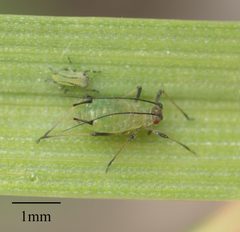
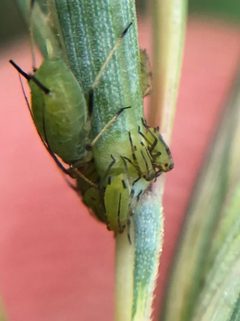
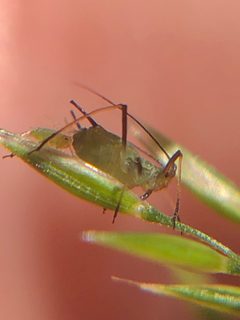
Larger than other cereal aphids (approximately 3 mm vs. ~1.5–2 mm for and ); long black , cornicles, and legs; lacks the dark stripe of greenbug (Schizaphis graminum) and the 'double-tailed' caudal projection of Russian wheat aphid (); lacks the reddish-orange cornicle bases of bird cherry-oat aphid (Rhopalosiphum padi)
Images
Habitat
temperate cereal crop fields; grassy field margins; volunteer wheat stands; associated with Poaceae-dominated agricultural landscapes
Distribution
Europe (widespread including UK, France, Germany, Scandinavia, Mediterranean countries, Eastern Europe, Russia); Asia (China, India, Central Asia, Middle East, Japan); Africa (North and East Africa, South Africa); North America (USA, Canada, Mexico); Central and South America (Argentina, Brazil, Chile, Uruguay, Colombia, Peru); occurs across all major cereal-producing regions globally
Seasonality
active spring through autumn; peak during flowering and grain-filling stages; cyclically parthenogenetic lines produce sexual morphs in autumn triggered by decreasing day length and temperature; overwinter on grasses; nymphs hatch after cold exposure of 2–3 months to initiate spring colonies
Diet
phloem sap from grasses (Poaceae), sedges, and rushes; primary agricultural are wheat (Triticum aestivum), barley (Hordeum vulgare), and oats (Avena sativa)
Host Associations
- Triticum aestivum - primary agricultural wheat; feeding on stems during flowering and developing kernels causes shrunken grain and reduced test weight
- Hordeum vulgare - primary agricultural barley
- Avena sativa - primary agricultural oats
- Poaceae - grasses, sedges, and rushes; stage occurs on grasses
Life Cycle
holocyclic (cyclical ) or anholocyclic (obligate parthenogenesis) depending on ; wingless parthenogenetic females produce live nymphs in spring and summer; winged morphs develop for ; sexual females and males induced in autumn by and temperature decline; mating and -laying on grasses in late November; eggs undergo and hatch after 2–3 months of cold exposure; muscles degenerate via programmed death after
Behavior
phloem-feeding using ; settles on plants to feed; exhibits wandering when encountering feeding deterrents such as high concentrations of surface waxes; winged morphs migrate before then undergo muscle degeneration; honeydew production can lead to development on plants
Ecological Role
pest causing direct damage through sap removal and kernel damage; of barley yellow dwarf virus and other yellow dwarf viruses; prey for coccinellids, syrphid flies, lacewings, parasitic , spiders, and damsel bugs; for entomophthoralean fungi; interacts with arbuscular mycorrhizal fungi in plant--soil
Human Relevance
significant agricultural pest of wheat, barley, and oats; economic impact from reduced grain quality (shrunken kernels, lower test weight) and virus transmission; managed through , , , and cultural practices; insecticide resistance documented; research target for novel control methods including sweet-taste inhibitors
Similar Taxa
- Schizaphis graminum; smaller (~1.5–2 mm), pale green with dark stripe, injects toxin causing leaf yellowing; S. avenae lacks dorsal stripe and is larger
- Diuraphis noxia; smaller, spindle-shaped, lime green, short , 'double-tailed' caudal projection; S. avenae has longer antennae and lacks caudal projection
- Rhopalosiphum padibird cherry-oat aphid; similar size range, yellowish-green to black with distinctive reddish-orange area around cornicle bases; S. avenae has uniformly colored cornicles without reddish bases
- Macrosiphum euphorbiaepotato aphid; similar , typically on different , green or pink forms with dark legs and cornicles; host association distinguishes from S. avenae
More Details
Genomic Resources
-level assembly published in 2026; genome size approximately 525 Mb anchored to 6 chromosomes; BUSCO completeness 98.6%; 15,326 protein-coding genes predicted.
Reproductive Plasticity
vary in reproductive mode: some are obligate parthenogens (anholocyclic), maintaining year-round; others are cyclical parthenogens (holocyclic), producing sexual stages seasonally. This variation affects strategy and genetic structure.
Feeding Physiology Research
Salivary gland transcriptome analysis identified 526 predicted secretory proteins including digestive , detoxification proteins, and candidate effectors; 11 of 15 most highly expressed secretory proteins remain functionally uncharacterized, suggesting undiscovered molecular mechanisms of manipulation.
Sources and further reading
- BugGuide
- Wikipedia
- GBIF taxonomy match
- iNaturalist taxon
- NCBI Taxonomy
- Catalogue of Life
- Aboveground Pests - AgriLife Extension Entomology
- Sweet Taste Inhibitor Curbs Aphid Feeding, but Also Plant Growth
- Sitobion avenae Archives - Entomology Today
- The English grain aphid Sitobion avenae
- Sitobion avenae . [Distribution map].
- Molecular characterisation of Sitobion avenae F. clones and their interaction with different host plants
- Exploring the interactions of bacterial secondary symbionts (BSS) in wheat aphids, Sitobion avenae F. with parasitoids
- Arbuscular mycorrhizal fungus Acaulospora delicata modulates tri-trophic interactions between wheat cultivars and Sitobion avenae under drought stress
- Effects of field simulated warming on feeding behavior of Sitobion avenae (Fabricius) and host defense systems
- Activity of the grain aphid (Sitobion avenae) and the bird cherry-oat aphid (Rhopalosiphum padi) during the feeding behaviour on an artificial diet containing extracts of surface waxes
- Transcriptome analysis of the salivary glands of the grain aphid, Sitobion avenae
- The Sequence of Heat and Insecticide Interactions in Shaping Intra - and Inter - Generational Life History of the Aphid Sitobion Avenae
- Effect of epicuticular waxes from triticale on the feeding behaviour and mortality of the grain aphid, Sitobion avenae (Fabricius) (Hemiptera: Aphididae)
- Abundance Patterns of the Wheat Aphid, Sitobion avenae (F.) (Hemiptera: Aphididae) and Beneficial Insects in Wheat Field
- Flight muscles degenerate by programmed cell death after migration in the wheat aphid, Sitobion avenae