
Sitobion
Mordvilko, 1914
Species Guides
3- Sitobion avenae(English Grain Aphid)
- Sitobion luteum(orchid aphid)
- Sitobion niwanistum
Sitobion is a of aphids in the Aphididae, comprising more than 80 described . Species within this genus are primarily associated with grasses and cereal crops, with Sitobion avenae (English grain aphid) being the most extensively studied. These aphids are phloem-feeding insects that can cause direct damage to plants and plant viruses. The genus has a distribution, with species found across Europe, Asia, Africa, North America, South America, and Oceania.
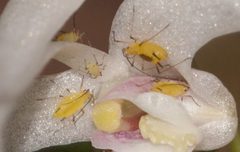
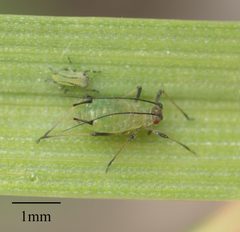
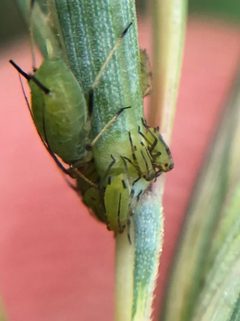
Pronunciation
How to pronounce Sitobion: /sɪˈtoʊbiˌɒn/
These audio files are automatically generated. While they are not always 100% accurate, they are a good starting point.
Identification
in Sitobion can be distinguished from other cereal by their relatively large body size, long , and long siphunculi (cornicles). Sitobion avenae specifically is larger than other common cereal aphids such as (Schizaphis graminum) and (), reaching approximately 1/10 inch in length. The body color ranges from light green to brown, with long black antennae, cornicles, and legs. Unlike the Russian wheat aphid, Sitobion species possess prominent cornicles and lack the distinctive "double-tailed" caudal projection. Unlike the fall armyworm, Sitobion lacks the white inverted "Y" on the .
Images
Habitat
Agricultural fields and grasslands, particularly those containing cereal crops and wild grasses. Associated with wheat, barley, oats, and other Poaceae .
Distribution
. Documented in Europe (including UK, France, Germany, Spain, Italy, and across Eastern Europe), Asia (China, India, Japan, Middle East, Central Asia), Africa (North Africa, East Africa, South Africa), North America (USA, Canada, Mexico), South America (Argentina, Brazil, Chile, Colombia, Peru, Uruguay), and Oceania (Australia, New Zealand, Pacific islands).
Diet
Phloem sap of grasses and cereal crops.
Host Associations
- Triticum aestivum - primary wheat
- Hordeum vulgare - primary barley
- Avena sativa - primary oats
- Poaceae - -level associationgrass
Ecological Role
Phloem-feeding herbivore and of barley yellow dwarf virus and potentially other plant . Serves as prey for natural enemies including lady beetles, parasitic , spiders, damsel bugs, larvae, and syrphid fly larvae. for bacterial secondary that may mediate defensive interactions with .
Human Relevance
Significant agricultural pest of small grain cereals. Direct feeding damage includes kernel shriveling and reduced test weight when feed on stems during flowering and on developing grain . have been established in some regions: 5 or more aphids per stem during flowering, 10 or more per stem during milk stage. Subject to research on novel control methods including sweet-taste inhibitors. Interactions with arbuscular mycorrhizal fungi have been shown to modulate performance under drought stress, with implications for pest management under climate change scenarios.
Similar Taxa
- Schizaphis graminumBoth are cereal aphids, but is smaller (approximately 1/16 inch), pale green with a dark green stripe, and injects toxins causing leaf yellowing and death. Sitobion avenae is larger (1/10 inch), lacks the dorsal stripe, and does not inject toxins.
- Diuraphis noxiaBoth infest wheat, but is lime green, spindle-shaped, has short , lacks prominent cornicles, and possesses a distinctive projection above the cauda creating a "double-tailed" appearance. Sitobion has long antennae, prominent cornicles, and lacks the caudal projection.
- Rhopalosiphum padiBoth are cereal aphids, but bird cherry-oat aphid is smaller, yellowish green to dark green or black, with a reddish-orange area around the base of the cornicles. Sitobion avenae is larger and lacks this reddish coloration.
Sources and further reading
- BugGuide
- Wikipedia
- GBIF taxonomy match
- iNaturalist taxon
- NCBI Taxonomy
- Catalogue of Life
- Aboveground Pests - AgriLife Extension Entomology
- Sitobion avenae Archives - Entomology Today
- Sweet Taste Inhibitor Curbs Aphid Feeding, but Also Plant Growth
- Molecular characterisation of Sitobion avenae F. clones and their interaction with different host plants
- Exploring the interactions of bacterial secondary symbionts (BSS) in wheat aphids, Sitobion avenae F. with parasitoids
- Sitobion avenae . [Distribution map].
- Redescription and lectotype designation of Sitobion (Metobion) graminearum (Mordvilko) (Hemiptera: Aphididae)
- Sitobion miscanthi . [Distribution map].
- Arbuscular mycorrhizal fungus Acaulospora delicata modulates tri-trophic interactions between wheat cultivars and Sitobion avenae under drought stress
- Effects of field simulated warming on feeding behavior of Sitobion avenae (Fabricius) and host defense systems