
Chaitophorinae
Mordvilko, 1909
Tribe Guides
2Chaitophorinae is a of aphids in the Aphididae, comprising approximately 12 and over 180 described . The subfamily is divided into two tribes: Chaitophorini, associated with deciduous trees and shrubs, and Siphini, associated with grasses. Members are characterized by numerous body setae and are predominantly distributed in the Northern Hemisphere. The subfamily originated on Acer plants in eastern Asia during the Late Cretaceous to early Paleocene, with subsequent dispersals and shifts driving diversification.
Pronunciation
How to pronounce Chaitophorinae: //kaɪ.toʊ.fɔːˈrɪ.naɪ//
These audio files are automatically generated. While they are not always 100% accurate, they are a good starting point.
Identification
The combination of abundant body setae and association with specific plant groups distinguishes Chaitophorinae from other . Chaitophorini ( Chaitophorus, Periphyllus, Pseudopterocomma, etc.) feed on deciduous trees and shrubs, particularly Acer, Salix, and Populus. Siphini (genera Sipha, Atheroides, Chaetosiphella, etc.) are found on grasses and sedges. Identification to genus and requires examination of morphological details including chaetotaxy (setal arrangement), siphunculus structure, and cauda shape; keys are available in regional taxonomic revisions.
Images
Appearance
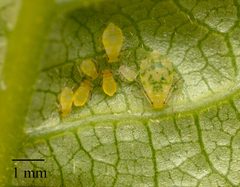
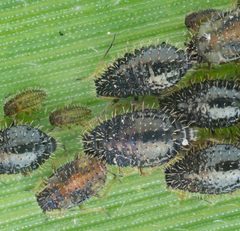
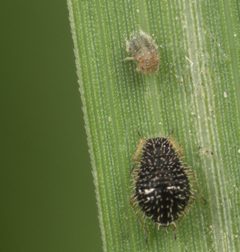
Aphids in this are distinguished by numerous setae (bristles) covering the body, a trait that separates them from other subfamilies. Body size and coloration vary among and morphs, with distinct seasonal forms including (wingless) females, (winged) females, females, and males. Some species exhibit dimorphic aestivating nymph forms. Siphini species are generally smaller and more slender than Chaitophorini, reflecting their grass-feeding habit.
Habitat
correspond to plant distribution: Chaitophorini occupy deciduous forests, riparian woodlands, and urban plantings of trees and shrubs; Siphini inhabit grasslands, steppes, meadows, and agricultural fields. Some Siphini are xerothermophilous, restricted to temperate steppe zones and dry mountain valleys.
Distribution
Predominantly Northern Hemisphere. Native to eastern Asia with subsequent to Europe, North America, and other regions. Documented from Canada, USA, Europe (Spain to Russia), Asia Minor, Mongolia, China, and Japan. The 's contemporary distribution results from multiple historical dispersal events from its Asian origin.
Seasonality
Activity patterns follow plant . occur during the growing season; sexual morphs ( females and males) appear in autumn. Some produce aestivating forms during summer. In temperate regions, occurs as laid on host plants.
Diet
Phloem sap feeding on specific plant groups. Chaitophorini feed on deciduous trees and shrubs, particularly Acer (maples), Salix (willows), and Populus (poplars). Siphini feed on grasses (Poaceae) and sedges (Cyperaceae), including Stipa, Calamagrostis, Ammophila, and others.
Host Associations
- Acer - primary origin; Periphyllus and other Chaitophorini
- Salix - Chaitophorus
- Populus - Chaitophorus
- Koelreuteria - Periphyllus koelreuteriae
- Stipa - Primary for Chaetosiphella stipae
- Calamagrostis - Chaetosiphella stipae setosa
- Ammophila - Chaetosiphella longirostris
- Poaceae - groupSiphini tribe association
- Cyperaceae - groupCaricosipha association
Life Cycle
with alternation between parthenogenetic and . Viviparous females ( and ) reproduce parthenogenetically during spring and summer. Autumn generations produce sexual morphs: females and males that mate and produce . Some exhibit including aestivating nymph forms. Anholocyclic may persist in mild climates.
Behavior
is environmentally cued, with temperature and influencing morph production. Some produce dimorphic aestivating forms that persist through summer dormancy. Colony formation on plants; some species are gregarious. Winged forms disperse to new host plants or sites.
Ecological Role
Herbivores that influence plant growth through phloem sap extraction. Some are significant pests of ornamental and agricultural plants. Serve as prey for and in . Siphini species in steppe are indicators of grassland quality; projected climate change may reduce Stipa grasslands and affect connectivity.
Human Relevance
Some are economically significant pests. Periphyllus koelreuteriae damages ornamental and medicinal Koelreuteria plants. Periphyllus acerihabitans and related maple aphids affect Acer species. Sipha species can be pests of cereals and forage grasses. Several species are subjects of taxonomic and evolutionary research due to their phylogenetic significance and association patterns.
Similar Taxa
- AphidinaeLarger with fewer body setae; lacks the dense chaetotaxy characteristic of Chaitophorinae
- LachninaeContains conifer-feeding and giant willow aphids; generally larger siphunculi and different associations
- EriosomatinaeWoolly aphids with waxy secretions; often induce plant galls rather than forming open colonies
More Details
Tribal classification
Chaitophorinae contains two tribes: Chaitophorini (6 including Chaitophorus, Periphyllus, Pseudopterocomma) and Siphini (5 genera including Sipha, Atheroides, Chaetosiphella). Molecular phylogenetic studies indicate that Sipha, Chaitophorus, and Periphyllus are not monophyletic as currently circumscribed, and Lambersaphis is nested within Chaitophorus, requiring taxonomic revision.
Macroevolutionary patterns
Diversification rate increased within Chaitophorus during the Miocene, associated with range expansion and plant shifts. The origins of Siphini and the Chaitophorus-Lambersaphis lineage coincided with of novel host plants (grasses and new tree ), highlighting the role of host switching in diversification.
Sources and further reading
- BugGuide
- Wikipedia
- iNaturalist taxon
- NCBI Taxonomy
- Catalogue of Life
- THE CHAITOPHORINAE OF CANADA (HOMOPTERA: APHIDIDAE)
- Description of sexuales of Periphyllus singeri (Börner) (Hemiptera, Aphidoidea: Chaitophorinae)
- Description of the previously unknown morphs of Periphyllus koelreuteriae (Takahashi) (Hemiptera, Aphididae: Chaitophorinae)
- Review of the genus Chaetosiphella Hille Ris Lambers, 1939 (Hemiptera, Aphididae: Chaitophorinae)
- Geographical variation in morphology of Chaetosiphella stipae stipae Hille Ris Lambers, 1947 (Hemiptera: Aphididae: Chaitophorinae)
- Descriptions of little-known and unknown morphs of Periphyllus acerihabitans Zhang (Hemiptera: Aphididae: Chaitophorinae)
- Descriptions of four hitherto unknown or little-known morphs of Siphini (Hemiptera, Aphidoidea: Chaitophorinae)
- Description of sexuales of <i>Sipha (Sipha) littoralis</i> (Walker, 1848) (Aphididae: Chaitophorinae) with remarks on its distribution and host plants
- Molecular phylogeny and macroevolution of Chaitophorinae aphids ( Insecta : Hemiptera : Aphididae )