
Schizaphis
Börner, 1931
Grass Aphids, Greenbug
Species Guides
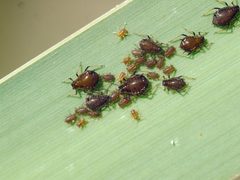
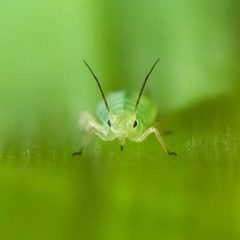
1- Schizaphis graminum(greenbug)
Schizaphis is a of aphids in the Aphididae, superfamily Aphidoidea. Originally distributed in the Palaearctic region, several have been introduced worldwide. The genus contains more than 40 recognized species, with () being the most economically significant. Species in this genus are primarily associated with grasses and cereal crops, exhibiting varying degrees of specificity from monophagy to polyphagy.

Pronunciation
How to pronounce Schizaphis: //ˈskɪ.zə.fɪs//
These audio files are automatically generated. While they are not always 100% accurate, they are a good starting point.
Images
Distribution
Originally native to the Palaearctic region. Some have been introduced to other parts of the world, including North America. occurs across Europe, Asia, Africa, North America, Central America, South America, and Oceania. GBIF records indicate presence in Denmark, Norway, and Sweden.
Diet
Phloem sap feeding on plants. show strong affinity for monocotyledon hosts, particularly grasses (Poaceae) and sedges (Cyperaceae). feeds on 109 host species across 54 and six .
Host Associations
- Poaceae (grasses) - primary Strongest affinity for Schizaphis spp.
- Cyperaceae (sedges) - primary Strong affinity
- Triticum spp. (wheat) - Major crop for S. graminum
- Sorghum bicolor (sorghum) - Preferred for North American of S. graminum
- Avena sativa (oat) - for S. graminum
- Hordeum vulgare (barley) - for S. graminum
- Secale cereale (rye) - for S. graminum
- Chaenomeles speciosa - Rosaceae for some
- Typha capensis - Typhaceae
Ecological Role
Major insect pest of cereal grains causing direct and indirect crop injury. Some serve as for plant . Natural enemies include such as Lysiphlebus testaceipes.
Human Relevance
Significant agricultural pest, particularly (), which affects wheat, sorghum, and other cereal crops. Management strategies include , , monitoring systems (e.g., Glance 'n' Go), and chemical control within programs. Greenbugs have developed resistance to some in certain regions.
Similar Taxa
- Sipha flava (yellow sugarcane aphid)Both are yellowish aphids feeding on grasses and sorghum, but yellow sugarcane aphid has rows of dark spots and short cornicles, and does not produce honeydew
- Melanaphis sacchari (sugarcane aphid)Both feed on sorghum, but sugarcane aphid has black feet, , and cornicles, and produces large amounts of honeydew
- Rhopalosiphum maidis (corn leaf aphid)Both occur on sorghum, but corn leaf aphid is dark bluish-green and typically feeds in the
- Diuraphis noxia (Russian wheat aphid)Both are cereal aphids, but has a distinctive 'double-tailed' appearance from a projection above the cauda and lacks prominent cornicles
More Details
Host Plant Specificity
Schizaphis exhibit highly restrictive plant selection. Analysis of 40 species showed 40% monophagy, 30% oligophagy, and 30% polyphagy. Host plants are drawn almost exclusively from monocotyledons (94.77%), with glumiflorae (Cyperaceae and Poaceae) showing distinct affinity (87.11%).
Genomic Resources
-level assemblies are available for (476.1 Mb, 6 chromosomes, 24,368 protein-coding genes) providing insights into wing dimorphism and evolutionary genetics.
Invasive Species
Schizaphis piricola was recorded as the 103rd plant lice in Europe, discovered in Madrid, Spain via social network photography. This species lives on pears and alternates with aquatic plants during summer.
Sources and further reading
- BugGuide
- Wikipedia
- GBIF taxonomy match
- iNaturalist taxon
- NCBI Taxonomy
- Catalogue of Life
- Aboveground Pests - AgriLife Extension Entomology
- Stem- and Leaf- Feeding Insects - AgriLife Extension Entomology
- Open-Access Article Takes a Closer Look at Crop-Damaging Greenbugs
- Uncategorized | Blog - Part 56
- Pensoft Editorial Team | Blog - Part 160
- Your small living creature shoots may benefit big science | Blog
- Greenbug (Schizaphis graminum): an overview
- Schizaphis graminum . [Distribution map].
- Aphids and their Host Affinity-VIII: Schizaphis spp.
- Postflight Behavior of the Greenbug, Schizaphis graminum (Homoptera: Aphididae), in the Laboratory1
- Chromosome-level genome assemblies of two cereal aphids, Metopolophium dirhodum and Schizaphis graminum, provides insights into wing dimorphism