
Xoridinae
Xoridine wasps
Genus Guides
3Xoridinae is a worldwide of Ichneumonidae containing approximately 220 described in four : Xorides, Odontocolon, Ischnoceros, and Aplomerus. These are idiobiont ectoparasitoids that specialize on wood-boring larvae, particularly Cerambycidae and Buprestidae, and occasionally Hymenoptera (). They are strongly associated with mature forest and are considered important agents of forest pests.
Pronunciation
How to pronounce Xoridinae: //ˌzɔrɪˈdaɪniː//
These audio files are automatically generated. While they are not always 100% accurate, they are a good starting point.
Identification
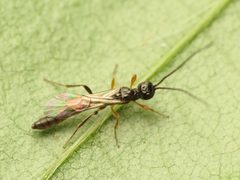
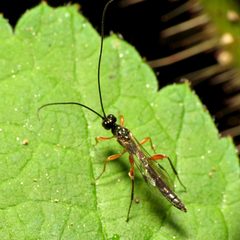
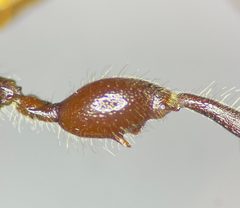
Xoridinae are recognized by a large tooth on the hind , a diagnostic feature visible in all four . Many are large, robust with black and orange coloration. Females possess long ovipositors adapted for drilling into wood to reach concealed . The can be distinguished from other ichneumonid groups by this combination of robust body form, hind femoral tooth, and association with wood-boring hosts.
Images
Habitat
Mature forests, particularly coniferous and deciduous woodlands. are closely tied to containing dead, dying, or recently felled trees that harbor wood-boring larvae. In the Ukrainian Carpathians, found in primeval beech forests and at elevations above 980 m in Switzerland.
Distribution
Worldwide distribution with representation on all continents except Antarctica. Documented from North America (23+ Odontocolon north of Mexico), Europe (46 species), Ukraine (28 species across multiple regions including Carpathians, Crimea), China (13 Xorides species in Palaearctic region), India, Kenya, Thailand, Vietnam, and Japan. Several species exhibit holarctic distributions.
Seasonality
Active primarily in autumn, coinciding with availability of wood-boring larvae in dead and dying trees. Seasonal dynamics and high-altitude zone distribution documented in Carpathian .
Host Associations
- Cerambycidae (longhorn beetles) - primary Larvae are main ; includes Acanthocinus aedilis, Xylotrechus stebbingi, Xylotrechus rusticus
- Buprestidae (jewel beetles) - Includes Agrilus biguttatus as of Ischnoceros caligatus; emerald ash borer galleries
- Curculionidae (weevils) - Pissodes nitidus recorded as of Xorides pissodius
- Hymenoptera (Symphyta) - occasional Wood-boring larvae
Life Cycle
Idiobiont ectoparasitoid development: are laid on or near living larvae inside wood. Larval develop as external , feeding on host tissues while host continues limited development. Development completes when host is consumed; wasp emerges from host pupa or larval gallery. Some observed to oviposit on host pupae rather than larvae.
Behavior
Females use long ovipositors to drill into wood to reach concealed , ignoring exposed host larvae that would be vulnerable to or desiccation. Triplet-style mating observed in Xorides ater, where single females mate simultaneously with two males; this may be common in the . search for host larvae in woodpiles and deadfall.
Ecological Role
Specialized of wood-boring beetles that regulate of forest pests, including economically important such as emerald ash borer. Function as biocontrol agents in natural and managed forests. Their presence indicates mature forest with standing or fallen dead wood.
Human Relevance
Potential agents for wood-boring pests. Documented association with emerald ash borer (Agrilus planipennis) in North America suggests possible utility in pest management programs.
Similar Taxa
- Rhyssinae (giant ichneumons)Also parasitize wood-boring insects; distinguished by lack of hind femoral tooth and typically much longer ovipositors relative to body size
- PoemeniinaeRelated within Ichneumonidae; distinguished by different wing venation and associations
- Other Ichneumonidae subfamiliesXoridinae distinguished by combination of hind femoral tooth, robust build, and specialized wood-boring relationships
Sources and further reading
- BugGuide
- Wikipedia
- iNaturalist taxon
- NCBI Taxonomy
- Bug Eric: Wasp Wednesday: Odontocolon
- A checklist of the Ukrainian Xoridinae (Hymenoptera, Ichneumonidae)
- A review of the genus Xorides Latreille, 1809 (Hymenoptera, Ichneumonidae, Xoridinae) in the Ukrainian Carpathians
- Xorides xylotrechi sp. n. (Hymenoptera: Ichneumonidae: Xoridinae) parasitizing Xylotrechus stebbingi (Gahan, 1906) (Coleoptera: Cerambycidae) in India
- New Records of Poemeniinae and Xoridinae (Hymenoptera, Ichneumonidae) from Ukraine and Poland, with Corrections to the Ukrainian Checklist
- European species of subgenus Moerophora Foerster of Xorides Latreille (Hymenoptera: Ichneumonidae: Xoridinae), with descriptions of two new species
- First record of the genus Aplomerus Provancher, 1886 <br />(Hymenoptera: Ichneumonidae: Xoridinae) from the Oriental region, with descriptions of two new species
- Species of <i>Xorides (Xorides)</i> (Hymenoptera: Ichneumonidae: Xoridinae) parasitizing wood-boring insects in the Palaearctic part of China
- Two males, one female: triplet-style mating behaviour in the Darwin wasp Xorides ater (Gravenhorst, 1829) (Hymenoptera, Ichneumonidae, Xoridinae) in the Swiss Alps
- Disjunctive distribution of the basal genus Aplomerus (Hymenoptera: Ichneumonidae: Xoridinae) in East Asia and North America, with a new species from Japan
- <p><strong>New species of the genus <em>Xorides</em> Latréille, 1809 (Hymenoptera, Ichneumonidae, Xoridinae) from Kenya</strong></p>
- Record of the Hymenopteran Parasitoid Xorides (Exomus) humeralis (Ichneumonidae: Xoridinae) from Emerald Ash Borer Galleries (Coleoptera: Buprestidae) in North Carolina
- Study of the subfamily Xoridinae (Hymenoptera: Ichneumonidae) in Iran: a new record, identification key and geographical distribution
- Supplementary material 1 from: Shaw MR, Giannotta M, Herrera-Flórez AF, Klopfstein S (2021) Two males, one female: triplet-style mating behaviour in the Darwin wasp Xorides ater (Gravenhorst, 1829) (Hymenoptera, Ichneumonidae, Xoridinae) in the Swiss Alps. Alpine Entomology 5: 15-22. https://doi.org/10.3897/alpento.5.64803
- Supplementary material 2 from: Shaw MR, Giannotta M, Herrera-Flórez AF, Klopfstein S (2021) Two males, one female: triplet-style mating behaviour in the Darwin wasp Xorides ater (Gravenhorst, 1829) (Hymenoptera, Ichneumonidae, Xoridinae) in the Swiss Alps. Alpine Entomology 5: 15-22. https://doi.org/10.3897/alpento.5.64803