
Poemeniinae
Narayanan & Lal, 1953
Genus Guides
3Poemeniinae is a small of ichneumonid wasps (Hymenoptera: Ichneumonidae) established by Narayanan & Lal in 1953. Members are ectoparasitoids of wood-boring insects, with including larvae (Cerambycidae, Buprestidae) and xylophilous bees (). The subfamily exhibits high local in undisturbed forest , particularly in the Carpathian Mountains where up to 95 of the broader pimpliform group have been documented in a single 250-hectare forest patch. Taxonomic stability has been limited, with such as Podoschistus historically transferred between Xorides, Neoxorides, and other groupings.
Pronunciation
How to pronounce Poemeniinae: /poʊˈɛmɪniˌaɪni/
These audio files are automatically generated. While they are not always 100% accurate, they are a good starting point.
Images
Habitat
Forested environments with standing or fallen dead wood, including remnant woodlands within agricultural and suburban matrices. occupy high-altitude zones in montane regions and have been documented in gardens, arboreta, and old-growth forest patches. The shows association with saproxylic — dependent on dead or decaying wood.
Distribution
Holarctic distribution with records from North America (Nearctic), Europe, and Asia. Documented from the Carpathian Mountains (Ukraine, Poland), Britain, Peru (first South American record), and the Nearctic region including Massachusetts, USA. The comprises approximately 39% of European pimpliform ichneumonid .
Seasonality
activity spans April to October in temperate regions, with specific records from surveys suggesting or nocturnal activity patterns in some . Seasonal dynamics vary by altitude in montane regions.
Host Associations
- Dicerca divaricata - Buprestidae; larval of Podoschistus vittifrons
- Graphisurus fasciatus - Cerambycidae; larval of Podoschistus vittifrons
- Xylotrechus rusticus - Cerambycidae; authenticated of Neoxorides opacus
- small xylophilous Apoidea - bees that construct or utilize tunnels in wood; of Nearctic Poemenia
Life Cycle
Ectoparasitoid development: females locate larvae concealed within wood using long, needle-like ovipositors to pierce woody substrate and deposit directly on host larvae. Emerging larvae consume the host larva externally. Mature larvae of Poemenia albipes have been described, providing the first morphological documentation for the .
Behavior
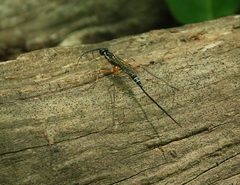
Females exhibit wood-probing to locate concealed , inserting ovipositors through bark and wood to reach or larvae in tunnels. Some have been observed resting on fallen logs during periods. Members are capable of colonizing fragmented forest patches within human-modified landscapes.
Ecological Role
Human Relevance
Similar Taxa
- RhyssinaeSimilar large body size, elongated ovipositor, and tree-trunk climbing ; distinguished by -level characters including wing venation and ovipositor structure
- XoridinaeHistorical taxonomic confusion with some Poemeniinae formerly placed in Xoridinae; both contain wood-boring but differ in diagnostic morphological features
- PimplinaeFrequently co-occur in ecological studies and share general pimpliform ; distinguished by -specific characters detailed in Goulet & Hauber (1993) identification keys
More Details
Taxonomic instability
The classification of Poemeniinae has undergone repeated revision. The Podoschistus was formerly placed in Xorides and Neoxorides. The remains subject to future modification as phylogenetic relationships are clarified.
Conservation significance
A 250-hectare Carpathian forest patch harbored 95 of Pimplinae, Poemeniinae, and Rhyssinae combined—representing the highest local recorded for this group in Europe and one of the highest globally. This underscores the conservation value of intact old-growth forests for specialized .
Identification resources
Illustrated keys to of world Ichneumonidae are available in Hymenoptera of the World: An identification guide to (Goulet & Hauber, 1993, Agriculture Canada). Detailed diagnostic information for Poemeniinae is accessible through specialized online resources.
Sources and further reading
- BugGuide
- iNaturalist taxon
- NCBI Taxonomy
- Bug Eric: Wasp Wednesday: Podoschistus
- A review of the subfamily Poemeniinae Narayanan & Lal, 1953 (Hymenoptera, Ichneumonidae) from Carpathians
- The mature larva of Poemenia albipes Cresson (Hymenoptera: Ichneumonidae, Poemeniinae) and a review of the biology of Nearctic Poemenia
- Adam Mickiewicz University Botanical Garden in Poznań as the environment for parasitoids of the Pimplinae and Poemeniinae subfamilies (Hymenoptera, Ichneumonidae)
- New Records of Poemeniinae and Xoridinae (Hymenoptera, Ichneumonidae) from Ukraine and Poland, with Corrections to the Ukrainian Checklist
- Neoxorides montanus Oehlke, 1966 (Hymenoptera: Ichneumonidae: Poemeniinae) new to Britain from Tatton Park, Cheshire (V. C. 58)
- Parasitic wasps of the Pimplinae, Poemeniinae and Diacritinae (Hymenoptera, Ichneumonidae) subfamilies at Kórnik Arboretum
- First record of Poemeniinae (Hymenoptera, Ichneumonidae) from Peru, with description of a new species and a key to the world species of Ganodes Townes
- <p><strong>Mochary example: how the highest European local species richness of pimpliform ichneumonid parasitoids (Ichneumonidae: Pimplinae, Poemeniinae and Rhyssinae) is under threat of disappearance in the Carpathian forests</strong></p>