
Xorides
Latreille, 1809
Species Guides
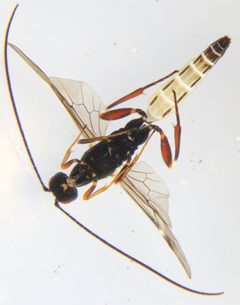
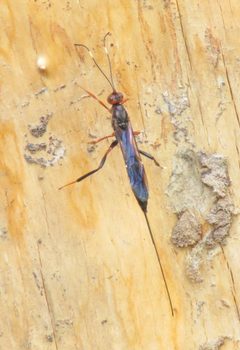
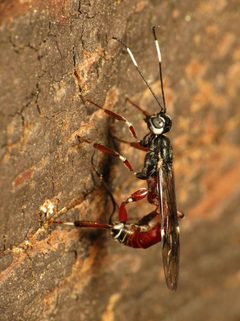
7Xorides is a of ichneumon wasps ( Ichneumonidae, Xoridinae) comprising at least 150 described . Members are ectoparasitoids of wood-boring larvae, particularly in the families Cerambycidae and Buprestidae. Females possess elongated ovipositors adapted for drilling through wood to reach concealed . The genus has a global distribution spanning the Palaearctic, Afrotropical, and Nearctic regions, with substantial diversity in China and Europe.
Pronunciation
How to pronounce Xorides: /ˈksoʊrɪdiːz/
These audio files are automatically generated. While they are not always 100% accurate, they are a good starting point.
Identification
Xorides can be distinguished from other ichneumonid by their association with wood-boring and morphological features including elongated ovipositors for penetrating wood. The subgenus Moerophora (formerly Xorides rufipes species-group) contains species with distinctive coloration and leg structure. Specific identification requires examination of diagnostic features such as propodeum , metasomal tergite punctation patterns, and ovipositor length ratios. Keys to regional species are available for China, Europe, and the Ukrainian Carpathians.
Images
Habitat
Forested with standing or fallen timber; specifically areas supporting wood-boring . have been documented in coniferous and deciduous forests including Picea abies woodpiles in alpine regions above 980 m, Juglans mandshurica stands in China, and various orchard and forest systems.
Distribution
Global distribution across Palaearctic, Afrotropical, and Nearctic regions. Documented from Europe (including Switzerland, Ukraine, Croatia, Bosnia), China (Palaearctic part with 46+ ), India, Iran, Kenya, and North America (including Vermont and North Carolina, USA).
Host Associations
- Cerambycidae - larval primary for many ; includes Osphranteria coerulescens, Xylotrechus stebbingi, Pyrrhidium sanguineum, Graphisurus fasciatus
- Buprestidae - larval includes Dicerca divaricata and Agrilus planipennis (Emerald Ash Borer)
- Curculionidae - larval Pissodes nitidus in Larix principis-rupprechtii
Life Cycle
Solitary idiobiont ectoparasitoid development. Female oviposits directly on larva, pupa, or quiescent within infested wood. 3–5 days. Larval feeding period 9–11 days, after which the larva spins a cocoon within the host gallery. Prepupal period highly variable, lasting 3–10 months; pupal stage approximately 30–33 days. One to two per year reported for some .
Behavior
Females locate concealed wood-boring larvae by detecting vibrations or chemical cues, then drill through wood with elongated ovipositor to deposit on surface. Triplet-style mating observed in X. ater, where one female mates simultaneously with two males; freshly eclosed females may rest on woodpiles before .
Ecological Role
agent of wood-boring beetles. suppression of pest cerambycids and buprestids documented, with rates of 15–18% reported in orchard systems. Contributes to natural regulation of forest and agricultural pest populations.
Human Relevance
Potential biocontrol agent for wood-boring pests. Xorides have been investigated for management of destructive cerambycids in fruit orchards and timber systems. Documented association with Emerald Ash Borer (Agrilus planipennis) in North America suggests possible role in regulating this invasive pest.
Similar Taxa
- PodoschistusFormerly classified within Xorides; distinguished by revised taxonomic placement in Poemeniinae and specific associations with Dicerca divaricata and Graphisurus fasciatus
- RhyssaSimilar large size, body shape, and tree-trunk searching ; distinguished by different placement and associations
Sources and further reading
- BugGuide
- Wikipedia
- GBIF taxonomy match
- iNaturalist taxon
- NCBI Taxonomy
- Catalogue of Life
- Bug Eric: Wasp Wednesday: Podoschistus
- Bug Eric: 2025 City Nature Challenge Recap for Kansas City Metro
- Species of <i>Xorides (Xorides)</i> (Hymenoptera: Ichneumonidae: Xoridinae) parasitizing wood-boring insects in the Palaearctic part of China
- A review of the genus Xorides Latreille, 1809 (Hymenoptera, Ichneumonidae, Xoridinae) in the Ukrainian Carpathians
- Figure 1 from: Shaw MR, Giannotta M, Herrera-Flórez AF, Klopfstein S (2021) Two males, one female: triplet-style mating behaviour in the Darwin wasp Xorides ater (Gravenhorst, 1829) (Hymenoptera, Ichneumonidae, Xoridinae) in the Swiss Alps. Alpine Entomology 5: 15-22. https://doi.org/10.3897/alpento.5.64803
- Xorides xylotrechi sp. n. (Hymenoptera: Ichneumonidae: Xoridinae) parasitizing Xylotrechus stebbingi (Gahan, 1906) (Coleoptera: Cerambycidae) in India
- European species of subgenus Moerophora Foerster of Xorides Latreille (Hymenoptera: Ichneumonidae: Xoridinae), with descriptions of two new species
- Two males, one female: triplet-style mating behaviour in the Darwin wasp Xorides ater (Gravenhorst, 1829) (Hymenoptera, Ichneumonidae, Xoridinae) in the Swiss Alps
- Two new species of Xorides Latreille (Hymenoptera, Ichneumonidae) from China, with notes on biology and a key to species known from China
- Record of the Hymenopteran Parasitoid Xorides (Exomus) humeralis (Ichneumonidae: Xoridinae) from Emerald Ash Borer Galleries (Coleoptera: Buprestidae) in North Carolina
- <p><strong>New species of the genus <em>Xorides</em> Latréille, 1809 (Hymenoptera, Ichneumonidae, Xoridinae) from Kenya</strong></p>
- The association of the parasitoid Xorides filiformis (Gravenhorst) (Hymenoptera: Ichneumonidae) with the longhorn beetle Pyrrhidium sanguineum (Linnaeus) (Coleoptera: Cerambycidae) in the United Kingdom
- Biology of Xorides corcyrensis Kriech. (Hymenoptera: Ichneumonidae), a Parasite of the Rosaceae Branch Borer Osphranteria coerulescens Redt. (Coleoptera: Cerambycidae)1