
Podoschistus
Townes, 1957
Species Guides
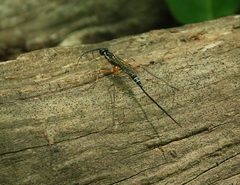
1Podoschistus is a of ichneumon wasps in the Poemeniinae. The genus contains at least one North American , P. vittifrons, which is an ectoparasitoid of wood-boring larvae. These use their elongated ovipositors to penetrate wood and deposit on beetle concealed within tree boles. The genus has undergone taxonomic revision, having been previously placed in the genera Xorides and Neoxorides.
Pronunciation
How to pronounce Podoschistus: /pɒˈdoʊs.kɪstəs/
These audio files are automatically generated. While they are not always 100% accurate, they are a good starting point.
Identification
Podoschistus can be distinguished from superficially similar ichneumonids such as Rhyssa by subtle morphological features. Members of this have a sleek, elongated body form. Definitive identification to genus level requires examination of detailed morphological characters; reference to illustrated keys for Poemeniinae is recommended. The single North American species, P. vittifrons, was historically misidentified due to its resemblance to other large, wood-associated ichneumonids.
Images
Habitat
Forested with standing trees suitable for wood-boring development. The North American P. vittifrons has been recorded in remnant woodlands surrounded by agricultural and suburban landscapes.
Distribution
Recorded from Denmark (DK), Norway (NO), and Sweden (SE) in Europe. In North America, P. vittifrons is known from Massachusetts and presumably occurs more broadly in forested regions where beetles are present. The appears to be uncommonly encountered throughout its range.
Host Associations
- Dicerca divaricata - Buprestidae; larval for P. vittifrons
- Graphisurus fasciatus - Cerambycidae; larval for P. vittifrons
Life Cycle
Females locate boring within tree trunks and insert their long, needle-like ovipositor through wood to reach the . The is laid directly on the beetle larva. The resulting larva consumes the host grub as an ectoparasitoid, developing externally on the living beetle larva.
Behavior
Females are observed climbing on tree trunks, apparently detecting the presence of concealed larvae through unknown sensory mechanisms. This trunk-climbing facilitates location and oviposition into wood.
Ecological Role
Ectoparasitoid of wood-boring larvae, contributing to of Cerambycidae and Buprestidae in forest .
Human Relevance
May provide incidental of wood-boring beetles, though not documented as a managed biocontrol agent.
Similar Taxa
- RhyssaSimilar large size, elongated body, and wood-associated ; historically confused with Podoschistus
- XoridesFormer placement for P. vittifrons; now recognized as distinct
- NeoxoridesFormer placement for P. vittifrons; taxonomic revision moved to Podoschistus
More Details
Taxonomic history
This has been subject to repeated taxonomic revision. P. vittifrons was formerly classified in Xorides and Neoxorides before placement in Podoschistus. Further revisions to ichneumonid classification are anticipated.
Rarity
P. vittifrons is described as not commonly encountered despite inhabiting forested areas where its presumably occur. This may reflect cryptic , limited survey effort, or genuinely low densities.