
Graphisurus fasciatus
(Degeer, 1775)
Banded Graphisurus
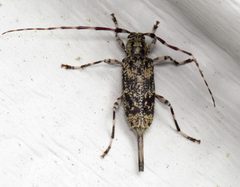
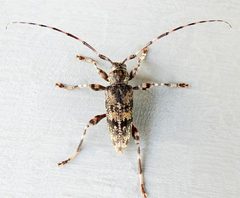
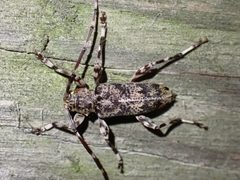
Graphisurus fasciatus is a longhorn beetle ( Cerambycidae, Lamiinae) found throughout eastern North America. It is one of three in the Graphisurus occurring in Missouri and is notably the most commonly encountered of the three. The species was described by Degeer in 1775. It is primarily associated with oak (Quercus spp.) as a larval .
Pronunciation
How to pronounce Graphisurus fasciatus: //ˌɡræfɪˈsaɪərəs fæˈʃiːətəs//
These audio files are automatically generated. While they are not always 100% accurate, they are a good starting point.
Identification
Graphisurus fasciatus can be distinguished from by its banded or fasciate elytral pattern. It is the most commonly encountered of the three Graphisurus in Missouri, with 271 specimens examined in collections compared to 45 of G. triangulifer and slightly more of G. despectus. G. triangulifer is distinguished by dark triangular markings on the and is less common. G. despectus breeds almost exclusively in hickory (Carya spp.), while G. fasciatus is associated primarily with oak.
Images
Habitat
Found in forested , particularly those containing oak. Specimens have been collected in rich, bottomland forest in the Ozark Highlands of Missouri. are frequently attracted to lights.
Distribution
Eastern North America. Distribution records from GBIF include: New Brunswick, Nova Scotia, Ontario, and Québec in Canada; and the United States. The has been documented in Missouri, particularly in the southeastern Ozark Highlands.
Diet
Larvae develop in dead oak (Quercus spp.) wood. Specific feeding habits of are not documented in the provided sources.
Host Associations
- Quercus - larval primary ; larvae develop in dead oak wood
Life Cycle
Larvae are wood-borers that tunnel through dead oak branches and trunks. Development likely spans one or more years, typical for cerambycid larvae developing in hardwood. emerge from wood and are attracted to lights.
Behavior
are and attracted to blacklights. Larvae bore into dead oak wood.
Ecological Role
Larvae function as decomposers of dead oak wood, contributing to nutrient cycling in forest . The serves as a for , including Podoschistus vittifrons (Ichneumonidae), which is ectoparasitic on G. fasciatus larvae.
Similar Taxa
- Graphisurus trianguliferSimilar size and ; distinguished by dark triangular elytral markings rather than banded pattern, and association with sugarberry (Celtis laevigata) rather than oak
- Graphisurus despectusSimilar size and ; distinguished by primary association with hickory (Carya spp.) rather than oak, and less common in collections
More Details
Parasitoid relationships
Documented for the ichneumonid Podoschistus vittifrons, which locates larvae boring in wood and inserts its ovipositor through the wood to parasitize them. Also likely host for aulacid wasps ( Aulacidae), which are known of cerambycid larvae.
Collection frequency
In a survey of Cerambycidae in Missouri, G. fasciatus was by far the most commonly collected Graphisurus , with 271 specimens examined compared to 45 of G. triangulifer and slightly more of G. despectus.
Sources and further reading
- BugGuide
- Wikipedia
- GBIF taxonomy match
- iNaturalist taxon
- NCBI Taxonomy
- Catalogue of Life
- Bug Eric: Wasp Wednesday: Aulacids
- Bug Eric: Wasp Wednesday: Podoschistus
- Graphisurus triangulifer in Missouri | Beetles In The Bush
- Hydrophyllaceae | Beetles In The Bush
- What do insects do in winter? Migrants in the DMV: Common Buckeye, Junonia coenia, Variegated Fritillary, Euptoieta Claudia, Painted Lady, Vanessa cardui, Large Milkweed bug, Oncopeltus fasciatus — Bug of the Week
- Bugs in Orange and Black II: Large milkweed bug, Oncopeltus fasciatus — Bug of the Week