
Graphisurus despectus
(LeConte, 1850)
Salt-and-pepper Long-horned Beetle
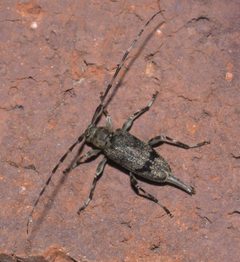
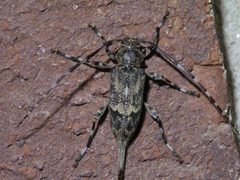
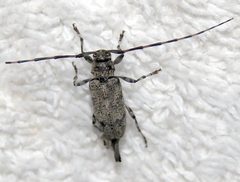
Graphisurus despectus is a of longhorn beetle in the Lamiinae, first described by John Lawrence LeConte in 1850. It occurs in the eastern United States and is one of three Graphisurus species found in Missouri. The species breeds almost exclusively in hickory (Carya spp.), showing strong fidelity compared to its . It is less commonly encountered than the widespread G. fasciatus but more frequently collected than the attractive G. triangulifer.
Pronunciation
How to pronounce Graphisurus despectus: //ˌɡræfɪˈsʊrəs dɪˈspɛktəs//
These audio files are automatically generated. While they are not always 100% accurate, they are a good starting point.
Identification
Distinguished from by association and likely subtle morphological differences. Graphisurus despectus breeds almost exclusively in hickory (Carya), while G. fasciatus primarily uses oak (Quercus) and G. triangulifer uses sugarberry (Celtis laevigata). The lacks the distinctive dark triangular elytral markings that give G. triangulifer its name. Specimens are typically encountered at lights.
Images
Habitat
Deciduous forests with hickory trees; associated with dead or dying hickory wood for larval development.
Distribution
Eastern United States; recorded from Ontario and Québec in Canada, Vermont, and throughout the eastern U.S. west to Missouri and possibly Kansas.
Diet
Larvae feed on dead hickory wood (Carya spp.); diet unknown.
Host Associations
- Carya spp. - larval breeds almost exclusively in hickory; strong fidelity
Behavior
are attracted to lights. Larvae bore into dead hickory wood.
Ecological Role
Wood decomposer; larvae contribute to nutrient cycling in forest by breaking down dead hickory wood.
Similar Taxa
- Graphisurus fasciatusMore common with similar size and general appearance; distinguished by primary association with oak (Quercus) rather than hickory
- Graphisurus trianguliferLess common with distinctive dark triangular elytral markings; distinguished by primary association with sugarberry (Celtis laevigata)
More Details
Taxonomic history
Described by John Lawrence LeConte in 1850, a prominent American entomologist who described thousands of .
Collection records
In Missouri surveys, 45 specimens were examined from major collections, making it less common than G. fasciatus (271 specimens) but comparable to G. triangulifer (45 specimens).