
Graphisurus triangulifer
(Haldeman, 1847)
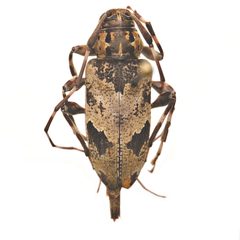
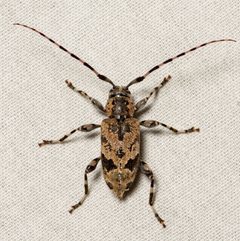
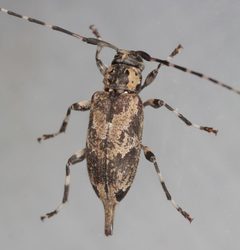
Graphisurus triangulifer is a of longhorn beetle in the Lamiinae, described by Haldeman in 1847. It is one of three Graphisurus species occurring in Missouri and is distinguished by dark triangular markings on the . The species exhibits a southern, lowland distribution pattern in eastern North America and is strongly associated with Celtis (hackberry/sugarberry) as its primary larval .
Pronunciation
How to pronounce Graphisurus triangulifer: /ɡræfɪˈsʊrəs traɪˌæŋɡjuˈlɪfər/
These audio files are automatically generated. While they are not always 100% accurate, they are a good starting point.
Identification
Distinguished from other Graphisurus by the dark triangular elytral markings. G. fasciatus is more common and lacks these distinct triangles; G. despectus is also uncommon but differs in pattern and is associated with hickory rather than Celtis. The species' relatively large size within the and southern distribution pattern aid in field identification.
Images
Appearance
Medium-sized longhorn beetle measuring 12–17 mm in length. Named for the distinctive dark triangular markings on the . Overall coloration and pattern distinguish it from G. fasciatus and G. despectus.
Habitat
Rich bottomland forests and lowland wooded areas, particularly in association with its primary plant Celtis laevigata (sugarberry) and related Celtis . are frequently attracted to blacklights in forested settings.
Distribution
Eastern United States from Long Island south to central Georgia, west to Texas, and northward in the interior to Ohio, Indiana, Kansas, and Missouri. Distribution largely tracks that of Celtis laevigata in the eastern U.S.
Seasonality
have been observed in early July in Missouri. Most records come from light-trapping, suggesting activity patterns typical of many cerambycids.
Diet
Larvae bore in dead wood of Celtis , particularly larger diameter branches and main trunk sections. likely feed on pollen, nectar, or other plant exudates typical of cerambycids, though specific adult diet is not documented.
Host Associations
- Celtis laevigata - larval Primary ; most breeding records from dead sugarberry
- Celtis occidentalis - larval Reared from larger branches and trunk sections in Ohio
- Acer negundo - possible larval Few reports, but no confirmed rearing records
Life Cycle
Larvae develop in dead wood of trees, with from larger diameter material. are attracted to lights. Specific details of -laying, larval instars, and are not documented.
Behavior
are strongly attracted to ultraviolet light sources, accounting for nearly all collection records. One non-light record involved an adult on the trunk of a large dead sugarberry tree. Larval boring in dead Celtis wood.
Ecological Role
Wood-boring larva that contributes to decomposition of dead Celtis wood. As a , it is part of the diverse saproxylic associated with hackberry/sugarberry in eastern North American forests.
Human Relevance
Occasional subject of entomological collecting and study. Not known to be an economic pest. Attracted to blacklights used for insect surveys and recreational collecting.
Similar Taxa
- Graphisurus fasciatusMuch more common Missouri ; lacks distinct triangular elytral markings; primarily associated with oak (Quercus) rather than Celtis
- Graphisurus despectusAlso uncommon in Missouri; differs in elytral pattern; breeds almost exclusively in hickory (Carya spp.)
More Details
Rarity in collections
MacRae (1994) found only 45 specimens in major Missouri collections versus 271 of G. fasciatus, making it the least commonly encountered of the three state Graphisurus .
Size-related host preference
Evidence suggests preference for larger diameter branches and trunk sections, consistent with its relatively large size within the . Successful rearing in Ohio required 4-foot trunk sections; smaller branches produced no beetles.